
When a court orders electronic monitoring as a condition of release, one of the first questions is often, "How much does an ankle monitor cost?" In most situations, the individual being monitored is responsible for the fees. These costs are separate from a bail bond and typically include a setup charge, a daily fee, and sometimes a removal fee. Understanding these potential expenses is a key step in navigating the pretrial process in Forsyth County, GA.
If you need help with bail bonds in Forsyth County, our team at Best Bonding is available 24/7 to provide clear, calm guidance. While we don't manage the monitors, we help you understand every step of the release process.
What to Do Right Now
- Confirm the Details: Understand the specific type of monitoring required (GPS, RF, or alcohol) and the duration.
- Contact an Approved Vendor: The court will provide a list of approved monitoring companies. You must contact one to start the setup process.
- Understand the Payment Structure: Ask the vendor for a clear breakdown of the setup fee, daily rate, and any other charges.
How The Bonding Process Works in Georgia
The process is designed to be straightforward:
- Call Us: We gather the necessary information about the person in custody.
- Handle Paperwork: Most paperwork can be completed over the phone or online.
- Post the Bond: We work with the local jail, whether in Forsyth or Hall County, to post the bond and secure release.
- Fulfill Conditions: Once released, the individual must follow all court-ordered conditions, which may include electronic monitoring.
Understanding Ankle Monitor Costs in Georgia
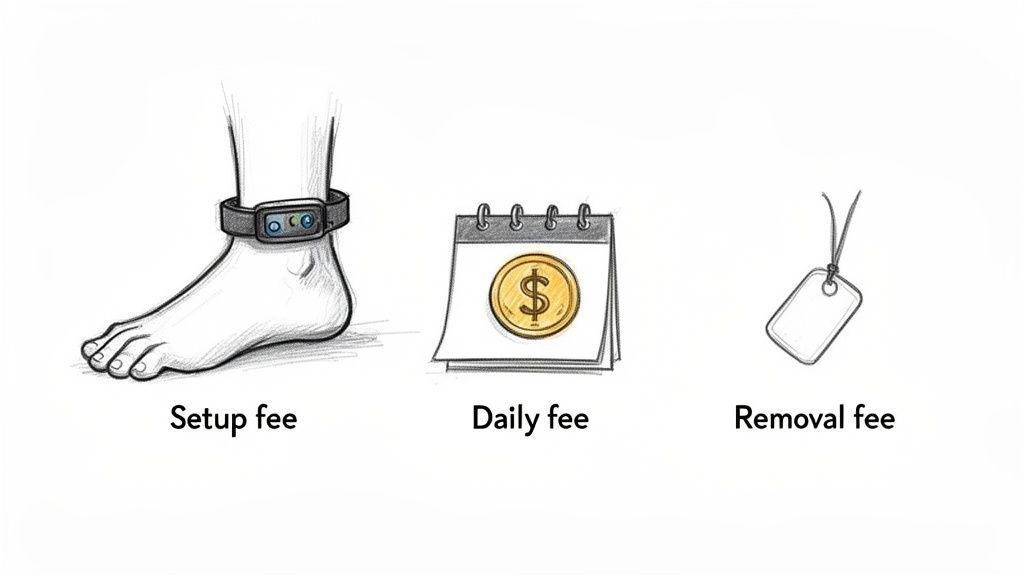
If electronic monitoring is a condition of pretrial release in Forsyth County or nearby areas like Cumming and Gainesville, it’s helpful to understand the financial side. It's important to know that these monitoring costs are completely separate from any bail bond premium. You'll pay them directly to a private company that the court has approved to manage the service.
While the added expense can feel like a burden, electronic monitoring often provides a path for an individual to return home, keep their job, and actively participate in their defense. This guide provides a clear financial picture so you and your family can plan accordingly.
The Typical Cost Structure
The total cost for an ankle monitor is rarely a single number. Instead, it’s broken down into several parts, a structure that’s common across Georgia.
You can usually expect to see these primary costs:
- A One-Time Setup Fee: An initial charge for installing the device and enrolling in the monitoring program.
- A Recurring Daily Fee: The ongoing cost for the monitoring service itself, covering data tracking and supervision.
- A Potential Removal Fee: Some providers charge a small fee at the end to have the device professionally removed.
This pay-as-you-go model spreads the cost over the required monitoring period, which can be easier to manage than a large upfront payment.
A Look at National Averages
While exact prices are set by local providers in places like Forsyth or Hall County, looking at national averages provides a useful baseline. The following table breaks down what you might expect.
Typical Ankle Monitor Cost Breakdown
| Fee Type | Common Cost Range (National Average) | Purpose of Fee |
|---|---|---|
| Setup Fee | $50 – $150 | A one-time charge for installation and program enrollment. |
| Daily Monitoring Fee | $10 – $35 per day | The ongoing cost for GPS/RF tracking and supervision. |
| Removal Fee | $25 – $75 | A one-time charge for professionally uninstalling the device. |
As you can see, for court-ordered house arrest or pretrial supervision, these fees can accumulate. Even at the lower end, monitoring fees can exceed $1,000 over a six-month period, not including the initial installation and final removal charges.
It’s important to put these expenses in context. Ankle monitoring is often the very thing that makes pretrial release possible, offering a way to maintain employment and be with family while a case is pending.
Understanding how these devices work can also help clarify why the costs vary. If you're interested, our guide on what is a ankle monitor provides more detail. This knowledge can help you and your family prepare for the road ahead with more confidence.
What Factors Influence Your Monitoring Fees?
The price of an ankle monitor is not one-size-fits-all. Several key factors determine the final setup fees and daily costs. Knowing these ahead of time helps you understand the financial responsibility and ask the right questions.
Just as courts use different legal tools for different situations, they also use various types of monitoring. The specific device assigned is one of the biggest drivers of the final cost.
The Type of Technology Required
The technology inside the device is what truly shapes the price. Here in Georgia, including courts in Forsyth and Hall County, you'll typically see two main kinds of monitors, and they come with different price points.
- Radio Frequency (RF) Monitors: These are typically used for simple home detention or enforcing a curfew. They work by confirming an individual is within a specific range of a base station in their home. They do not track movement outside that zone.
- GPS Monitors: This is a more advanced option using satellite technology to provide real-time, 24/7 location tracking. Courts require these to enforce "exclusion zones" (places someone cannot go) or "inclusion zones" (places they must be, like work or school).
Because GPS monitoring is a more active process involving constant data, it is almost always the more expensive option. The court's specific requirements for pretrial release will determine which device is used.
The Duration of the Monitoring Period
This is straightforward: how long does the device have to be worn? Since most monitoring companies charge a daily fee, the length of time has a direct and significant impact on the total cost.
A 30-day requirement will be more manageable financially than a six-month or year-long order. The financial responsibility adds up daily, making the timeline set by the judge a critical piece of the cost puzzle.
It is important to understand that these fees are paid directly to a private, court-approved monitoring company, not the bail bond agency. Your bail bond secures release from jail; electronic monitoring is a separate condition of that release.
Specific Conditions of Release
The complexity of the release rules also plays a role. A simple curfew with an RF monitor will cost less than a complicated set of rules managed by a GPS device.
For instance, someone ordered to stay away from multiple locations needs more active supervision from the monitoring company. That extra oversight often translates to a higher daily fee. You'll also see specialized devices for certain cases, like alcohol-detecting monitors for DUI charges, which have their own, often higher, cost structure.
The Local Jurisdiction and Provider
Finally, the price can shift depending on the county and the specific private company providing the monitoring services. While many companies work across North Metro Atlanta, their fee schedules can vary from one jurisdiction to the next, whether you're in Cumming, Alpharetta, or Gainesville.
Each county's pretrial services division approves a list of vendors, and those vendors set their own rates. This is why you must contact the specific provider assigned to the case to get the exact numbers.
GPS vs. Radio Frequency Monitors and Their Costs
When a court orders electronic monitoring, the specific device required plays a large part in the final cost. Not all ankle monitors are the same.
Here in Georgia, courts generally use two main types of technology, and the one chosen depends on the conditions of the pretrial release. Knowing the difference is the first step to understanding the financial responsibility.
The two devices you'll most often see are Radio Frequency (RF) monitors and Global Positioning System (GPS) monitors. Each performs a different job, and its technology directly impacts the daily fees.
Comparing GPS and RF Ankle Monitor Technology
To put it simply, one acts like a home curfew system, while the other provides 24/7 real-time tracking. This table breaks down the key differences.
| Feature | GPS Ankle Monitor | RF (Radio Frequency) Ankle Monitor |
|---|---|---|
| Primary Function | Tracks an exact location 24/7 using satellite technology. | Confirms an individual is at a single, approved location (usually home) during specific hours. |
| How It Works | Communicates with satellites to provide real-time location data to the monitoring company. | A device on the ankle communicates with a base station plugged in at the home. |
| Common Use Cases | Cases requiring strict movement restrictions, such as no-contact orders or tracking to/from work. | Used for enforcing house arrest or curfews. |
| Typical Cost | More expensive due to constant data transmission and active monitoring. | Less expensive due to its limited function. |
Ultimately, the technology inside the device is the biggest factor driving the daily cost. A simple RF monitor for a home curfew will always be less expensive than a sophisticated GPS unit that tracks every move.
Radio Frequency (RF) Monitoring Explained
An RF monitor works with a small base station installed in the home. The ankle device constantly communicates with that base, confirming that the individual is within range during court-ordered hours.
An RF monitor’s only job is to verify someone is at home when required. It cannot track movements once they leave that set range. Because its function is straightforward, RF monitoring is almost always the more affordable option. A Forsyth County judge might order one for cases where a strict home curfew is the main condition of release.
GPS Monitoring Explained
A GPS ankle monitor is the more advanced device most people picture. It uses satellite technology to provide real-time, 24/7 location tracking. This allows the monitoring company and the court to see exactly where the person is at all times.
Courts use GPS monitoring for more complex situations. For example, a judge can set up "inclusion zones"—like a place of employment or school—where someone is allowed to go. They can also create "exclusion zones," which are places someone is strictly forbidden from entering, like a specific address or neighborhood.
Because of the constant satellite communication and the higher level of supervision it requires, GPS monitoring is always the more expensive option.
This infographic breaks down the main factors that determine how much an ankle monitor will cost.
As you can see, the technology level, the required duration, and the specific rules of release are the three biggest drivers of the total cost.
The technology used has the greatest impact on daily rates. You can find more detail in our article covering the main types of ankle monitors used by the courts. In the end, the judge decides which device is appropriate for the case based on the charges and individual circumstances.
Costs for Specialized Alcohol Monitoring Devices
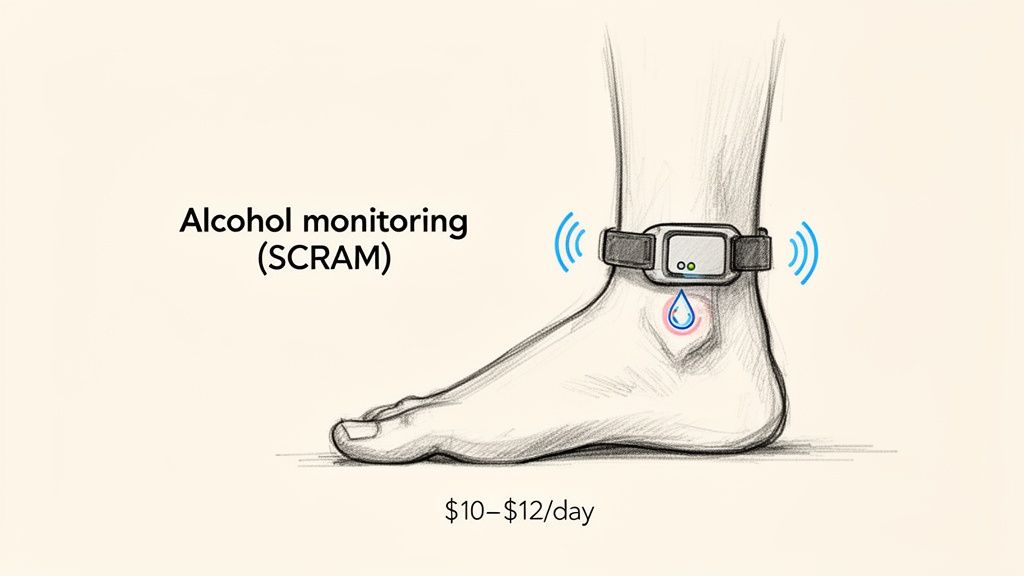
Sometimes, a standard GPS or RF monitor is not sufficient. For specific charges, like a DUI in Georgia, a judge may order a more specialized device to ensure sobriety is maintained as a condition of release.
These devices are often a Secure Continuous Remote Alcohol Monitoring (SCRAM) system, and they come with a different function and cost structure. If you are dealing with alcohol-related charges in Forsyth County or anywhere in North Georgia, it's helpful to understand how they work.
Instead of only tracking location, these advanced monitors are designed to detect alcohol consumption. They do this by continuously sampling perspiration for any trace of alcohol, providing the monitoring agency with a constant data feed. This gives the court confidence that sobriety orders are being followed.
The Cost Structure of SCRAM Devices
Because this technology is more advanced, alcohol monitoring ankle monitors are typically more expensive than standard electronic monitoring. The payment model is similar: an initial setup fee and then a recurring daily monitoring charge.
The higher daily fees are due to the complexity of the technology. It isn't just receiving a satellite signal; it's constantly analyzing biological data. This requires more sophisticated hardware and software, which increases the cost.
Based on general data, these systems can cost between $10 to $12 per day. This adds up to a monthly expense of $300 to $360, in addition to initial setup fees, which are usually between $50 to $100.
It’s important to know that these fees are paid directly to the court-approved monitoring company. This is completely separate from any payments made to a bail bondsman. The bail bond secures release from jail; the monitor is an added condition of that release.
Do Programs Offer Financial Assistance?
These costs can be a financial burden, and some monitoring programs recognize that. While it's not guaranteed, some programs may offer assistance based on a person's ability to pay.
Some providers may use a sliding scale to adjust the daily fee based on documented income. For example, under certain programs, individuals in lower-income brackets might pay a reduced daily rate, while those in higher brackets could pay a higher one.
If you are concerned about affording one of these devices, the first step is to talk to your attorney. They can provide guidance on whether a sliding scale or other payment arrangement is available through the court-approved vendor in your area. For anyone dealing with this specific requirement, you can learn more about using a SCRAM monitor as a condition of bond.
Ankle Monitor Costs vs. The Alternatives
To understand the cost of an ankle monitor, it helps to look at the bigger picture. When a judge sets electronic monitoring as a condition for pretrial release, those daily fees can feel significant. However, it’s important to weigh that expense against the primary alternative.
The main alternative to being released on bond with monitoring is remaining in jail until the case is resolved. The cost of being incarcerated isn’t just financial; it impacts every part of a person's life, from their job and family to their ability to assist with their own case.
The Real Cost of Staying in Jail
While there is no direct bill for time spent in jail, the indirect costs can be substantial. A person who is incarcerated cannot go to work, which means lost income, the risk of losing their job, and a significant financial strain on their family. This kind of disruption can cause problems that last long after a case is closed.
Electronic monitoring, even with its daily fee, allows a person to keep their life on track. It’s an opportunity to:
- Continue working and earning money to support a family.
- Live at home and be present for children and loved ones.
- Work closely with an attorney to prepare a defense.
When viewed this way, the daily monitoring fee can be seen as a manageable trade-off for freedom and stability.
How Bail Bonds and Monitoring Fit Together
Securing a bail bond is usually the first step to getting out of jail. The ankle monitor is often an additional condition the court adds to ensure appearance at court dates and for community safety. A bail bond company like ours helps you navigate the release process, and the monitoring company provides the technology the court requires.
It’s important to remember that electronic monitoring is often the very thing that makes getting out on bond possible. It gives the court the confidence it needs to allow someone to return home while their case is pending.
The numbers provide even more context. Some government-run monitoring programs cost around $14 per day. That’s more than 95% less than the estimated $320 nightly cost of keeping someone in detention. Over six months, monitoring fees might add up to over $1,000, which is a fraction of the $50,000+ it costs for that same period of incarceration. You can discover more insights about ankle monitor trends and their financial impact to see the full scope.
Understanding this context helps you see the whole picture. While the fees are a new expense, they are part of a system designed to offer a better path forward than remaining in jail. At Best Bonding, our job is to make these steps clear, helping you secure release and understand all the conditions with patience and local experience.
Navigating the Process in Forsyth County and Cumming, GA
When a judge in Forsyth County or a nearby city like Cumming orders electronic monitoring, it can feel like another complication during an already stressful time. We understand. Knowing what to expect with the local process can bring much-needed clarity, and our role is to guide you through it.
First, the bail bond company and the ankle monitoring company are two separate entities. As your bonding company, our focus is on securing your loved one's release from jail. From there, the court will direct you to a private, pre-approved vendor that handles the monitoring service.
The Local Setup Process
Once the bond is posted and release is secured, getting the ankle monitor installed is usually a straightforward process.
The court or pretrial services office will provide a list of approved local vendors that serve Forsyth and Hall Counties. It is then up to the person being monitored to contact a vendor and begin the process.
Typically, this involves a few simple steps:
- Scheduling an appointment to have the device fitted and activated.
- Signing an agreement that outlines all the rules, responsibilities, and payment details.
- Paying the initial setup fee and arranging a plan for the ongoing daily payments.
These monitoring companies are professionals. They will walk you through how to charge the device, explain the rules, and clarify what kind of activity would trigger a violation.
Managing Payments and Compliance
It is critical to understand that all monitoring fees are paid directly to the third-party vendor, not to the bail bond company.
If payments are missed, the court can treat it as a violation of pretrial release conditions, which can have serious consequences. The easiest way to avoid this is to set up automatic payments or create daily reminders.
Full compliance is not optional. It’s more than paying on time—it means following every single rule. This includes adhering to curfews, staying away from any court-ordered "exclusion zones," and keeping the device charged and working properly at all times.
While having an ankle monitor can feel like a major adjustment, it's often the condition that allows someone to be released from jail. It provides the court with the assurance it needs to let a person go home, keep their job, and actively participate in their own defense.
At Best Bonding, we have helped countless families in Forsyth, Hall, and the surrounding North Georgia communities work through these situations. While we do not manage the monitors ourselves, we provide the clear, step-by-step guidance you need to understand the entire process. If you need help securing a bail bond and want to know what to expect, call us anytime, 24/7.
Your Questions About Ankle Monitoring, Answered
When electronic monitoring is part of a pretrial release, it's natural to have questions. We've helped hundreds of families navigate this situation, and our experience allows us to provide clear, direct answers to common concerns.
Our goal is to offer straightforward information you can use to move forward with confidence. Here are the answers to the most common questions we hear about ankle monitors in Georgia.
Who is responsible for paying for the ankle monitor?
In nearly all cases, the person ordered to wear the ankle monitor is responsible for paying for it. This includes the one-time setup fee and the daily monitoring charges. These payments are made directly to a private, court-approved monitoring company—not to the bonding company. It is a financial obligation separate from the bail bond premium.
What happens if I can't afford the monitoring fees?
If you are concerned about covering the costs, it is important to speak with your lawyer right away. In some situations, courts or monitoring companies may have programs for reduced fees or payment plans for those facing genuine financial hardship. This is not guaranteed and depends on local court rules and your specific circumstances. Your attorney is the only one who can properly advise you and help you request assistance if it's available.
Staying on top of all court orders—including paying for monitoring—is critical for a successful pretrial release. Keeping your lawyer informed about any financial struggles is the most important first step.
Are ankle monitor fees paid to the bail bond company?
No. The fees for electronic monitoring are completely separate from the fee paid for a bail bond, and they go to two different companies.
Here’s a simple way to think about it:
- Bail Bond Premium: This is the fee paid to a bonding company, like Best Bonding Forsyth. It is our fee for guaranteeing to the court that the person will appear for their court dates.
- Ankle Monitoring Fees: These are ongoing payments made directly to the technology company that provides the device and handles the day-to-day electronic supervision.
Our job is to help you or your loved one get out of jail. The monitoring company's job is to ensure the electronic supervision rules set by the court are followed.
What is a violation and what happens next?
A violation occurs anytime a rule of the monitoring agreement is broken. It does not have to be a new offense—it can be as simple as letting the battery die or entering an area the court has marked as an "exclusion zone."
Some of the most common violations include:
- Forgetting to charge the device.
- Attempting to tamper with or remove the monitor.
- Entering a prohibited area or leaving an approved one during curfew.
- Falling behind on payments to the monitoring company.
When a violation occurs, the monitoring company receives an immediate alert and is required to report it to the court. This can lead to a new warrant being issued and the judge revoking the bond, which means returning to jail. Following the rules precisely is essential.
When you need to navigate the bail process in Forsyth County, Hall County, or the surrounding areas, you need a local partner who provides clear, calm guidance. Best Bonding Forsyth is available 24/7 to explain your options and help you take the right steps to secure a timely release.