
Facing a situation where electronic monitoring is a possibility can be an unfamiliar and stressful experience. If a judge in Forsyth County, GA, has ordered an ankle monitor as a condition of release, it is a tool used to help ensure court appearances. Understanding the different types of ankle monitors can demystify the process and provide clarity on what to expect. At Best Bonding Forsyth, our role is to provide calm, straightforward information based on our experience helping families navigate these requirements.
This guide explains the kinds of ankle monitors you might encounter in the Forsyth, Hall, Alpharetta, or Johns Creek areas. We will cover how each device works, its general rules, and what is expected for compliance. Knowing these details can reduce stress and help you successfully manage the conditions of pretrial release. This list is designed to give you practical, helpful information, breaking down the technology and responsibilities into clear, manageable parts. This is a procedural step in the bail bond process, and our focus is to ensure you have the knowledge needed to handle the requirements with confidence.
What to Do Right Now
- Gather Information: Have the full name and date of birth of the person in custody, along with the jail location (e.g., Forsyth County Jail).
- Call for Clear Guidance: The process can seem complicated. A call to an experienced local bonding company can provide immediate, clear steps. You can call us at 770-888-4585 for 24/7 assistance in Forsyth and Hall County.
- Understand the Purpose of Monitoring: Ankle monitoring is often a condition that allows for a person's release from jail while their case proceeds. Compliance is essential, and knowing the rules is the first step.
1. GPS-Based Real-Time Location Monitoring
GPS-based monitors are one of the most common types of ankle monitors used today, particularly in situations where a person's specific location must be known at all times. These devices operate using the Global Positioning System, a satellite-based network that can pinpoint the wearer's location. The monitor continuously transmits this location data to a central monitoring station, providing court-appointed officers with a map of the individual's movements.
This technology is especially useful for enforcing geofencing, which involves setting digital boundaries. For example, a court might order an individual to stay within Forsyth County, remain at home during certain hours, or stay away from a specific address. If the wearer enters a restricted "exclusion zone" or leaves a designated "inclusion zone," the device sends an alert to the monitoring agency. This capability is a key component in many pretrial release scenarios. To learn more about how this applies, you can find helpful information on the conditions of pretrial release in Georgia.
How to Manage a GPS Monitor
Compliance is the key to avoiding violations. Due to the constant satellite communication, these devices require daily charging.
- Establish a Charging Routine: Charge the device at the same time every day, such as overnight, to ensure it remains powered.
- Understand Your Boundaries: Ask your court officer for a clear map of your geofenced areas.
- Communicate Proactively: If you have a legitimate reason to be near a boundary (like a medical appointment), it is often best to notify your supervising officer in advance.
2. RF (Radio Frequency) Proximity-Based Monitoring
Unlike GPS monitors that track your location everywhere, RF monitors are designed to confirm your presence at a single, specific location, most often your home. These systems use an ankle bracelet that communicates via radio frequency with a corresponding base station installed in the residence. The base station, which is typically connected to a phone line or cellular network, periodically sends signals to the monitoring center, verifying the ankle monitor is within its limited range, usually about 50 to 150 feet.
This technology is a common choice for house arrest or curfew enforcement. It is often utilized in Forsyth County for cases where constant real-time tracking is not deemed necessary. If the ankle monitor goes out of range of the base station, or if the base station's power or phone connection is disrupted, an alert is sent to the supervising agency. Understanding and following the rules of release is very important for both the defendant and any co-signer on the bond.
How to Manage an RF Monitor
Maintaining a consistent connection between the ankle bracelet and the base station is the most important part of successful compliance.
- Optimal Base Station Placement: Place the base station in a central area of your home, away from large metal objects or appliances that could interfere with the signal.
- Stay Within Range: Be mindful of the unit's signal range. Activities like walking to the mailbox could potentially trigger a violation if they take you too far from the base station.
- Maintain Power and Connection: Ensure the base unit remains plugged in and connected at all times. The ankle bracelet itself will also need regular charging.
- Notify Before Moving: If you must move residences, you will need authorization from your supervising officer first. The base station will need to be professionally relocated.
3. Alcohol and Drug-Detecting Ankle Monitors (SCRAM)
For cases involving alcohol or substance-related charges, courts may require a specialized device like a SCRAM (Secure Continuous Remote Alcohol Monitoring) ankle monitor. Unlike monitors that only track location, these types of ankle monitors use technology to sample the wearer’s perspiration. The device tests for alcohol metabolites being eliminated through the skin, providing a near-continuous record of sobriety. This data is then transmitted to a monitoring agency.
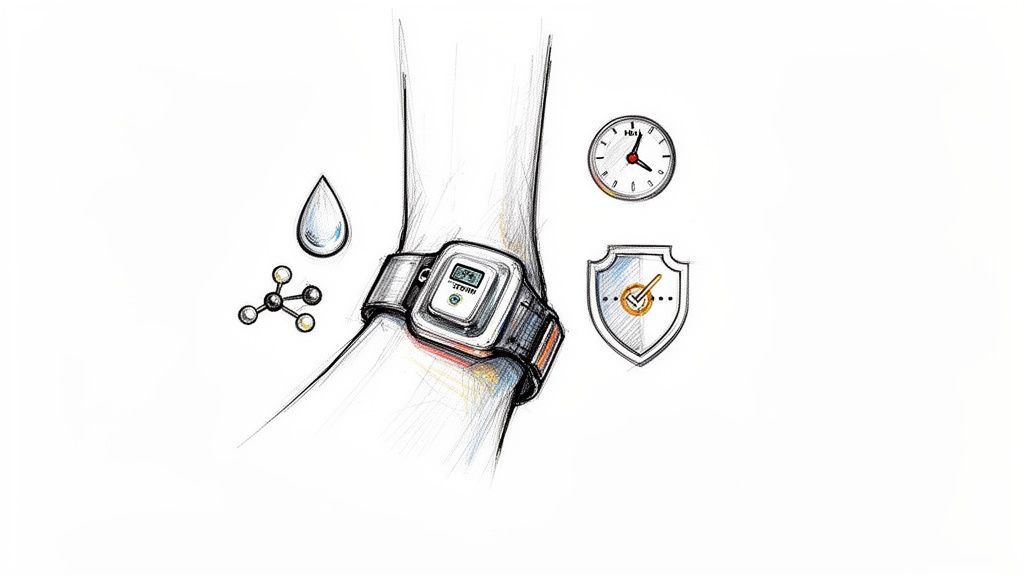
This technology is frequently used as a condition of pretrial release or probation in Forsyth County for individuals with certain charges. A positive test for alcohol consumption, or any attempt to tamper with the device, results in a violation alert. To understand the risks of non-compliance, you can learn more about what is bail forfeiture.
How to Manage a SCRAM Monitor
Avoiding false positives and maintaining compliance is crucial when wearing a sensitive device.
- Avoid All Alcohol-Containing Products: This includes not only beverages but also some types of mouthwash, hand sanitizer, and certain topical lotions that contain alcohol.
- Keep the Device Dry: While the device is water-resistant, you should not submerge it. Avoid swimming, hot tubs, or long baths.
- Maintain a Charging Schedule: Follow the charging instructions provided to ensure continuous operation.
- Report Issues Immediately: If you experience any skin irritation or damage to the device, notify the monitoring company and your supervising officer right away.
4. Biometric (Facial Recognition & Fingerprint) Verification Monitors
Biometric verification represents one of the more advanced types of ankle monitors available. These devices add a layer of security by integrating features like facial recognition cameras or fingerprint scanners. The core purpose is to confirm that the correct individual is with the device at all times. This technology addresses concerns about tampering. The device periodically prompts the wearer to provide a biometric scan, such as taking a photo of their face or scanning a fingerprint, which is then cross-referenced with the data on file.
This security solution is typically reserved for cases where the flight risk is considered significant or where identity verification is a primary concern. In Forsyth County and across Georgia, courts may order these monitors for certain defendants. The technology ensures that the person under court supervision is the one complying with the release conditions.
How to Manage a Biometric Monitor
Successfully managing a biometric device requires consistent and timely cooperation with its verification requests.
- Be Ready for Prompts: The device will prompt you for verification at scheduled or random times. You must complete the scan within the allotted window to avoid a violation alert.
- Maintain a Stable Connection: Biometric data uploads require a stable internet or cellular connection. Ensure you are in an area with reliable service.
- Report Physical Changes: Inform your supervising officer of significant changes to your appearance, such as growing a beard or getting new glasses, as these can interfere with facial recognition.
- Address Failures Immediately: If a scan fails, attempt it again carefully and contact your monitoring officer to report the issue and prevent it from being logged as a non-compliance violation.
5. Hybrid GPS-RF Combination Monitoring Systems
Hybrid monitors offer a flexible approach by combining the real-time tracking of GPS with the home-based verification of Radio Frequency (RF) technology. This system switches between the two modes. When the wearer is away from home, the device uses GPS to track their location. Once the wearer returns to their approved residence, the monitor switches to RF mode, communicating with a home beacon to confirm they are within the required range.
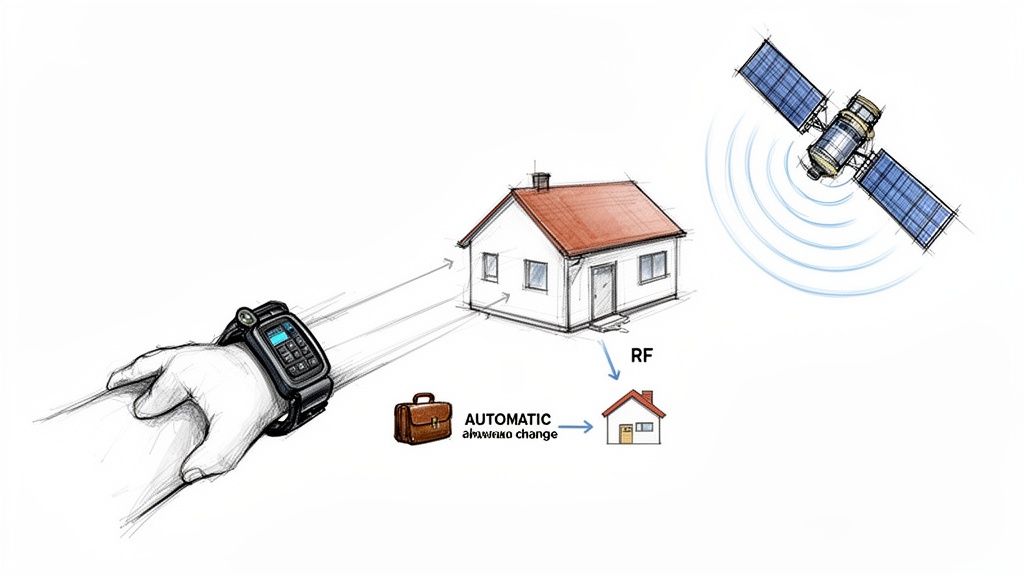
This dual-mode capability makes hybrid systems one of the most practical types of ankle monitors for individuals permitted to leave home for specific reasons, such as work or medical appointments. Georgia courts, including those in Forsyth County, may order these devices for defendants who have stable housing and employment. The system provides accountability when the person is mobile while conserving battery life when they are home.
How to Manage a Hybrid Monitor
Success with a hybrid monitor depends on strict schedule adherence and clear communication. The device is programmed based on your approved movements.
- Document Your Schedule: Keep a written or digital copy of your court-approved schedule, including work hours and appointment times.
- Communicate All Changes: Immediately notify your supervising officer of any changes to your employment, residence, or approved appointments.
- Plan for Charging: Since you will be mobile, it may be helpful to carry your charging cable with you.
- Be Patient During Setup: The initial fitting and programming for a hybrid device can take longer because approved locations and schedules must be entered. Ask for written clarification of all rules.
6. Smart Watch and Mobile App-Based Monitoring
Representing a newer generation of court-ordered supervision, smartwatch and mobile app-based monitoring leverage personal devices for tracking. This method uses a combination of GPS, Wi-Fi, and cellular data from a defendant’s own smartphone or a provided smartwatch. Instead of a traditional ankle device, compliance is managed through software. This technology is sometimes used in programs for lower-risk individuals.
This system can be suited for pretrial supervision in cases involving non-violent offenses, especially for defendants with stable housing and employment in areas like Forsyth County. The app typically requires the user to perform periodic check-ins, which may involve taking a photo for identity verification. Monitoring agencies can still implement geofencing and receive alerts if the device is turned off, the app is disabled, or a boundary is crossed.
How to Manage App-Based Monitoring
Successful compliance depends on maintaining the functionality of your personal device and the monitoring app.
- Keep Your Phone Charged: Your smartphone or smartwatch is your monitoring device. Carry a portable battery pack to ensure you do not run out of power.
- Enable All Permissions: The app requires constant access to location services. Do not modify these settings or use airplane mode, as doing so will likely trigger a violation alert.
- Perform Check-Ins Promptly: Respond immediately to any prompts from the app.
- Report Technical Issues: If the app or your phone malfunctions, contact your supervising officer immediately to report the problem and get instructions.
7. Voice Recognition and Two-Way Communication Monitors
Among the different types of ankle monitors, those with voice recognition and two-way communication offer a direct supervision method. These devices are equipped with a built-in microphone and speaker, allowing for conversations between the monitoring center and the individual under supervision. This technology adds a layer of personal contact and identity verification. The voice recognition feature requires the wearer to confirm their identity periodically by speaking a predetermined phrase.
This functionality can be valuable in cases where clear and immediate communication can prevent misunderstandings. For example, if a GPS signal is temporarily lost, an officer can call the device directly to verify the individual's status. In Forsyth County, these monitors can be ordered to enhance supervision for individuals where frequent check-ins are deemed necessary by the court.
How to Manage a Two-Way Communication Monitor
Effective communication is the cornerstone of managing this device successfully. Proactive and clear interaction can help prevent potential violations.
- Speak Clearly and Calmly: When the monitoring center calls or you are prompted for a voice sample, speak in a clear, normal tone.
- Keep the Device Unobstructed: Ensure that clothing does not muffle the microphone or speaker.
- Use the Feature Proactively: If you have an urgent question about your boundaries, you may be able to use the two-way communication feature to contact the monitoring center.
- Document Your Calls: It can be helpful to keep a log of your conversations with the monitoring center, including the date, time, and topic discussed.
8. Satellite-Based Monitoring with Offline Capability
For situations where consistent cellular service is unreliable, satellite-based monitors provide a tracking alternative. Unlike GPS or RF devices that depend on cellular networks to transmit data, these ankle monitors communicate directly with commercial satellite networks. This ensures location tracking even in rural parts of Georgia where cell towers are sparse. This technology is helpful for individuals who have legitimate reasons to be in areas with poor coverage, such as those with outdoor employment.
These types of ankle monitors can be used for defendants who may work in agriculture or forestry in areas outside of Cumming or Gainesville, or for cases where a person might travel to an isolated location. The device collects GPS location data and uploads it via satellite, ensuring that supervising officers have a complete picture of a person's movements, regardless of their proximity to cellular infrastructure.
How to Manage a Satellite Monitor
Reliable satellite communication depends on having a clear view of the sky and maintaining sufficient power.
- Prioritize Sky Exposure: Satellite signals can be blocked by buildings or dense tree cover. Maximize your time in areas with a clear view of the sky to ensure consistent signal transmission.
- Be Aware of Power Demands: Communicating with satellites can require more energy than cellular transmission. You will likely need to charge the device frequently.
- Communicate Your Work Schedule: If your job requires you to be in remote areas, inform your supervising officer in advance. Proactive communication helps them understand your movement patterns.
A Simple Comparison of Ankle Monitor Types
| Monitoring Type | Complexity | Resource Needs | Effectiveness | Expected Outcome | Ideal Use Case |
|---|---|---|---|---|---|
| GPS Real-Time | Medium | High cost, daily charge | High | Improved compliance | Moderate to high-flight risk |
| RF Proximity | Low | Low cost, long battery | Good for home only | Affordable home compliance | Low-risk, stable housing |
| SCRAM Alcohol | High | High cost, frequent sampling | Very High | High sobriety compliance | DUI/DWI related charges |
| Biometric ID | High | Very high cost, Wi-Fi | Very High | Prevents identity fraud | High-risk or serious charges |
| Hybrid GPS-RF | High | Moderate cost, daily charge | High | Supports work schedules | Employed defendants |
| Mobile App | Low | Low cost, uses own phone | Moderate | Lower stigma, user-dependent | Low-risk, tech-savvy users |
| Two-Way Voice | Medium | Moderate cost | Good | Fewer false violations | Cases needing communication |
| Satellite Offline | High | Highest cost, frequent charge | High in remote areas | Off-grid tracking | Rural workers, poor coverage |
Taking the Next Step with Confidence
Navigating the legal system can be challenging, especially when faced with conditions like electronic monitoring. This guide has detailed the most common types of ankle monitors, from real-time GPS tracking to specialized SCRAM devices. Each technology serves a specific purpose, designed to offer a structured alternative to remaining in custody while a case moves forward. Understanding how these devices function and what is expected for compliance is a critical step toward managing this period successfully.
The core takeaway is that while the technology varies, the goal remains consistent: to allow an individual to return home while their case proceeds. Whether the court in Forsyth County or a neighboring jurisdiction like Hall County orders a simple location tracker or a more advanced system, full adherence to its rules is necessary. This means diligently charging the device, staying within designated zones, and promptly reporting any technical issues as instructed. Compliance is about demonstrating responsibility and maintaining the freedom granted through a bonded release.
Your Questions, Answered
Knowing the difference between these monitoring systems empowers you to ask the right questions. When you speak with a court official or a bail bonding company, you can now inquire specifically about:
- The exact type of monitor required.
- The fee structure, including setup costs and ongoing payments.
- The charging schedule and battery life expectations.
- The precise rules for inclusion and exclusion zones.
This knowledge transforms uncertainty into a clear plan. Instead of reacting to unfamiliar requirements, you can proactively prepare for them. The period of pretrial release is a crucial time, and managing your monitoring obligations correctly is key to making the most of it. A calm, methodical approach, grounded in a clear understanding of the technology, will help you navigate this process with confidence.
If you or a loved one needs to arrange a bail bond that may include electronic monitoring conditions in Forsyth County, Cumming, Hall County, or the surrounding areas, having an experienced local partner can make a significant difference. At 24-7 Best Bonding, we help you understand the court's requirements and guide you through every step of the process with clarity and respect. Call us now to get the straightforward answers you need and to start the release process.