
When a court orders someone to wear an ankle monitor, it can feel intimidating and confusing. However, it's a straightforward tool that allows a person to leave jail and return home while their case moves through the legal system. For families in Forsyth County, GA, understanding what these devices are is the first step toward navigating the bail process with less anxiety.
If you need help with bail bonds in Forsyth County or surrounding areas, our team is available 24/7. We are here to provide clear explanations and guide you through the next steps.
What an Ankle Monitor Is and How It Works
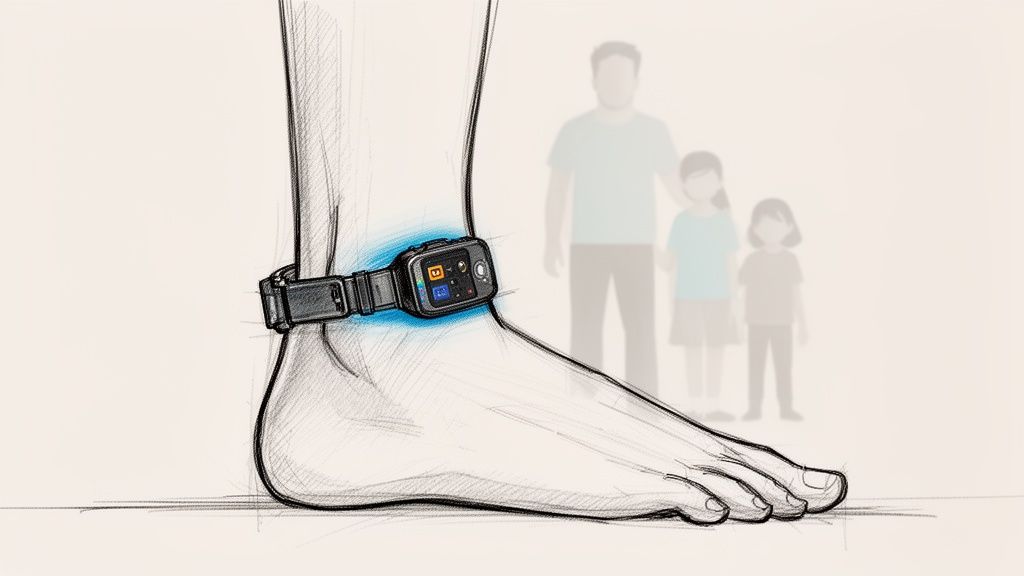
Hearing a judge mention "electronic monitoring" can sound serious. In reality, the device is a piece of technology with one clear purpose: to help the court supervise an individual who is out on bond. It is a way to ensure they follow the specific rules of their release.
The Basics of the Device
At its core, an ankle monitor—also called an electronic ankle bracelet—is a small tracking device strapped securely above the ankle. It uses either GPS or radio-frequency (RF) technology to keep track of a person's location. This is not meant as punishment; it's a practical solution that balances community safety with a person's freedom. For more background, you can learn about the history and use of electronic monitoring in the United States on Wikipedia.org.
The device itself is built to withstand daily wear. It is roughly the size of a deck of cards and is both shock-resistant and waterproof. The strap is also tamper-evident, meaning it will send an alert if anyone tries to cut or remove it.
To provide a clearer picture, here's a simple breakdown of what makes up a typical ankle monitor.
Ankle Monitor Features at a Glance
| Feature | Simple Explanation |
|---|---|
| Tracking Technology | Uses GPS or Radio Frequency (RF) to pinpoint the wearer's location. |
| Durable Casing | The main unit is waterproof and shock-resistant for everyday life. |
| Tamper-Resistant Strap | A durable strap that sends an alert if it's cut, stretched, or removed. |
| Internal Battery | A rechargeable battery that must be charged daily to keep the device active. |
| Communication System | The device constantly sends location data back to a monitoring center. |
As you can see, each part has a specific job designed to make the system reliable and secure.
What to Expect Physically
A trained agent will fit and secure the device to the person's ankle. While it will be noticeable, it's designed to be as unobtrusive as possible and should not cause pain. For many people in Forsyth County, Hall County, and nearby communities like Cumming and Alpharetta, an ankle monitor is a key component of being granted pretrial release from jail.
The primary function of an ankle monitor is to provide location data to the court, ensuring that pretrial release conditions are being met. It is a tool for supervision, not punishment.
Once you understand what the device is for and how it works, the entire situation becomes much less mysterious. It is a manageable requirement that allows someone to return to work, be with their family, and handle responsibilities while their legal case proceeds.
Why Georgia Courts Use Electronic Monitoring
When a judge in Forsyth County or Hall County orders electronic monitoring, it's a practical decision meant to strike a careful balance. The court has two primary responsibilities: to ensure community safety and to make sure the accused appears for all court dates. An ankle monitor is a tool that helps them achieve both.
Think of it as a middle ground. Sometimes, a judge may feel that releasing someone on a standard bond is not enough to ensure they follow all conditions. At the same time, keeping that person in jail until their trial may seem excessive. Electronic monitoring bridges that gap, allowing for release with an added layer of supervision.
A Practical Alternative to Jail
Ankle monitors are not a new concept. Their use grew across the country as a response to overcrowded jails and the high costs of incarceration. For courts managing large caseloads, it provided a way to manage the system more effectively.
In the U.S., the incarcerated population grew from around 200,000 in 1973 to over 2 million by 2009. This significant increase prompted states to find less costly, community-based ways to supervise individuals. A 2016 report showed that the use of electronic monitoring more than doubled in just ten years. For a local bonding company like Best Bonding here in Forsyth County, an ankle monitor is often a key part of the solution when a judge needs extra reassurance to grant someone's release. You can find a detailed analysis of this trend in the Journal of Criminal Law and Criminology.
This approach means a person can go home, maintain their job, and care for their family—a more stable and constructive outcome for everyone involved.
Key Reasons for Court-Ordered Monitoring
A judge does not decide to use an ankle monitor without specific reasons. The decision is always based on the details of the case and the individual involved.
Here are the most common reasons a court will order electronic monitoring:
- Enforcing Curfews: The court can set strict hours when a person must be home, and the monitor provides proof of compliance.
- Creating "Stay-Away" Zones: If someone is ordered to stay away from a specific place—like a victim's home or workplace—a GPS monitor can create a virtual boundary. If that boundary is crossed, authorities receive an immediate alert.
- As a Condition of Bond: For certain offenses, a judge might only grant bond if the person agrees to wear a monitor. It gives the court confidence that the individual will remain in the area and adhere to the rules.
An ankle monitor provides verifiable data showing that a person is following the specific rules set for their release. It helps make release an accountable option.
By using this technology, Georgia courts can consider bond in more complex situations. It creates a path for people to await their court date at home instead of in a jail cell.
How Different Types of Ankle Monitors Work
When a court orders electronic monitoring, the technology can seem complex. The good news is the systems used here in Georgia are generally straightforward. In most situations, courts rely on one of two main types of ankle monitors, each designed for a specific purpose.
Once you understand what each one does, much of the uncertainty disappears. The two technologies you will likely encounter are Radio Frequency (RF) and Global Positioning System (GPS). They are different tools chosen based on the needs of the case.
Radio Frequency (RF) Monitoring
The easiest way to think of a Radio Frequency monitor is as a "home base" system. Its only job is to confirm that a person is at their approved residence during specific, court-ordered hours.
It works with a small base station that is set up inside the home, usually plugged into a wall outlet. The ankle bracelet communicates with this base station using a short-range radio signal.
- How It Works: As long as the ankle device stays within range of the base station (typically about 150 feet), the system registers that the person is home.
- What It Does: If the person leaves that area during a curfew, the connection is broken, and an alert is sent to the monitoring agency.
- Limitations: This system does not track where a person goes after leaving the house. It only knows if they are "home" or "away."
This type of monitoring is a common choice for enforcing simple curfews or home detention, ensuring someone remains at their residence overnight or for other required periods.
Global Positioning System (GPS) Monitoring
A GPS ankle monitor is a more advanced system that provides real-time location tracking, working much like the GPS in a car or on a smartphone.
Instead of a home base station, a GPS device uses satellites to pinpoint a person's exact location 24/7. That information is continuously sent back to a monitoring center, creating a detailed map of their movements. For more information, you can read our guide on the different types of ankle monitors.
A GPS monitor provides the court with a full location history. This allows them to set up virtual boundaries—like "inclusion zones" where you need to be (such as work or school) and "exclusion zones" where you are not allowed to go.
This technology is important in cases where a judge needs to ensure someone stays away from a particular person, address, or even an entire neighborhood. The system can be programmed to send an immediate alert if the wearer enters one of these restricted zones.
Comparing GPS and Radio Frequency (RF) Monitors
To make it simple, here is a quick breakdown of how these two common ankle monitors compare in the Georgia legal system.
| Technology Type | How It Works | Commonly Used For |
|---|---|---|
| Radio Frequency (RF) | Communicates with a home-based receiver to confirm you are within a set range. | Enforcing curfews and home detention. Confirms presence at a single location. |
| Global Positioning System (GPS) | Uses satellite signals to track and record your location in real-time, 24/7. | Higher-risk cases, enforcing no-contact orders, and tracking movement in the community. |
Ultimately, both RF and GPS monitors are tools for the court. The type chosen is based on the specific rules and safety requirements of an individual’s release conditions.
What to Expect: The Fitting Process and Daily Responsibilities
Learning that someone needs to wear an ankle monitor can be stressful, but knowing what to expect makes the process more manageable. The fitting is straightforward, and the day-to-day responsibilities are simple once you establish a routine.
A trained agent handles the fitting, which is a quick and painless procedure. They place the device securely just above the ankle, making sure it is snug but not too tight. After activating the monitor, they will provide the charger and clear instructions on how to use it.
Your Daily Checklist for Success
Living with an electronic monitor comes down to a few key duties. Think of it as a simple daily checklist to stay on track. The main responsibilities are keeping the device charged and adhering to all rules about where you can and cannot go.
Most ankle monitors need to be charged for one to two hours every day, and there is usually a specific time frame to do so. The best approach is to create a routine—like plugging it in every evening—to ensure the battery never runs out.
Beyond charging, it is essential to follow the geographic rules set for the case. These will be explained very clearly.
- Inclusion Zones: These are places you must be at certain times, such as your home during curfew hours or your job during a scheduled shift.
- Exclusion Zones: These are "no-go" areas you are not allowed to enter. This could be a specific person's house, a particular neighborhood, or even part of a town.
Following these rules is non-negotiable for a smooth monitoring period. The technology used to track you depends on which rules are in place.
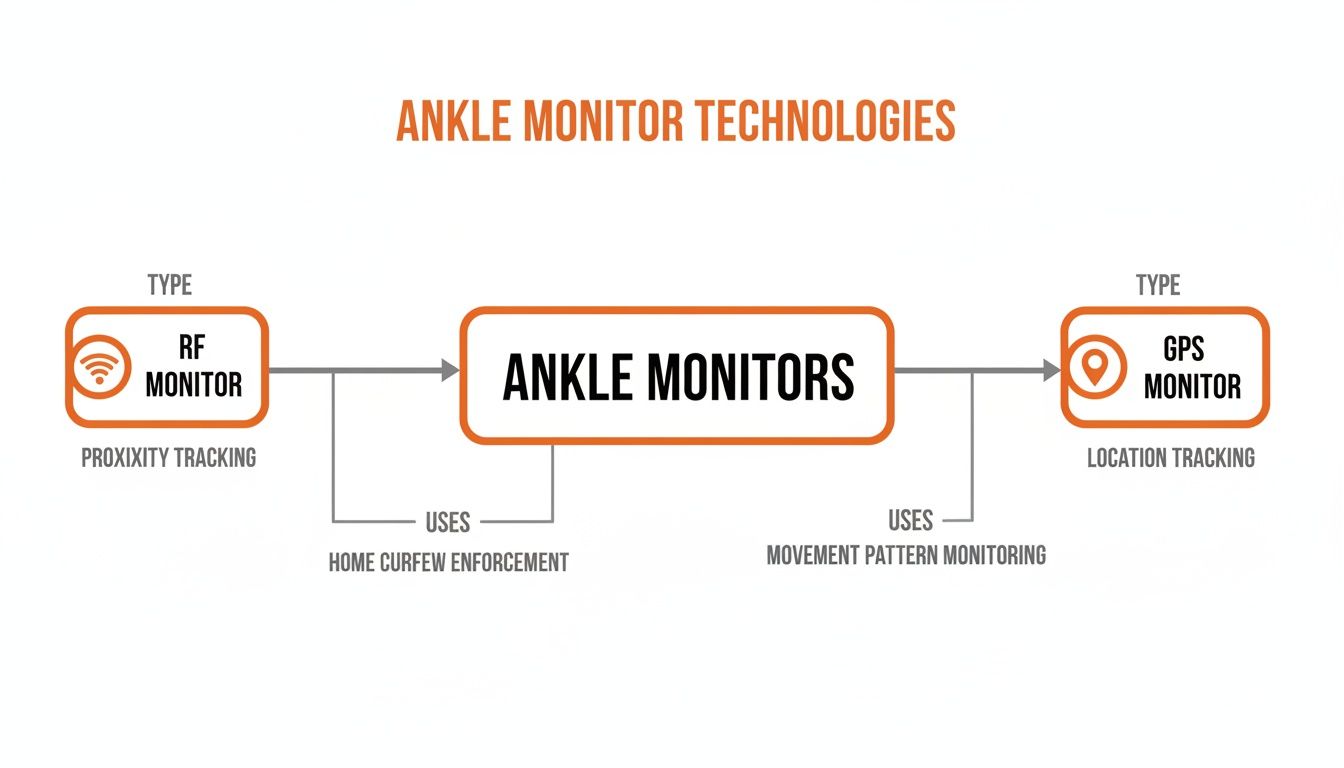
As you can see, a simpler RF monitor just confirms you are at home when required, such as for a basic curfew. A GPS monitor, on the other hand, tracks your location in real-time wherever you go, which is necessary for enforcing more complex rules like exclusion zones.
Routine is key. When you make charging the device and following your schedule a normal part of your day, you can get through the monitoring period without accidental issues.
If you ever encounter a problem with the device—such as a faulty charger or a damaged strap—you need to report it to the monitoring agency immediately. Proactive communication is always the correct approach.
How to Successfully Comply and Avoid Violations
Wearing an ankle monitor can seem challenging, but it is manageable once you understand the rules. The secret to completing the monitoring period without trouble is building a consistent daily routine.
Knowing exactly what is expected helps you avoid simple mistakes that can cause unnecessary stress. It comes down to two main jobs: keeping the device charged and sticking to your court-ordered schedule. A little attention to these details is all it takes to complete the monitoring period successfully.
Understanding Common Violations
Most violations are accidental, and some planning is all it takes to prevent them. The system is designed to send an alert for any deviation, so staying on top of your responsibilities is important.
Here are the most common issues that trigger an alert:
- Low Battery: This is the most frequent violation. The easiest fix is to set a specific time to charge the device every day.
- Entering an Exclusion Zone: Going into a restricted area—even for a moment—will trigger an immediate alert.
- Tampering with the Device: Any attempt to cut, remove, or damage the strap or the monitoring unit is a major violation.
- Leaving an Inclusion Zone: If you have a curfew, leaving your home during those hours is a clear rule violation.
When any of these violations occur, the monitoring agency receives an automatic notification and will begin to investigate. An alert does not automatically mean bond is revoked, but it creates a serious issue that must be addressed.
Repeated violations can put pretrial release at risk and may lead a judge to send the person back to jail. Ignoring the rules can lead to serious consequences, including bail forfeiture, which means the entire bond amount becomes due.
The goal is to establish a predictable daily routine. By making charging the device and respecting your approved schedule a normal part of your day, you can avoid nearly all potential issues.
If something unexpected happens—like a charger stops working or a medical emergency requires you to break curfew—it is critical to call the monitoring agency immediately. When in doubt, communicate. It is always the best approach.
How Ankle Monitors Affect the Bail Bond Process

When a judge in Forsyth County requires an ankle monitor as a condition of release, it adds a step to the bail bond process. In many cases, it is the factor that persuades the court to grant bond, creating a way for your loved one to come home while their case is pending.
For families in Cumming, Alpharetta, or Johns Creek, this can be a welcome option. Agreeing to electronic monitoring is often the key that allows for release from jail, especially when a judge wants extra assurance that the defendant will appear for all court dates.
The Role of Your Bail Bondsman
Once a court orders electronic monitoring, securing a bond becomes a multi-step process. This is where an experienced, local bail bondsman is essential. Our role is to act as the coordinator between you, the court, and the monitoring company to ensure every requirement is handled correctly.
We help you navigate the paperwork and walk you through the logistics, like understanding the monitor's fees and scheduling the fitting. Having a professional who knows the Forsyth and Hall County court systems makes the release process smoother and less stressful. Our guide on how to bail someone out of jail breaks down the standard process in more detail.
When an ankle monitor is involved, the bail process has an extra layer of complexity. Our job is to simplify that for you, handling the coordination so you can focus on getting your loved one home.
At Best Bonding, we have experience with these types of conditional releases. We work to ensure that once the bond is posted, the next steps for setting up the monitor are clear and handled promptly. The goal is to provide calm, professional guidance through every step.
Common Questions About Ankle Monitors
When a judge orders electronic monitoring, it is normal to have questions. The situation can feel overwhelming, but getting clear answers makes it much easier to manage. Here are a few of the most common questions we hear from families in Forsyth County.
Is Wearing an Ankle Monitor Painful or Heavy?
No, the monitors are designed for long-term wear and are not painful. They are made of a durable, lightweight plastic and usually weigh just a few ounces—similar to a smartphone.
When the device is fitted, a trained agent makes sure it is secure without being too tight. You will be aware of it, but it should not hurt or interfere with walking normally.
Can I Still Go to Work or Run Errands?
This depends on the specific rules the court sets. Many people, especially those with GPS monitors, are allowed to travel for essential activities like work, school, doctor's appointments, or religious services.
The key is that you must adhere to the exact schedule and locations approved by the judge. It is critical to be 100% clear on your approved zones and times to avoid an accidental violation.
Who Is Responsible for Paying for the Monitor?
In most cases in Georgia, the person ordered to wear the monitor is responsible for the costs. This typically includes a one-time setup fee plus a daily monitoring fee for the duration of its use.
The final cost can vary depending on the type of technology and the company providing the monitoring service. Always ask for a clear, written breakdown of all costs and the payment schedule from the court or the monitoring agency.
What Happens if the Battery Accidentally Dies?
This is a common concern. If the battery dies, the monitor stops sending its signal, and the monitoring company receives an immediate alert. Even if it was accidental, it is treated as a violation.
You will receive specific instructions for charging the device, which usually takes a couple of hours each day. The best way to prevent this is to get into a routine and charge it at the same time daily. If you ever have a problem with the charger or the battery, you need to report it immediately.
If you need help navigating the bail process in Forsyth, Hall, or surrounding North Metro Atlanta counties, Best Bonding is available 24/7 to provide clear answers and immediate assistance. We can start everything over the phone and guide you step by step.