
Your family member missed court this morning. Maybe the notice went to an old address, or a work shift ran late. Now you're trying to find out whether there's a warrant, whether someone will be arrested, and whether you can arrange bail tonight.
The most useful starting point is to separate the warrant, release from custody, and the next case date. A judge can decide each differently at a bench warrant hearing. Getting someone home doesn't necessarily answer every question the family needs resolved.
What a Bench Warrant Hearing Is and Why It Happens
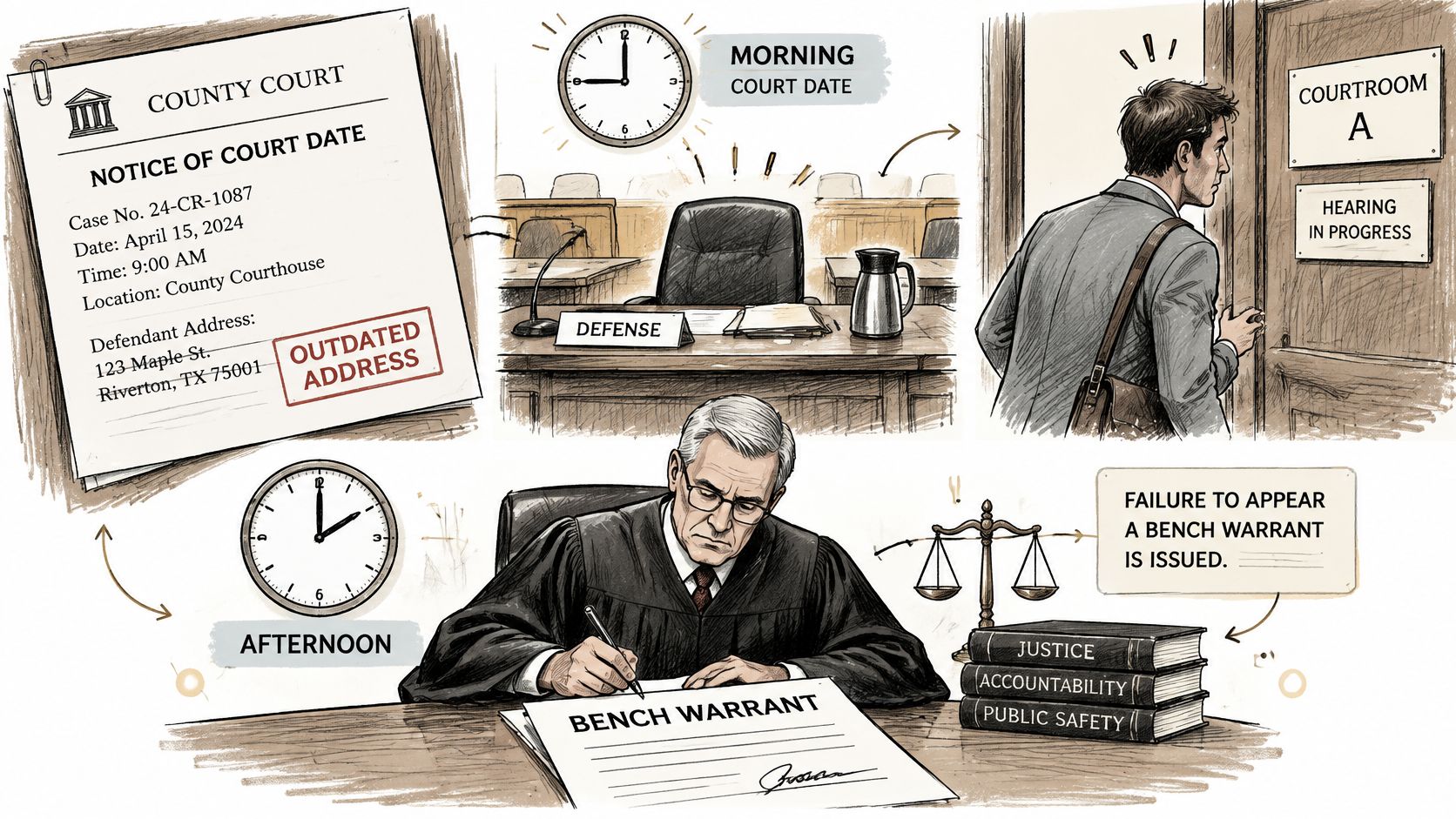
Say a defendant misses a morning hearing and learns that afternoon that the judge signed a bench warrant. Think of the warrant as a pickup order: it directs law enforcement to bring the defendant before the court that issued it. It isn't a replacement appointment.
Under Georgia Code § 17-7-90, a judge may issue a bench warrant after a defendant fails to appear following actual notice in open court, mailed notice to the last known address, or written personal notice from a court official; once arrested, the person must be committed to jail until bail is tendered.
What the judge needs to understand
The warrant itself isn't a conviction or a new finding of criminal guilt. It's an enforcement tool, but it can turn a missed appointment into a custody problem.
At the hearing, the judge considers the absence, future attendance, custody, and appropriate release conditions. Counsel can present documents about notice, an emergency, current employment, residence, and arrangements that make another missed appearance less likely.
First task: Identify the issuing court before making travel or surrender arrangements.
A notice mailed to an old address can raise an important question, but it doesn't automatically invalidate the warrant. Preserve the envelope and notice, explain when the address changed, and let defense counsel evaluate the legal significance.
Possible Outcomes and What Each One Means
Possible outcomes at a bench warrant hearing
| Outcome | What the judge decides | Typical trigger | What happens next |
|---|---|---|---|
| Warrant recalled | Accepts the explanation and cancels the warrant | Proven notice problem, verified emergency, or voluntary appearance supporting recall | Case returns to its prior stage on a new date |
| Released on a new date | Lets the defendant leave custody on an existing or reset bond | Judge finds future appearance likely | Defendant must attend the new date, or a fresh warrant can follow |
| Bond set or reset | Sets a bond amount or changes release conditions | No bond in place, or the bond is revoked | An authorized cash, property, or surety bond can be posted once the amount is set |
| Held without bond or pending bond | Denies release, or bond hasn't yet been posted | Nonappearance risk, prior failures, or a serious charge requiring further review | Defendant remains jailed until authorized release, changed conditions, or case resolution |
| Case reset with warrant still open | Continues the case without clearing the warrant | Insufficient explanation, or a warrant issued by another court | Counsel must address the open warrant; another hearing may be necessary |
These are possible outcomes, not promises based on a particular explanation. More than one row can apply during the same hearing, and the judge's authority depends on the case.
Separate doors, separate decisions
Think of the hearing as having separate doors. Behind one is warrant recall, behind another is release or bond, and behind another is the underlying case schedule. Opening one doesn't automatically open the others.
For example, a judge might accept hospital records and recall the warrant but still require a bond decision before release. Or the court might authorize release and schedule the next hearing while counsel still needs confirmation that the warrant record has been cleared.
The Forsyth County Magistrate Court handles warrants and may set bail in matters within its authority, but that doesn't make it the correct court for every missed appearance. The court where the hearing was missed remains central to resolving that warrant.
Match the request to the problem
A warrant is returnable to the issuing court. Appearing in one court may not resolve an order issued by another, even when both matters involve the same defendant.
A documented absence can support a request for recall, although the judge must find the explanation legally sufficient. Prior failures to appear or a serious underlying charge may require closer attention to whether release is available and what safeguards are appropriate.
Before leaving, have counsel or the issuing court confirm:
- Warrant status: Has the judge recalled it, or does it remain open?
- Custody status: Has release been authorized?
- Case status: What proceeding comes next, and when must the defendant attend?
Release doesn't end the criminal case. The written orders, rather than the family's impression of what happened, should guide the next steps.
How the Hearing Runs, Step by Step
The process involves jail staff, court personnel, the judge, defense counsel, and sometimes a surety. Each handles a different part, so a completed task at one desk doesn't mean everyone else has finished.
From booking to the judge
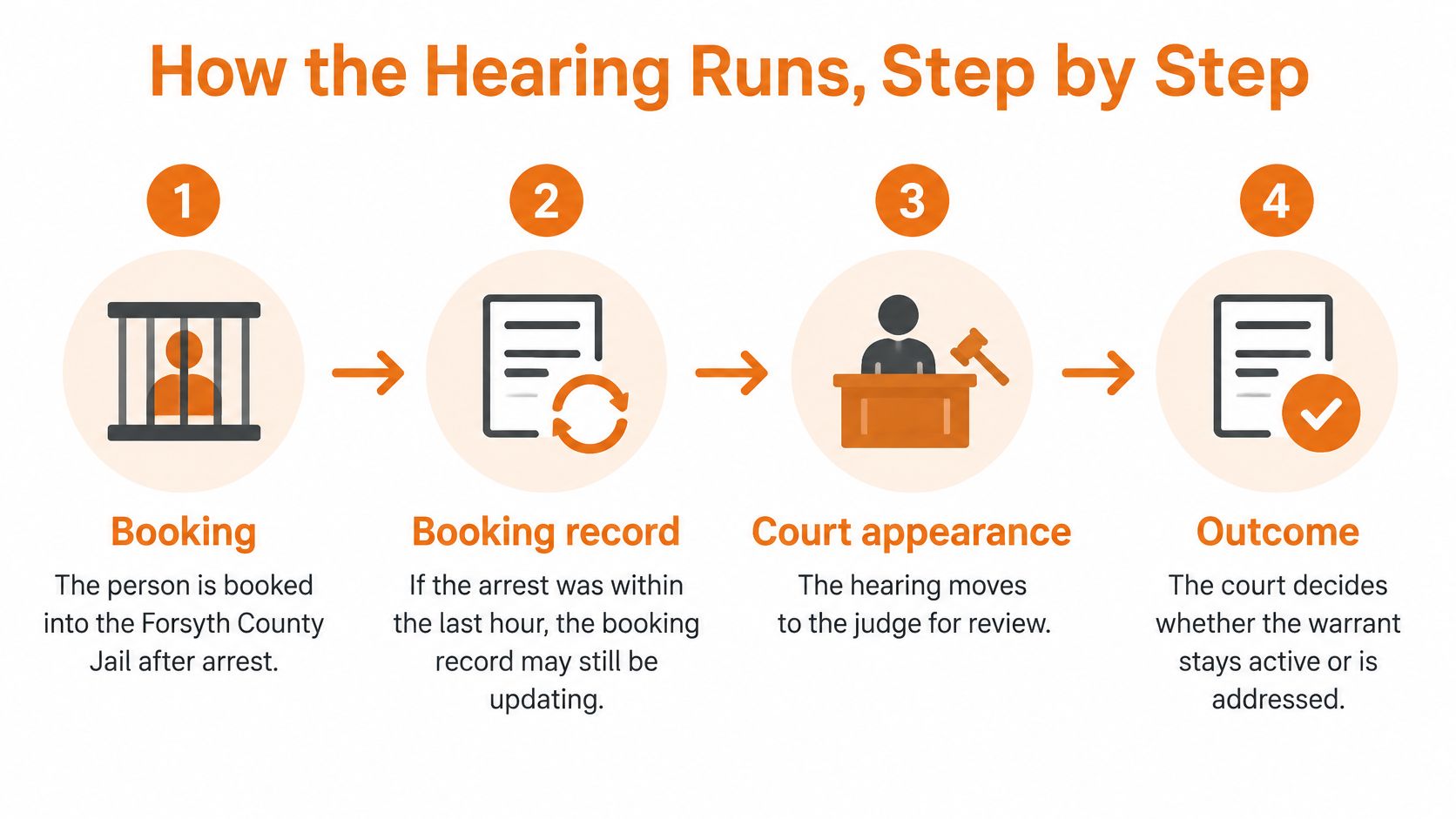
Booking establishes the custody record. After arrest, the person is booked into Forsyth County Jail. If the arrest happened within the last hour, the booking record may not yet be posted; we keep checking rather than treating a missing record as proof the person isn't there.
The record check identifies other barriers. We check for a probation hold or a warrant from another county before posting a bond, because either can prevent release. This avoids treating the visible charge as the only reason someone remains detained.
The defendant appears before the appropriate court. The judge confirms identity and reviews the warrant and underlying charge. Counsel should flag any mismatch in the name, case number, or issuing court so the court addresses the correct matter.
The explanation becomes part of the hearing. The defendant or lawyer explains the absence and presents supporting documents. A medical record showing treatment on the hearing date is more useful than an unsupported statement that the person was sick.
From the decision to release processing
The judge enters an order. The court may recall the warrant, address bond, continue detention, or set another appearance. Listen for the actual ruling on each request rather than assuming that a new date means permission to leave.
Authorized bond paperwork goes to the jail. For surety bail bonds, we post the full face value of the bond with the court on behalf of the person in custody. Once the paperwork is signed, we take the bond to Forsyth County Jail, and the release clock starts at that point.
The next obligations must be clear. Obtain written notice of the next court date and release conditions before departure, or ask how those documents will be delivered. Check whether reporting, monitoring, travel restrictions, or other requirements begin immediately.
Signed paperwork starts another stage of the process. It isn't confirmation that the jail has completed release.
Families sometimes wait in a parking lot because they've heard that the bond is “done.” Ask which task is complete: approval, signing, delivery, verification, or discharge processing. Those descriptions identify where the person is in the process.
Prepare identification and accurate contact information early, and stay reachable if staff need a correction. Nobody outside the jail should promise an exact discharge time while processing remains unfinished.
How Bond Works and How Fast Release Can Happen
If you're asking how to post bail, start with the authorized method. The Fulton County Sheriff's bond explanation describes cash bond, property bond, and a professional bonding company, identifying the person guaranteeing appearance as the surety and the detained person as the principal.
Cost and timing
The percentage charged and fees require written terms tied to the bond amount and the company's agreement. For affordable bail bonds or no collateral bail bonds, get a written quote and collateral answer rather than assuming an advertised phrase applies to your case.
The Middle District of Georgia's federal bond instructions require a court-ordered bond before acceptance and warn that same-day release isn't guaranteed. Those are federal instructions, not a Forsyth County timetable, but they illustrate why payment alone doesn't complete release.
- Approval: Nobody can post bail until a judge sets an amount.
- Paperwork: Early preparation reduces avoidable delays, not court or jail processing.
- Responsibility: The surety answers for attendance and compliance with release conditions.
For DUI bail, don't assume a driver's license is sufficient. The sheriff's explanation limits license collateral to certain misdemeanors with bond of $1,000 or less, after at least five days in custody, and excludes DUI. A DUI case needs another authorized bond method, such as cash, property, or surety.
What a Missed Court Date Does to the Bond
The custody question concerns whether the defendant can leave jail. The bond question concerns potential financial liability after a missed appearance.
Georgia Code § 17-6-71 requires forfeiture and a bench warrant when the principal fails to appear, an execution hearing not sooner than 150 days and not later than 180 days after the failure, and notice to the surety within 10 days through an authorized method, with strict compliance required.
Why the service record matters
Authorized notice methods include certified mail, authorized electronic means, and personal service. The date the family opens an envelope isn't necessarily the legally controlling service date.
Suppose, hypothetically, a surety receives an envelope on day twelve. That's a reason to examine mailing, service, and docket records, not proof by itself that the court missed its deadline. Counsel should determine what happened and whether a notice defect affects enforcement.
Georgia gives the surety a window to bring the defendant back before the full amount becomes due. That window isn't permission for the defendant to remain absent, and a later appearance shouldn't be treated as automatically resolving every forfeiture issue.
Preserve evidence for both tracks
The same documents may help explain the absence and support counsel's review of financial consequences:
- Notice problems: Keep envelopes, returned mail, address updates, and received notices.
- Hospitalization: Obtain records showing relevant admission, treatment, and discharge information.
- Incarceration elsewhere: Preserve booking and custody records.
- Transportation failure: Save repair receipts, cancellation messages, or other corroboration.
- Other circumstances: Collect records that establish what prevented attendance, not just someone's conclusion.
Our explanation of what happens if you miss court can help families organize the practical questions before speaking with counsel.
When the defendant attends every required court date and completes the appearance obligation, the bond is exonerated. Counsel should still confirm the court's disposition and any remaining paperwork rather than assuming the financial record closes immediately after an appearance.
Your Rights at a Bench Warrant Hearing
Ask questions early enough for counsel to act. A family member can help gather records, but the defendant's lawyer handles legal arguments and advises what the defendant should say.
Questions to raise with counsel and the court
- Notice of the allegations: “What charge and missed appearance form the basis of this warrant?”
- Legal representation: “Can I speak with counsel, and how do I request appointed counsel if I can't afford a lawyer?”
- An opportunity to respond: “How can my lawyer present documents or witnesses explaining the absence?”
- Release eligibility: “Is this charge bailable, or is bail restricted?”
- Written instructions: “How do I obtain the order and next appearance date?”
We check whether a charge is bail restricted. That check doesn't replace a lawyer's advice about the court's authority or the right motion to file.
Ask for counsel before the hearing date, not only when the judge calls the case.
The defendant retains the right to remain silent about the underlying charge. Explain the absence with counsel's guidance rather than volunteering a defense to the original accusation.
Review rights after arrest while arranging representation. For a first-time theft charge, 24-7 Best Bonding can't arrange pretrial diversion or conditional discharge; a defense lawyer must request those options early.
Forsyth County Courthouse Logistics and Contacts
Forsyth County courts and jail contacts
| Location | Address | Phone | Use it for |
|---|---|---|---|
| Forsyth County Magistrate Court | Tribble Gap Road, Cumming, GA; confirm street number with the court | Unconfirmed; verify through the court's official directory | First appearance, warrants within magistrate authority, and bond in misdemeanor matters |
| Forsyth County Jail | Cumming facility listed below | Primary number listed below | Booking, custody status, and release questions |
| Issuing court identified by the case | Court named on the warrant or notice | Use the official directory for that court | Warrant recall, new court date, and case-specific orders |
The Georgia Department of Corrections listing identifies Forsyth County Jail at 202 Veterans Memorial Boulevard, Cumming, Georgia, with primary telephone number 770-781-2226. The listing doesn't promise a fixed release time after bond is posted.
Choose the destination by the task
In Forsyth County, a first appearance takes place at Magistrate Court on Tribble Gap Road, where a bond amount is normally set for misdemeanors. A hearing to address a missed appearance may require a different court, so read the warrant heading before traveling.
Hours, courtroom assignments, the Magistrate Court's street number, and its telephone number are unconfirmed here. Verify those details with the court before leaving home, including whether the defendant appears remotely or in person.
For inmate release in Forsyth County, jail staff can address custody and processing questions. The clerk of the issuing court is the better starting point for hearing schedules and copies of orders.
Traveling from nearby communities
Whether you're searching for bail bonds in Cumming, bail bonds in Dawsonville, bail bonds in Alpharetta, bail bonds in Suwanee, or bail bonds in Buford, identify the actual county and court first. A nearby mailing address doesn't establish who issued the warrant.
The same applies to “bondsman near Forsyth jail” searches. Physical proximity can help with paperwork delivery, but it doesn't give a bondsman authority to cancel a court order.
Keep a call log with the clerk's name, time of contact, case number, and instructions received. Read back unfamiliar courtroom or filing information before hanging up.
How to Prepare Before the Hearing
Gather enough information to make the next call useful. You don't need a perfect file before starting.
Documents, information, and calls
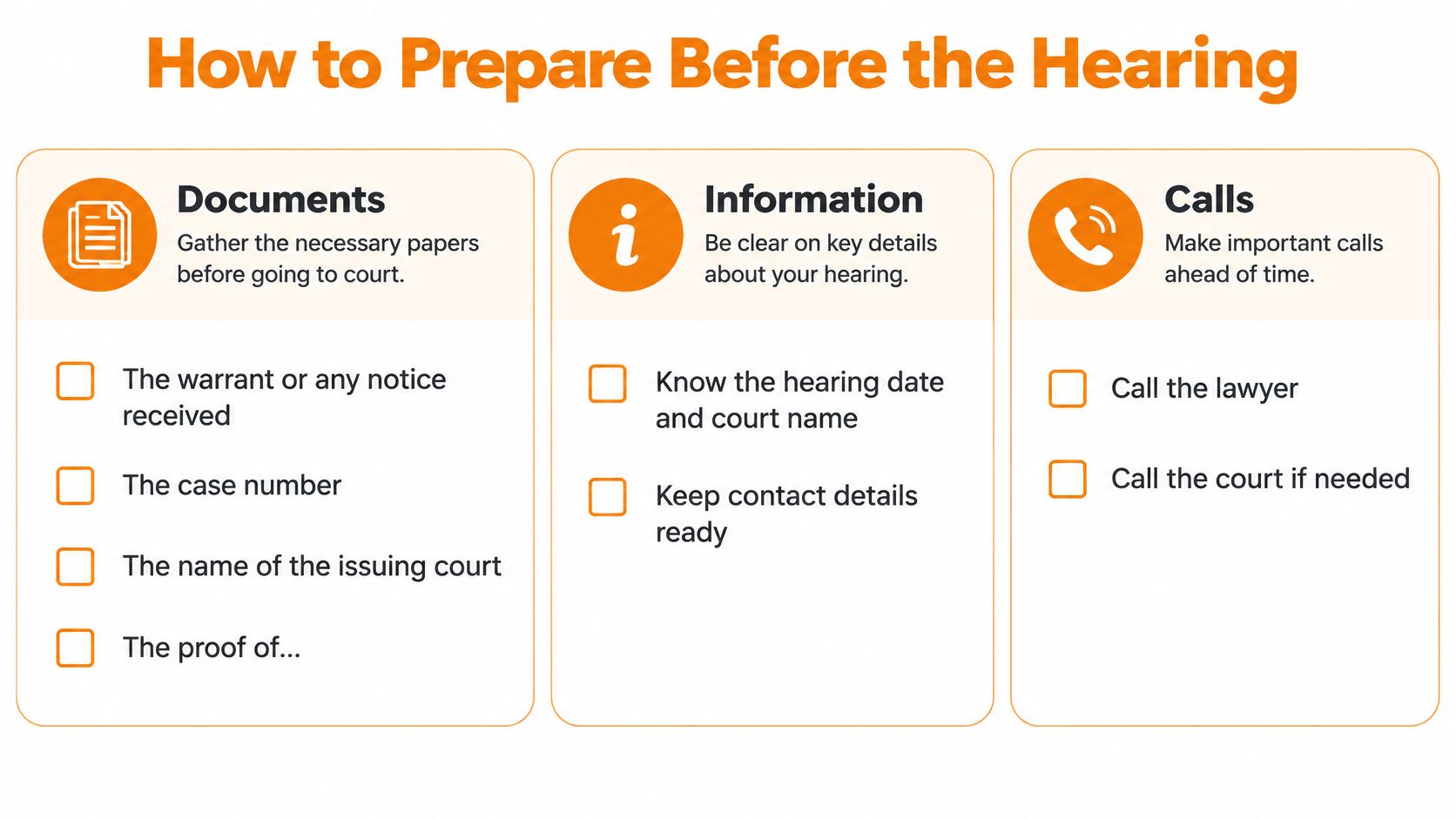
- Documents: Bring the warrant, notices, case number, supporting records, and a written timeline showing when notice arrived and where it was sent.
- Information: Give us the full legal name, date of birth, charge, and bond amount if known. We find missing details; you don't need every answer or money in hand before the amount is known.
- Calls: Confirm the hearing date, time, room, identification requirements, and security screening with the clerk. Send your lawyer the timeline and documents before the hearing.
Easy-to-miss details are the issuing court's name and the date notice was sent. Put both at the top of your timeline so counsel doesn't have to reconstruct them during the hearing.
Use the court hearing preparation checklist to organize the practical arrangements. Plan transportation, allow time for entry screening, and keep family, lawyer, and surety contact details accessible.
If someone offers a ride or childcare, confirm the arrangement rather than leaving it tentative. A workable attendance plan is more useful than a promise to try harder.
Confirm the Warrant and Act Today
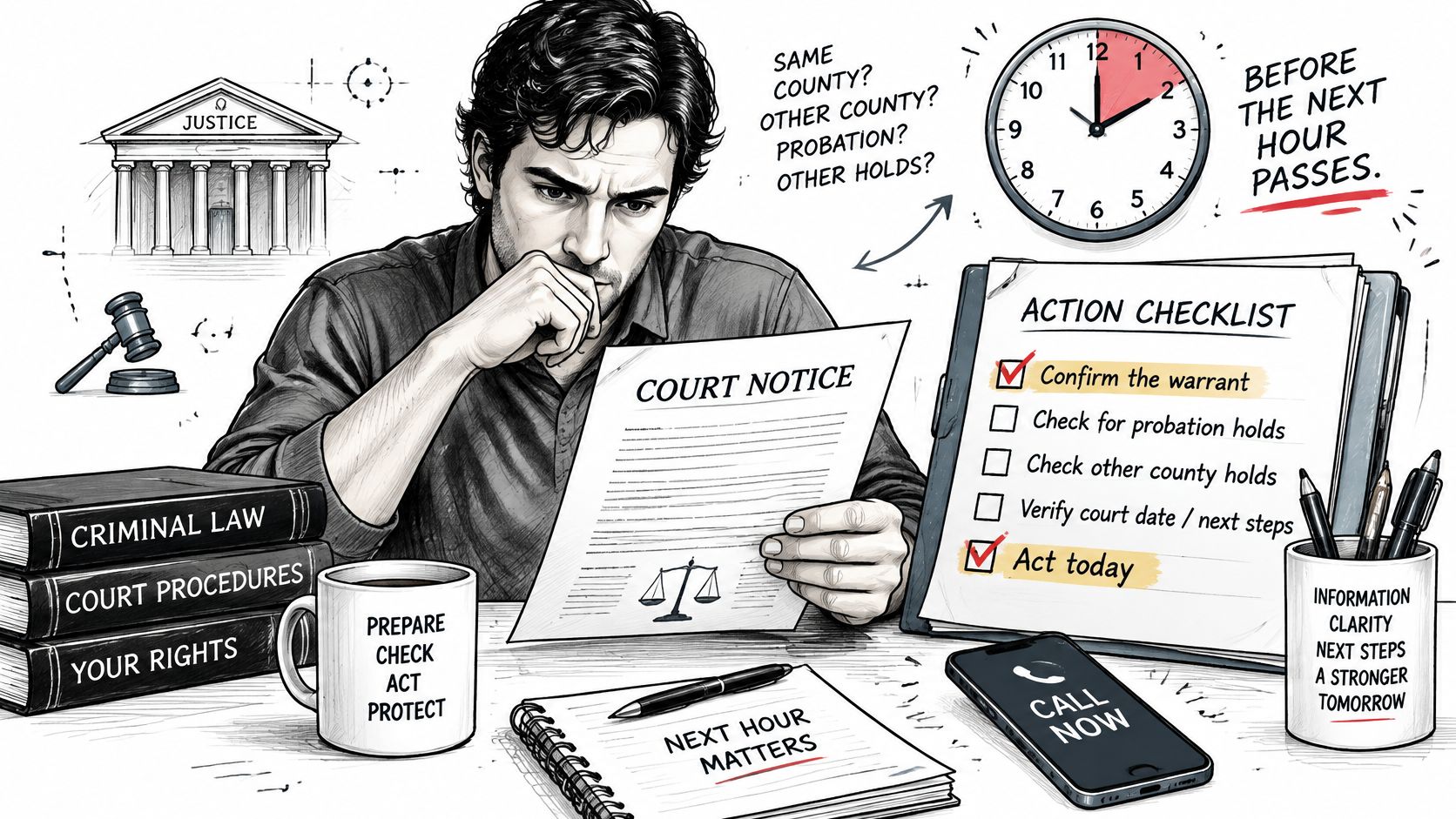
If you're searching “bail bonds near me” or “24 hour bail bonds near me,” make the first conversation specific. Confirm custody, identify any additional hold, obtain the bond amount if already set, and establish what court action is needed.
Start with facts, not a release promise
Call 24-7 Best Bonding at 770-888-4585, any hour. Our office is at 110 Samaritan Dr, Suite 112, Cumming, GA 30040; one call starts the bond paperwork.
Checking for probation holds, immigration detainers, or out-of-county warrants is free. If you're unsure whether a prior conviction counts for a theft bond, call with the name and date of birth so we can check.
For emergency bail bonds, fast jail release starts with accurate information and responsive handling, not a guaranteed deadline. We handle the bonding process discreetly, while defense counsel advises on the case and hearing strategy.
Keep a written record of each contact. Before leaving the courthouse, confirm the next appearance with the clerk and put it on the calendar with reminders and transportation arranged.
24-7 Best Bonding offers around-the-clock Forsyth County bail bonds assistance, local procedural familiarity, and clear communication when a bench warrant creates an urgent custody problem. Visit 24-7 Best Bonding to start the paperwork and discuss what's needed for an authorized release.