
A late-night arrest call scrambles people fast. One minute you're asleep or finishing dinner, the next you're trying to figure out where someone was taken, whether bond has been set, and what to do before morning.
A lot of families type ga bounty hunter into search because they're worried about the worst-case scenario. In most cases, that isn't the actual issue in front of you. The urgent problem is getting clear information, finding the jail, and starting a lawful release as soon as the booking process allows it.
Understanding the GA Bounty Hunter Search in a Crisis
Those seeking a ga bounty hunter are usually not looking for a movie character. They're scared a loved one has been arrested, or they think missing one step will make the situation spiral.
In Georgia, that search term points people in the wrong direction at the start. Georgia does not appear to use the term “bounty hunter” the way popular media does. In the bail industry, the role is tied to the bail system, and bail can be posted only after arrest and booking, while release stays subject to court conditions and required appearances, as described in the Georgia reference discussed here.
That means your first move usually isn't tracking anyone down. Your first move is handling the custody side correctly.
What matters in the first hour
Right after an arrest, families tend to lose time on the wrong questions. They ask whether someone can be picked up immediately, whether a bondsman can bypass the jail, or whether a “bounty hunter” can get involved before bond is posted.
Those are the wrong pressure points. Focus on these:
- Confirm the jail location: Make sure you know where the person is being held.
- Wait for booking to move forward: Bail doesn't happen before the arrest and booking process exists on paper.
- Ask whether bond has been set: If it hasn't, the next step may depend on the charge and court process.
- Get the defendant's legal name exactly right: One wrong letter can slow everything down.
If you're still trying to locate someone, a practical first step is this guide on how to find someone in jail.
Practical rule: The fastest release usually starts with accurate jail and booking information, not panic searching.
The real issue behind the search
Families in Cumming, Alpharetta, Suwanee, Buford, and Dawsonville often use the same language because television made it familiar. The legal system doesn't work like television.
Courts and sheriffs control custody and release. A bail bond is the tool that addresses the immediate emergency. If you move quickly, stay organized, and deal with the actual jail process, you can often keep the situation from becoming more complicated later.
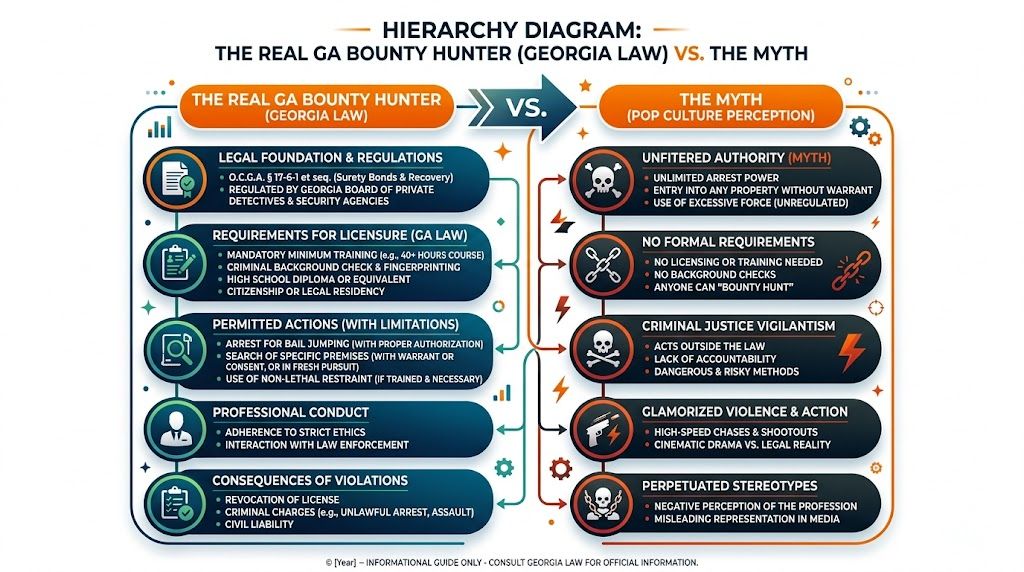
The Real GA Bounty Hunter Georgia Law vs The Myth
The phrase ga bounty hunter sounds dramatic. Georgia law is much more controlled than that.
The legal term is bail recovery agent. Under Georgia Code § 17-6-56, Georgia treats fugitive recovery as a regulated but not state-licensed function, and county sheriff registration is the control point rather than a single statewide credential, as summarized in this Georgia bail recovery overview.
What the myth gets wrong
In movies, the so-called bounty hunter looks like an independent operator who can move anywhere, anytime, under his own authority. That's not how this should be understood in Georgia.
A bail recovery agent's work is tied to the bail bond relationship. The agent isn't replacing the sheriff, the court, or the jail. The recovery side exists because a defendant was released through the bond system and then failed to meet that obligation.
Here is the clean distinction:
| Issue | Pop culture myth | Georgia reality |
|---|---|---|
| Role | Solo hunter chasing fugitives | Bail recovery agent connected to the bail system |
| Authority | Broad, informal power | Regulated activity tied to statutory rules |
| Credential | One badge works everywhere | County-level sheriff registration matters |
| Purpose | Action and pursuit | Return of a defendant connected to bond obligations |
Why county registration matters
This detail catches people off guard. Georgia-based recovery teams can't rely on one state credential for every county. The practical checkpoint is county registration.
That matters because recovery work isn't just about locating someone. It starts with documentation, eligibility, and lawful deployment. A bondsman who ignores that creates risk for everyone involved.
A serious bail company worries about paperwork before movement. That's how problems stay manageable.
If you're dealing with missed court and possible failure-to-appear issues, a bench warrant becomes part of the picture. This explanation of what is a bench warrant gives the plain-language version families usually need.
What actually works
What works is boring compared with television. Good records. Clear court dates. Fast communication. Defendants who understand release conditions. Families who call early when something feels off.
What doesn't work is waiting until a person disappears, assuming every county handles things the same way, or treating recovery as some informal favor. In Georgia, the legal framework matters. If you need help right now, the practical move is still the same. Get the bond process handled correctly first.
How 24 Hour Bail Bonds in Forsyth County Work
Forsyth County is not a tiny market where everything slows to a crawl after dinner. Data USA reports a population of 267,000 in 2024 for Forsyth County, Georgia, which is one reason round-the-clock bail help matters when arrests happen outside business hours, as shown in this Forsyth County profile.
That scale changes the day-to-day reality. More people, more traffic, more arrests, more urgent calls. In a county this active, delays usually come from missing information, incomplete paperwork, or waiting too long to call.
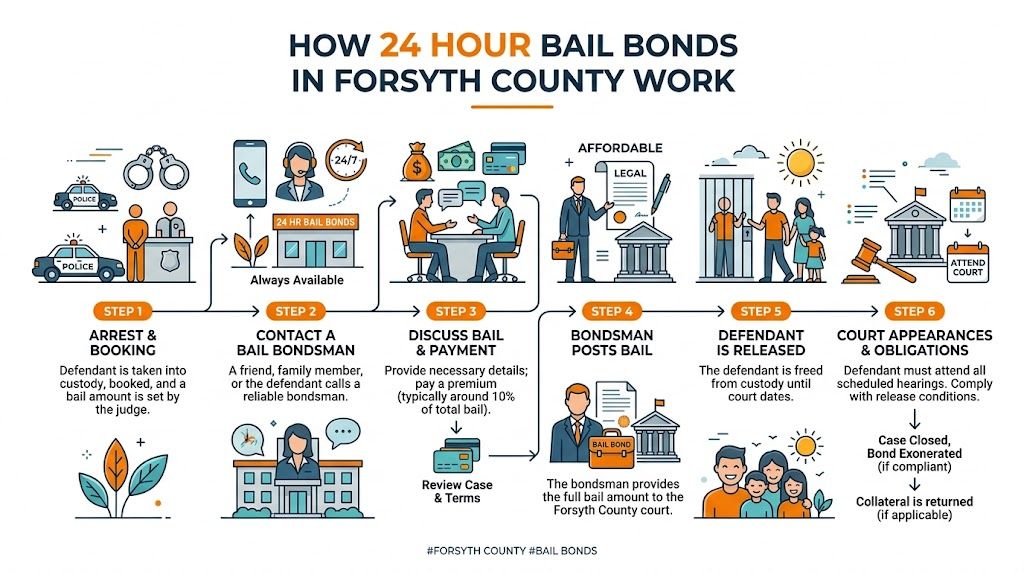
What happens after an arrest
Most families first hear, “They've been taken in.” After that, the process becomes more mechanical than emotional.
A typical release path looks like this:
Arrest and transport
The defendant is taken to the jail or detention facility for processing.Booking
Personal information, charges, and custody records are entered. Until this part moves forward, nobody is posting bond.Bond determination
Depending on the charge and case posture, bond may already be set, may be set later, or may require court action.Bond arrangement
Once bond is available, the person arranging release works with a bondsman to complete the required steps.Posting the bond
The bondsman submits the bond paperwork so the jail can process the release.Release processing
Even after bond is posted, the jail still has to complete its own release procedures.
Where families lose time
People assume the biggest delay is always the bondsman. In practice, that's often not true. Delays usually happen because someone has the wrong jail, doesn't know whether bond has been set, or can't answer basic identity questions.
The quickest calls are the ones where the family already has:
- Full legal name
- Date of birth, if available
- Jail location
- Charge information, if known
- Any booking or case number they were given
For local searches tied to urgency, that's why people often look for 24 hour bail bonds near me. They aren't shopping casually. They're trying to stop lost time from turning into an overnight stay or longer.
If you're calling for a loved one, don't wait until every detail is perfect. Start with confirmed basics, then fill in the rest fast.
What a local bail process feels like
In Cumming and the surrounding Forsyth County area, the best results come from staying practical. Call as soon as you know where the defendant is. Ask whether bond is set. Have identification and payment questions ready. Make sure the defendant understands that release is not the end of the matter. It's a conditional release.
That last part matters. Bail solves the immediate custody problem. It doesn't erase the court obligation that comes next.
What works and what doesn't
What works: fast contact, accurate names, realistic expectations about booking, and quick follow-through once bond is available.
What doesn't: arguing with jail staff, guessing at charge information, waiting for daylight because you assume nothing can happen overnight, or treating release as automatic once payment is discussed.
Families who move early and stay organized usually have a smoother path. Families who panic and scatter their attention across five different guesses usually add delay they didn't need.
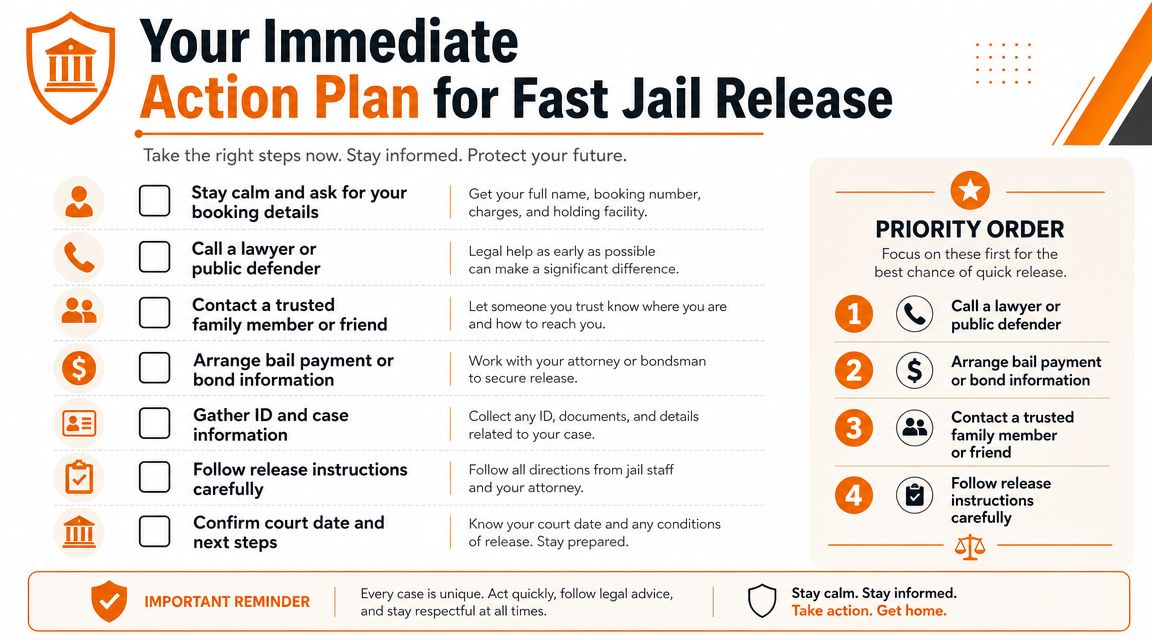
Your Immediate Action Plan for Fast Jail Release
If someone you care about is in custody, speed matters. Not reckless speed. Organized speed.
This is the checklist that keeps people from wasting the next few hours.
Have this ready before you call
Write this down before you start making calls:
- Defendant's legal name: Use the exact spelling, not the nickname everyone knows.
- Jail or holding location: This keeps you from starting the process in the wrong county.
- Charge type if known: DUI, warrant arrest, probation-related issue, traffic-related arrest, or another criminal charge.
- Booking details: If you have a booking number or case number, keep it in front of you.
- Your own identification and contact information: The person arranging bond needs to be reachable and prepared to sign documents.
That sounds simple, but it changes the quality of the call immediately.
Questions to ask right away
Some calls drift. Good calls get to the point.
Ask these questions first:
- Has bond been set yet?
- What documents are needed from me now?
- Is collateral required in this situation, or are other options possible?
- What court obligations should the defendant expect after release?
- If this is a DUI or warrant-related arrest, are there any special release issues to prepare for?
The family member who gets answers in writing usually avoids the second round of confusion later.
Cost and collateral questions
People often search for affordable bail bonds, no collateral bail bonds, and “what percentage is required.” The honest answer is that the exact cost and collateral requirements depend on the bond amount, the charge, the court situation, and the risk the bondsman is being asked to take.
So don't trust a one-size-fits-all answer from a generic website. Ask for the specific terms on the actual case in front of you.
What works here is directness:
| Situation | Best approach |
|---|---|
| You're worried about price | Ask for the exact payment requirements tied to the actual bond |
| You're hoping for no collateral | Ask whether the case qualifies instead of assuming |
| You need emergency bail bonds late at night | Have signer information ready so paperwork can start quickly |
| You're helping from out of town | Clarify remote document and payment options early |
Charge-specific problems people run into
Not every arrest feels the same to a family. The stress pattern changes by charge.
- DUI bail: People often expect a quick in-and-out release, then get frustrated when timing depends on the jail's internal process and release conditions.
- Warrant assistance: A warrant arrest can create confusion because families don't always know whether the matter is local, old, or tied to a missed appearance.
- First-time arrest: First-timers often lose time asking broad legal questions when they should first secure the release path.
- Repeat system contact: These cases usually move better when everyone sticks to facts and avoids stories that change each time they're told.
How to help the defendant after release
Fast jail release only helps if the person stays compliant afterward.
Tell them plainly:
- Keep every court date
- Save all bond paperwork
- Answer calls from the bondsman
- Don't leave address or phone changes unreported
- Treat release conditions as mandatory
A missed hearing can turn a stressful night into a much bigger problem. If your goal is fast release and no repeat chaos, the work doesn't stop at the jail door.
What Happens If a Defendant Misses Court
Missing court is the point where the ga bounty hunter search finally touches real life. This is when people realize the bond wasn't just a payment. It was a promise backed by legal responsibility.
The usual chain starts with a missed hearing. Then the court addresses the failure to appear, and the bondsman has to deal with a defendant who is now out of position and creating risk.
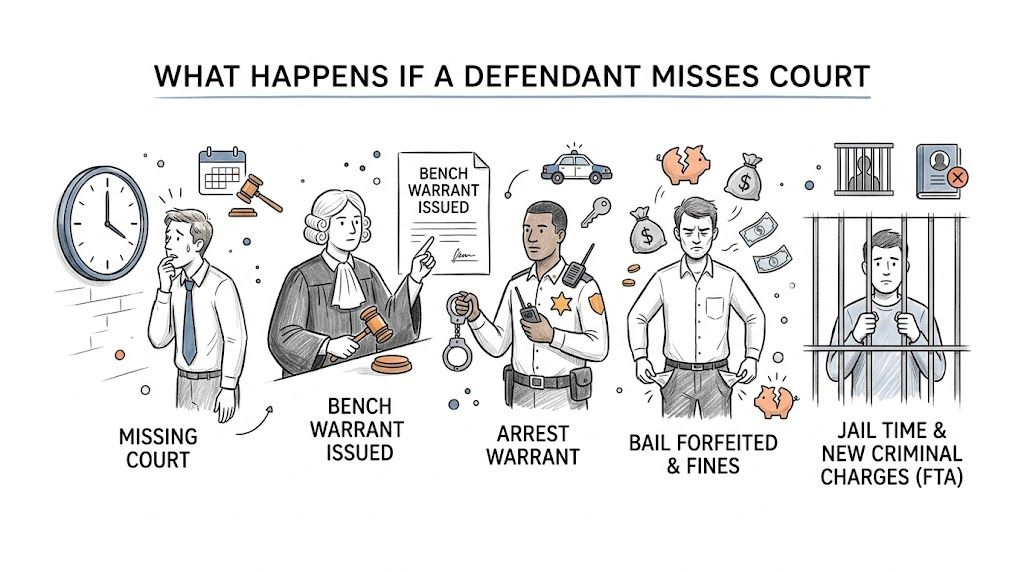
How this usually unfolds
A family often says the same thing: “He thought the date changed,” or “She meant to go but got scared.” The court doesn't treat those explanations lightly.
The practical sequence looks like this:
- Court date is missed
- The court responds to the nonappearance
- The bond problem becomes active
- The bondsman starts trying to locate and return the defendant
- A bail recovery agent may become involved if the case reaches that stage
This is why strong bondsmen spend time reminding clients about obligations. Prevention is cheaper, calmer, and safer than recovery.
Recovery is regulated, not random
Congressional research summarizing Georgia law notes that a bail recovery agent must be at least 25, be a U.S. citizen, obtain a gun permit, and notify local police of the intended arrest, as described in this Congressional research summary on Georgia law.
That notification piece matters more than commonly understood. It affects timing, planning, and how an apprehension is coordinated. This is not supposed to be freelance chaos.
Missing court doesn't create a movie scene. It creates paperwork, liability, and a narrowing set of options.
What families should do if court was missed
If the defendant missed court, silence is usually the worst choice. Families sometimes think lying low will help. It usually makes the problem harder to fix.
Better moves include:
- Contact the bondsman immediately
- Confirm whether the missed date can be addressed quickly
- Stop making excuses and start gathering facts
- Get legal advice if the case is turning more serious
- Do not assume the issue will disappear on its own
People often wait because they're embarrassed. Embarrassment costs time. Time makes recovery more likely.
Your Local Forsyth County Bail Expert and FAQs
When an arrest happens in Forsyth County, local knowledge saves time in ways outsiders don't always see. It isn't just about answering the phone. It's knowing how families speak when they're stressed, what information matters first, and which delays are normal versus avoidable.
A local bondsman near the jail usually gives better guidance because the advice is grounded in the actual workflow people are dealing with in Cumming and nearby communities.
Why local usually moves faster
| Factor | 24-7 Best Bonding (Local) | National Chain (Non-Local) |
|---|---|---|
| County familiarity | Knows the Forsyth County process and local expectations | Often relies on general scripts |
| Urgent communication | Built around local emergency release calls | May route calls through a broader intake setup |
| Paperwork focus | Tailored to the immediate county situation | Can feel standardized and less specific |
| Client support | Practical help for families, attorneys, and local contacts | Less grounded in day-to-day Forsyth handling |
Quick answers families usually need
Can a bail bondsman speed up release?
A bondsman can speed up the bond side by getting documents handled correctly and quickly. The jail still controls its own release process.
How long does release from Forsyth County Jail take?
There isn't one fixed answer. Timing depends on booking status, whether bond has been set, how fast paperwork is completed, and the jail's own release procedures.
Can someone get help with a DUI bail or warrant arrest?
Usually, yes, but the details matter. DUI and warrant cases can involve extra confusion, so exact charge and custody information matter right away.
Does posting bond end the case?
No. Bond gets the person out of custody under conditions. The defendant still has to appear in court and follow the terms of release.
The best bail help is calm, local, and available when the call comes in. That's what families remember the next morning.
When you need fast, respectful help in Forsyth County, 24-7 Best Bonding is available around the clock to help with jail release, explain the next steps clearly, and move the bond process forward without added confusion. If your loved one has been arrested in Cumming or nearby North Georgia communities, call 770-888-4585 or visit the office at 110 Samaritan Dr, Suite 112, Cumming, GA 30040 for immediate assistance.