
When a family hears, “Release is approved, but there's an ankle monitor,” the first reaction is usually relief mixed with panic. Relief because your person may be coming home. Panic because nobody explains what happens next, how long it takes, what it costs, or what can go wrong if one step gets missed.
In Forsyth County, that kind of release condition can slow things down if you treat it like ordinary bail. A jail ankle bracelet adds another layer of approval, setup, and rules. The good news is that it's manageable when you know what the court is asking for and you move in the right order.
Understanding Ankle Monitoring as a Condition of Release
A jail ankle bracelet usually means the court is allowing someone out of custody, but not without close supervision. That can happen in pretrial cases where the judge wants extra control over movement, curfew, or contact restrictions. For a family trying to secure fast jail release in Forsyth County, it helps to understand one thing right away: this is often a path home, not a denial of release.

Courts across the country use electronic monitoring far more than they used to. The number of people monitored with ankle bracelets rose nearly 140 percent between 2005 and 2015, and more than 150,000 people were on electronic monitoring at any given time in state and local systems as of 2022, according to Pew Charitable Trusts research on electronic offender tracking. That matters because it shows this isn't some rare or unusual order. It's now a standard release tool.
What the judge is really saying
When a judge orders monitoring, the message is usually straightforward:
- You can leave jail, but only under specific movement rules.
- The court wants verification, not promises.
- Compliance starts immediately, not when it's convenient.
That last point trips people up. Families often think the bond is the hard part and the bracelet is a detail that gets handled later. In practice, the monitor can become the gatekeeper for release if paperwork, vendor coordination, residence approval, or charging instructions aren't lined up quickly.
Practical rule: If an ankle monitor is part of release, treat it like a required key, not an add-on.
What families need to do first
The fastest way to calm the situation is to get clear answers to five questions:
- Was release granted already, or is it still waiting on a hearing?
- Is the monitor a firm condition, or is counsel trying to modify it?
- Is the person allowed home only, or home plus work, school, treatment, or medical travel?
- Which residence is being approved for monitoring?
- Who is handling setup with the monitoring provider?
If you don't have those answers yet, don't guess. A wrong assumption can cost hours or even a full day. The court order controls everything.
Why this can still be a good outcome
A jail ankle bracelet can feel invasive. It is restrictive. It can also let someone sleep at home, keep a job if movement is approved, and prepare for court from outside a jail pod. For many families in Cumming, Dawsonville, Alpharetta, Suwanee, Buford, and nearby North Georgia communities, that's a much better position than waiting in custody.
The key is simple. Move fast, follow the exact order, and don't treat the monitor like a technical side issue.
How Jail Ankle Bracelets Actually Work
It is often assumed that every jail ankle bracelet works the same way. They do not. The two systems families run into most often are GPS monitoring and RF monitoring, and the difference affects daily life.
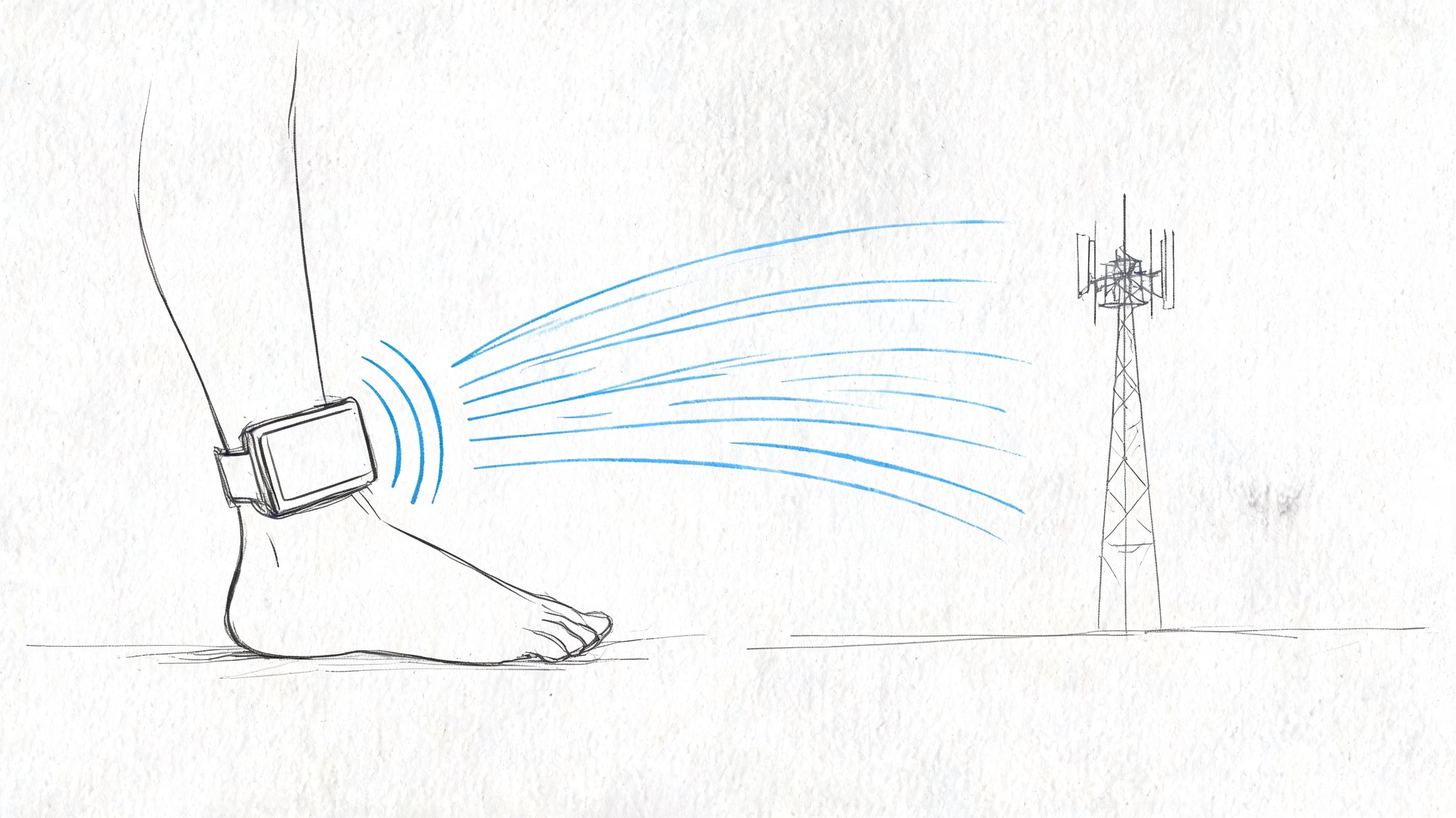
GPS and RF mean different kinds of supervision
The easiest way to think about it is this:
- GPS works like navigation on a phone or in a car. It tracks where the person is outdoors and helps enforce movement boundaries.
- RF works more like a home-based signal check. It confirms whether the person is at or near a required location, usually the residence.
GPS-based systems achieve outdoor accuracy within 10 meters, making them ideal for enforcing geofenced exclusion zones. RF systems verify proximity to a residential base station, which is better suited for simple curfew enforcement, as described in this overview of electronic tagging technology.
If you want a closer look at how location-based supervision works in day-to-day release situations, this guide on GPS ankle monitoring breaks down the practical side.
What the device is actually doing
A jail ankle bracelet usually involves more than the plastic band you can see. The setup may include:
- A tamper-resistant strap that alerts if it's cut, loosened, or interfered with
- A tracking component that reports movement or presence
- A charging routine that the person has to follow consistently
- A base station in some RF setups that confirms they're home during required hours
That's why families need to stop thinking in terms of “wearing a bracelet” and start thinking in terms of “following an electronic supervision system.” The bracelet is the visible part. The rules attached to it are what matter.
How movement rules are usually enforced
Most release orders fall into one of these patterns:
| Type of rule | What it usually means |
|---|---|
| Home confinement | Stay at the approved residence unless the court or officer approves travel |
| Curfew | Be home during listed hours, even if daytime movement is allowed |
| Inclusion zones | Travel is allowed only to approved places such as work, school, treatment, or court |
| Exclusion zones | Stay away from a specific address, neighborhood, or person |
A GPS monitor is better when the court wants to know whether someone entered a prohibited area. An RF setup is better when the main concern is whether the person stayed home during curfew.
If the order says work travel is allowed, the address, schedule, and route still need to be handled carefully. “Allowed” doesn't mean “figure it out later.”
What works and what doesn't
What works is reading the order line by line, confirming the approved address, and asking about work or medical movement before release happens.
What doesn't work is relying on verbal summaries from worried relatives, assuming all monitors are waterproof or low-maintenance, or waiting until after installation to ask whether the person can leave for a job shift. Those mistakes create violations that often could have been avoided with one phone call.
Comparing Release Options Ankle Monitor vs Bail Bond
Families usually compare three different paths when someone is sitting in jail. They may post cash, use a bail bond, or deal with release that includes electronic monitoring. Those options can overlap, but they are not the same thing.
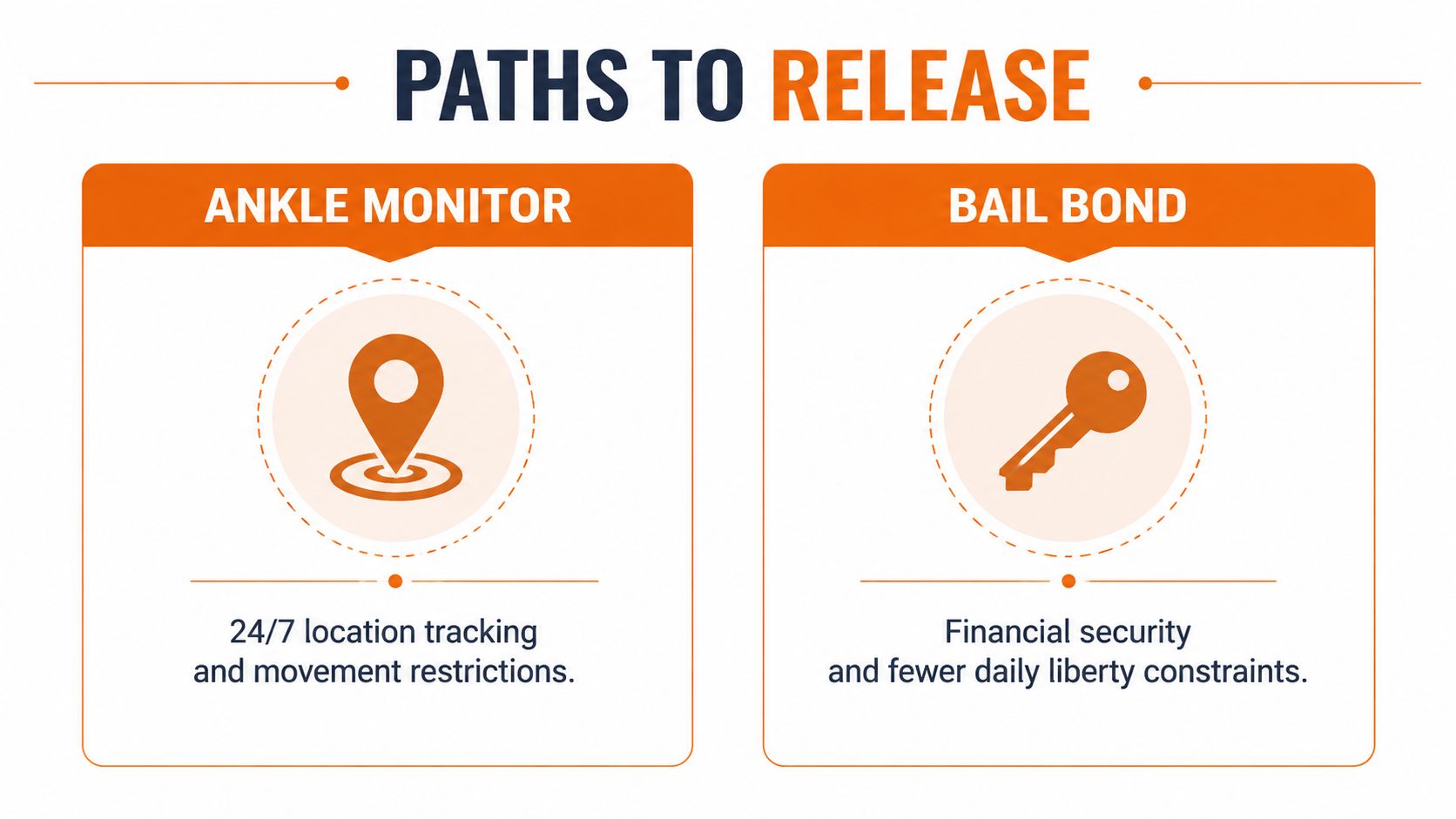
The practical trade-offs
A cash bond is simple in theory. You pay the full amount set by the court. The problem is that many families don't want to tie up that much money all at once.
A bail bond changes that equation because the family isn't usually posting the full cash amount directly to the jail. If you need a plain-English explanation of that distinction, this breakdown of the difference between bail and bond is useful.
Electronic monitoring is different from both. It's not just a payment decision. It's an ongoing supervision condition.
Side-by-side comparison
| Release path | Main advantage | Main drawback | Best fit |
|---|---|---|---|
| Cash bail | Direct release path if funds are available | Large upfront cash requirement | Families who can post the full amount quickly |
| Bail bond | More manageable way to secure release without tying up the full bail amount | Still involves approval, paperwork, and court obligations | Families focused on fast action and predictable process |
| Ankle monitoring | Lets a person be out of jail under supervision | Daily restrictions, setup, and ongoing compliance burden | Cases where the court requires extra control |
The biggest misunderstanding is thinking ankle monitoring is automatically the cheaper or easier option. It may cost less than sitting in jail from the system's point of view, but that doesn't mean it feels easier for the person wearing it.
The money and freedom issues families should weigh
According to electronic monitoring cost data compiled here, GPS electronic monitoring costs from $4 to $35 per day, with setup fees of $100 to $200 often falling on the individual. That same source notes that 97% of individuals on location monitoring at sentencing remained free of violent offense arrests during their monitoring term.
Those numbers tell two truths at once:
- Monitoring can support public safety and release.
- Monitoring can become expensive fast for the person and family paying for it.
A one-time bond arrangement and a daily monitoring bill are different kinds of burdens. One is usually about getting someone out. The other can keep adding pressure week after week.
Bottom line: Don't compare only the first payment. Compare the total burden, including movement limits, charging requirements, schedule approvals, and the risk of technical violations.
What works best in real cases
When the court allows a standard bond without a monitor, many families prefer that route because it's cleaner. There's less daily friction. Work and family life are easier to stabilize.
When the judge insists on a jail ankle bracelet, the smartest move isn't to argue with reality at the jail window. It's to focus on clean setup, accurate residence details, and a release plan that avoids delays. Speed comes from coordination, not from wishful thinking.
How 24-7 Best Bonding Speeds Up Release in Forsyth County
The local problem with a jail ankle bracelet isn't usually the judge's order itself. The delay often happens after the order, when families realize they now need bond paperwork, monitor approval, residence details, and vendor coordination moving at the same time.

In Forsyth County and nearby metro-Atlanta jurisdictions, that delay isn't unusual. Pretrial monitoring rose 28% from 2023 to 2025, vendor approval can take 24 to 72 hours, and local bondsmen can often speed the process by pre-arranging monitor compliance during bail posting, potentially cutting release time by up to 50%, according to reporting on electronic monitoring delays and local release practices.
That's the part stressed families need to hear. The order may be set, but the timeline still depends on execution.
Where release usually slows down
The common friction points are predictable:
Residence problems
The home address hasn't been confirmed, nobody's available there, or the court needs clearer information about who lives in the household.Movement confusion
The person assumes work travel is included, but the written order is narrower than expected.Vendor timing
The monitoring provider still needs intake, scheduling, or setup confirmation before the jail can process release.Incomplete communication
One relative talks to the lawyer, another talks to the jail, and a third person is trying to gather money. Important details get split up.
What local experience changes
Forsyth County release work moves faster when the person helping you already understands the local sequence. That means knowing how to confirm the booking status, how to spot whether a hold-up is bond-related or monitor-related, and when to push on paperwork versus when to wait for court authorization.
A family searching for 24 hour bail bond help usually isn't asking for legal theory. They want to know why release hasn't happened yet and what needs to be done next. With ankle monitoring, the answer is rarely “just wait.” It's usually “one missing approval is still open.”
In real release work, the fastest path is often the most organized path.
The immediate checklist for Forsyth County families
If your loved one is being held in or around Forsyth County and a monitor is part of release, gather this before you start making multiple calls:
- Full legal name and date of birth
- Facility and booking status
- Charge information if you have it
- The court's release terms, especially any monitor language
- Approved home address
- Work schedule or medical needs that may require movement approval
- A single family contact person
That last one matters more than people think. One contact person cuts down conflicting messages and keeps the process cleaner.
What helps and what wastes time
Helpful actions include sending the exact court order, confirming the correct residence, and asking direct questions about what still blocks release.
Time gets wasted when families rely on verbal summaries like “they said he just needs a bracelet” or “I think she can still go to work.” With a jail ankle bracelet, “I think” is where mistakes start.
Common Ankle Bracelet Violations and How to Avoid Them
Most ankle bracelet problems aren't dramatic. They're technical, preventable, and frustrating. A person doesn't have to cut the device off to land in trouble. Missing a charge cycle, leaving home outside an approved window, or failing to report a problem fast enough can all create issues.
The violations that show up most often
Here are the ones families should take seriously from day one:
Dead battery
If the device needs charging and the person lets it drop too low, that can trigger alerts and questions about compliance.Unapproved travel
Going to work, the store, a relative's house, or an appointment without proper approval can be treated as a violation even if the reason sounds reasonable.Strap damage or tamper alerts
Rough handling, attempted removal, or damage to the device can bring immediate scrutiny.Missed communication
Ignoring calls, messages, or instructions from supervising personnel can make a small issue much worse.Being in the wrong place at the wrong time
Curfew violations and prohibited-zone entries are common because people assume “close enough” counts. It usually doesn't.
The daily habits that prevent most trouble
The safest approach is boring and consistent.
| Habit | Why it matters |
|---|---|
| Charge the device on schedule | A low battery can look like noncompliance |
| Keep a copy of approved hours and places | Memory is unreliable under stress |
| Report problems immediately | Delay makes technical issues look intentional |
| Plan travel before leaving | Last-minute improvising causes mistakes |
| Treat the device as fragile equipment | Damage creates avoidable suspicion |
A person on monitoring should act like every movement may be reviewed later, because it might be.
What to do when something goes wrong
If there's a problem, the worst move is silence. Don't wait and hope the system ignores it.
Use this order instead:
- Stop and confirm the issue
- Document what happened
- Contact the supervising authority or monitoring contact right away
- Follow the written instructions you're given
- Tell the family member handling release support so everyone stays on the same page
Power issues, medical emergencies, and work disruptions do happen. The difference between a manageable incident and a violation is often whether the person reported it promptly and followed instructions.
What families can do to help
Family support matters more than people realize. The household can reduce mistakes by keeping charging space clear, helping track approved schedules, and avoiding pressure like “just run this one errand.” Small favors create big problems when someone is on a jail ankle bracelet.
The best mindset is simple. If it isn't clearly approved, treat it as not allowed until confirmed.
Your Jail Ankle Bracelet Questions Answered
Can you shower with a jail ankle bracelet
Usually, people can handle basic hygiene with the device on, but they should follow the exact instructions given for that specific unit. Don't assume every device handles water the same way. If the instructions weren't clear at installation, ask before testing it.
Swimming is a different issue. Don't assume that's allowed.
Can someone work while wearing an ankle monitor
Sometimes yes, sometimes no. It depends on the release order and the monitoring setup. A person may be allowed to travel only to a listed job site during approved hours, and that approval needs to match the actual schedule.
The mistake is assuming normal life resumes automatically after release. With a jail ankle bracelet, work travel is controlled travel.
What if the job requires changing locations
That can be harder. A fixed workplace is simpler than a route-based job, service work, or travel between sites. If the person's employment involves movement, that needs to be explained clearly and approved in advance.
Don't leave this for after release if you already know the work schedule is complicated.
What happens during a power outage
The first step is to follow the device instructions and report the problem through the proper channel. A power outage may be real, but the system still expects communication. If the person can relocate temporarily to charge under approved conditions, they need permission before doing it.
Silence creates doubt. Fast reporting protects the person.
If there's ever a question about equipment, charging, or an unexpected schedule problem, communicate before it becomes a violation.
Can a person leave for medical treatment
Often yes, but the trip usually needs to fit the release terms or be approved. Routine care, urgent care, prescriptions, and specialist visits should all be handled carefully. Keep records and communicate early.
Medical need doesn't erase reporting requirements.
What if the bracelet gives a false alert
That can happen. The right response is documentation and immediate communication. Note the time, location, what the person was doing, and any device behavior. Don't assume the system will sort it out by itself.
Calm, prompt reporting is the best protection.
Are phone app monitors replacing ankle bracelets
In some places, yes. App-based monitoring adoption in major markets rose from 5% to 22% since Q1 2025, vendors market them as offering 60% cost savings, but studies cited in reporting found higher false positive rates of 18% for apps compared with 12% for bracelets, with rural signal issues creating concern in parts of North Georgia, according to ProPublica's reporting on digital monitoring and debt.
That trade-off matters. A phone app may feel less intrusive because there's no ankle device, but it can create its own problems if signal quality is weak or the phone situation is unstable. In parts of North Georgia, that's not a small concern.
Is a jail ankle bracelet better than staying in jail
For most families, being home under restrictions is preferable to sitting in custody. But “better” doesn't mean “easy.” It still requires discipline, planning, and strict compliance.
The best way to think about it is this: release with monitoring is an opportunity. The person has to protect it every day.
If you need fast, local help with Forsyth County bail bonds, 24 hour bail bonds near me, emergency bail bonds, DUI bail, warrant assistance, or a release that involves a jail ankle bracelet, contact 24-7 Best Bonding. Their team serves Cumming, Dawsonville, Alpharetta, Suwanee, Buford, and surrounding North Georgia communities from 110 Samaritan Dr, Suite 112, Cumming, GA 30040. Call 770-888-4585 any time for clear answers, quick action, and dependable help getting a loved one home as fast as possible.