
A late-night DUI arrest in Forsyth County puts families into panic mode fast. One minute you’re trying to find a bail bondsman near Forsyth jail, and the next minute you’re hearing new terms from the court like alcohol ankle monitor, release conditions, reporting requirements, and installation appointments.
That’s usually when the confusion gets worse. People think posting bail is the whole job. It isn’t. In many DUI bail cases, especially when the court wants tighter supervision, release can depend on more than paying the bond. The judge may require an alcohol ankle monitor before your loved one can stay out and keep moving through the case.
If you’re in Cumming, Dawsonville, Alpharetta, Suwanee, Buford, or nearby North Georgia, the true goal is simple. Get them released fast, then make sure they don’t violate the order and end up back in jail. The alcohol monitor is part of that path, not a side issue.
A Guide for When an Arrest Involves an Alcohol Ankle Monitor
A common call goes like this. A husband, wife, parent, or employer finds out someone has been booked after a DUI arrest. They’re searching for 24 hour bail bonds near me, trying to figure out how to post bail, and then they hear that the court may require an alcohol ankle monitor as a condition of release.
That changes the conversation immediately.
Now the family isn’t just asking, “How do we get them out?” They’re asking:
- Can they still come home tonight
- What is this monitor
- Who installs it
- What happens if they mess it up
- How much is this going to cost on top of the bond
Those are the right questions.
An alcohol ankle monitor usually shows up in cases where the court wants proof that the defendant won’t drink while the case is pending. In practical terms, it gives the court a reason to allow release while still keeping control over the case. For the family, that can be the difference between a loved one sitting in jail and a loved one getting back to work, back to treatment, back to home, and back in front of the judge in compliance instead of in trouble.
Practical rule: If the court mentions an alcohol monitor, treat it like part of the bail itself. Don’t think of it as something to “deal with later.”
Families often lose time because they focus only on the bond amount and ignore the release conditions attached to it. That’s a mistake. A fast jail release in Forsyth County depends on handling both pieces at once.
What families need to understand right away
The monitor isn’t there for appearance. It’s there for evidence and compliance.
If the court orders one, the message is clear. The judge wants the person out of custody, but only under strict alcohol supervision. Fighting that reality in the moment usually slows release down. Accepting it, planning for it, and moving quickly usually gets better results.
The smartest approach in the first few hours
When an arrest involves an alcohol ankle monitor, keep your focus on three things:
Confirm the release conditions
Don’t guess. Find out exactly whether the monitor is required, when it must be installed, and whether proof of installation has to be provided.Prepare for the added logistics
This may involve paperwork, an appointment, transportation, and daily compliance responsibilities right after release.Treat compliance like a serious court order
Because that’s what it is. If your loved one gets out and then ignores the monitor rules, the release you worked so hard to secure can disappear fast.
How an Alcohol Ankle Monitor Actually Works
The easiest way to understand an alcohol ankle monitor is this. It acts like a constant alcohol check running in the background.
Not a breath test you remember to take. Not a random call-in test. A device on the ankle that keeps checking automatically.
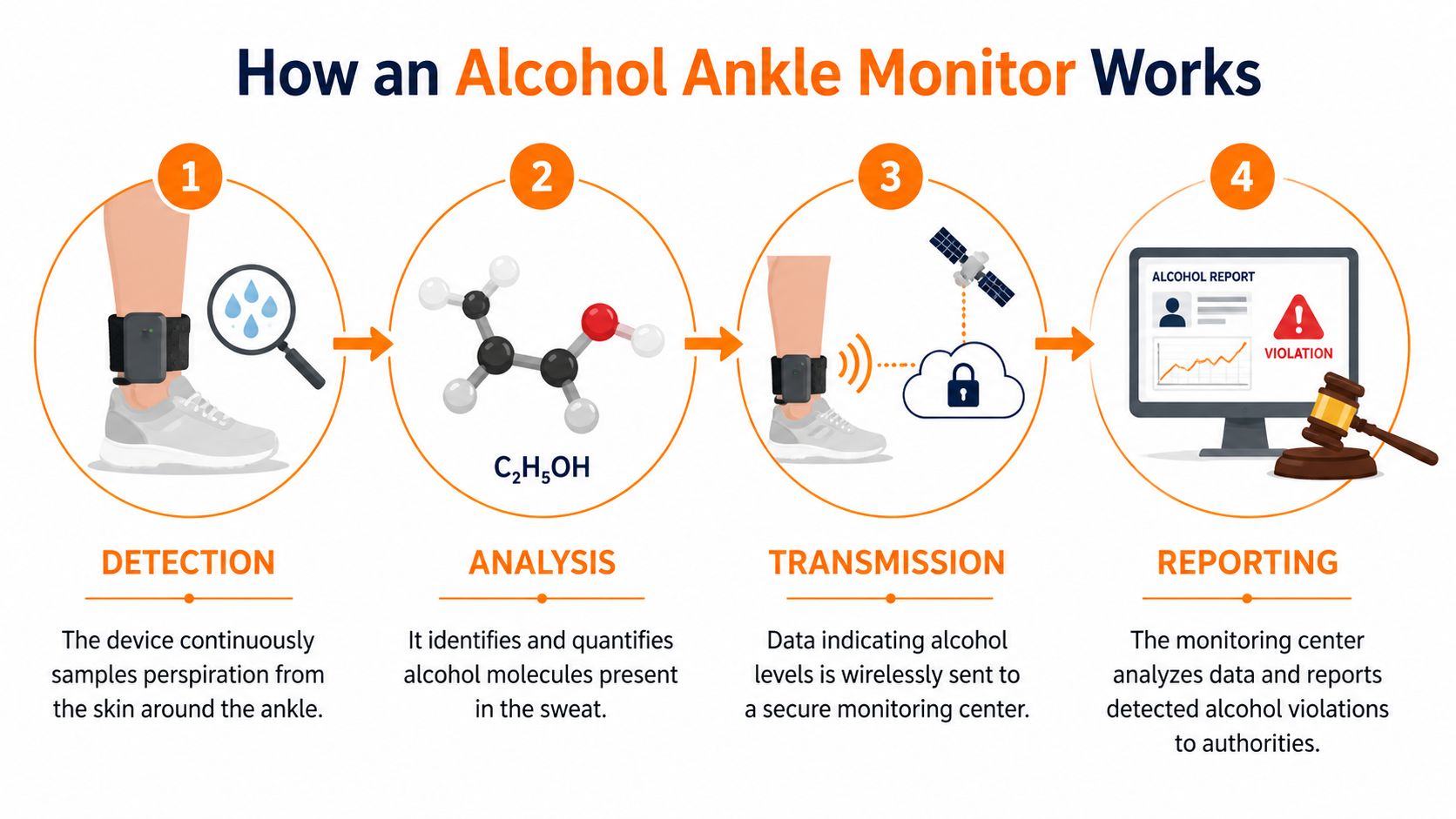
The best-known version is the SCRAM CAM® bracelet. It uses transdermal alcohol detection. That means it samples tiny amounts of perspiration from the skin every 30 minutes, 24/7, and uses fuel cell sensor technology to measure alcohol, with a detection threshold of 0.02 BAC equivalent, according to the SCRAM CAM specification sheet.
It samples skin, not breath
People hear “alcohol monitor” and assume it works like a handheld breathalyzer. It doesn’t.
The device measures alcohol that leaves the body through the skin. The monitor passively samples insensible perspiration, so the person wearing it doesn’t have to blow into anything or push a button every half hour. The whole point is that it keeps working whether the person is asleep, working, driving, or sitting at home.
That matters in a bail setting because the court wants monitoring that doesn’t depend on the defendant remembering to participate.
It’s built to catch both drinking and tampering
The same specification sheet explains that the bracelet also uses infrared and temperature sensors to detect tampering or removal, and it sends data daily to a secure web platform. In plain English, wrapping it, blocking it, or trying to remove it is a bad idea.
Here’s the simple version of what the device is doing:
| Function | What it means in real life |
|---|---|
| Regular testing | The monitor checks for alcohol every 30 minutes without needing the wearer to do anything |
| Alcohol detection | It looks for ethanol leaving the body through the skin |
| Tamper checks | It can flag obstruction, removal, or interference |
| Data reporting | Readings are transmitted for review and reporting |
Why families shouldn’t fear the technology
The device sounds intimidating until you understand it. Then it becomes straightforward.
If your loved one doesn’t drink and doesn’t mess with the monitor, the system is doing exactly what you want it to do. It creates a record of compliance. That can help calm the court’s concerns while the case is pending.
The monitor isn’t asking the wearer to be perfect at technology. It’s asking them to follow one simple instruction. Don’t drink and don’t interfere with the device.
There’s a good plain-English breakdown in this guide on how an alcohol ankle bracelet works.
One detail people often miss
Detection through the skin doesn’t happen the same way as a roadside breath test. The specification sheet notes a 12-18 hour lag between peak BAC and detectable transdermal alcohol concentration. That means the device is not just catching a split-second snapshot. It’s tracking a pattern over time.
That’s one reason courts like it. It creates a stronger compliance record than occasional testing.
Why Courts in Forsyth County Use Alcohol Monitoring
Judges don’t order an alcohol ankle monitor to make life harder for the sake of it. They order it because they want control, accountability, and a safer release option in alcohol-related cases.
That’s especially true in DUI bail Forsyth County situations. If the charge involves alcohol, the court has one immediate concern. Will this person stay sober while the case is pending?
Courts use it because it is established, not experimental
The SCRAM CAM® has been around long enough that courts know what they’re dealing with. It launched in 2003 and had logged over 2 billion alcohol tests by May 24, 2016. It has also monitored more than 483,000 clients and is used in 48 U.S. states, according to this PR Newswire report on SCRAM CAM’s adoption in community corrections.
That matters for one reason. A Forsyth County judge is far more likely to trust a tool that has already become part of standard community corrections practice.
Why a judge may prefer monitoring over jail
In a lot of cases, the court is balancing two goals that push against each other:
- Protect the public
- Allow the defendant to remain in the community under strict rules
Alcohol monitoring helps the judge do both. The person can go home, keep a job, meet with counsel, support family, and continue daily life. But they do it under active supervision tied directly to sobriety.
That’s often a better fit than holding someone in custody when the court believes supervised release can work.
The court’s logic is usually straightforward
When a judge looks at an alcohol-related case, a monitor can serve several purposes:
| Court concern | Why monitoring helps |
|---|---|
| Risk of drinking again | The device creates continuous sobriety monitoring |
| Need for quick accountability | Alerts and data reporting give the court an enforcement tool |
| Pretrial release structure | The person can be released under measurable conditions |
| Confidence in compliance | The court gets more than promises or self-reporting |
This is why families should stop viewing the monitor as some random extra burden. From the court’s perspective, it is often the thing that makes release possible.
What that means for the defendant
If the court requires an alcohol ankle monitor, arguing that it feels unfair usually doesn’t change much in the short term. Complying with it does.
The better move is to understand what the order is designed to do. The judge wants proof, not explanations. The monitor gives that proof.
A monitor can be the bridge between custody and release. If the court trusts the bridge, your loved one has a path home.
The Process and Cost of Getting a Monitor Installed
This is the part families usually weren’t ready for. They’ve prepared for the bail premium, maybe for an attorney, maybe for towing or impound fees after a DUI. Then they learn there’s another layer. The person has to get the alcohol ankle monitor installed and keep paying for it while the order stays in place.
That’s where people start asking the right practical question. Not “Is this annoying?” but “How do we get this done without causing a delay or violation?”
What the installation process usually looks like
The exact details depend on the court order and provider, but the path is usually pretty simple once someone explains it clearly.
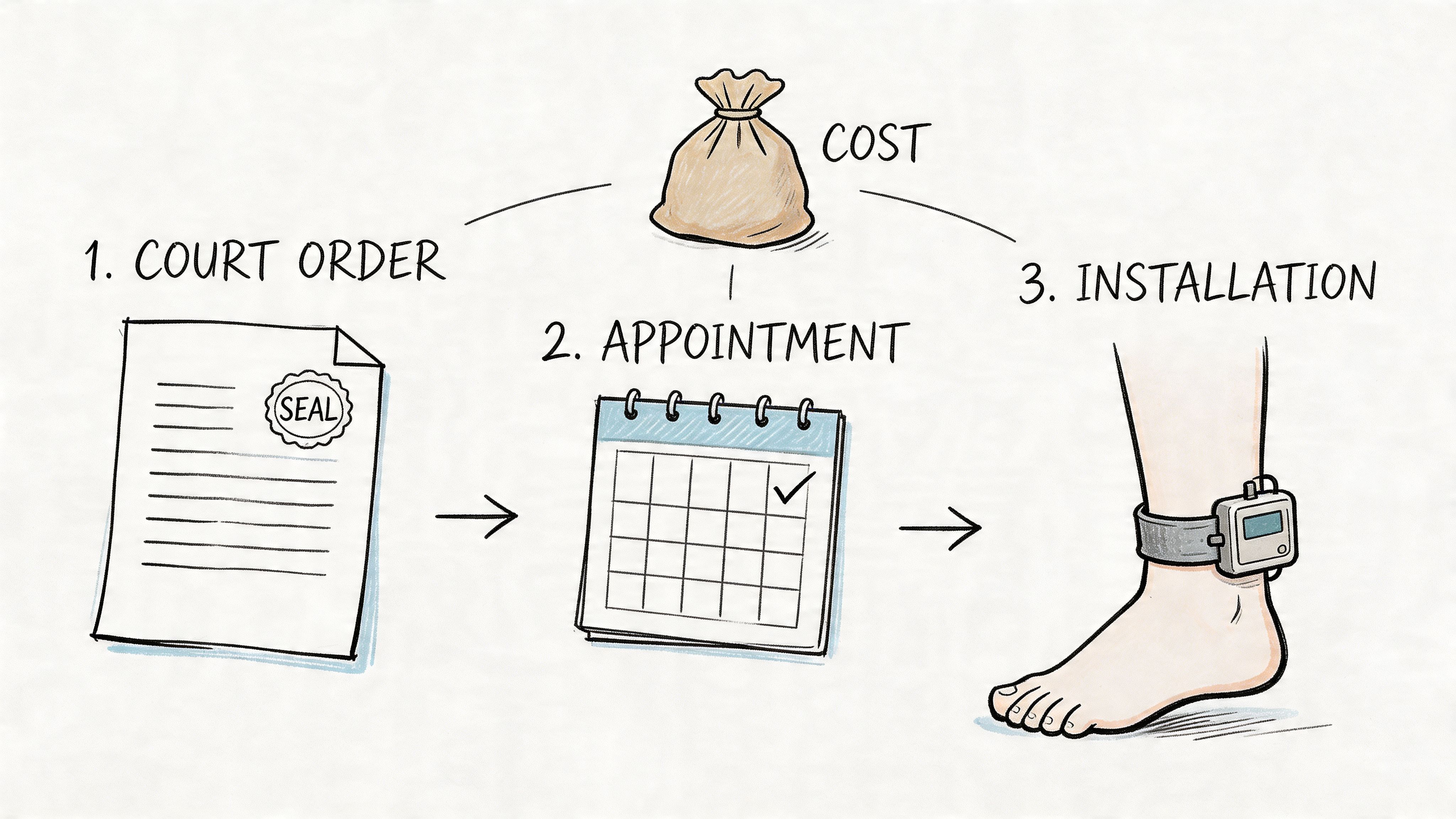
Get the court requirement confirmed
Make sure you know whether the monitor is required before release, immediately after release, or by a specific deadline. Read the paperwork carefully. If something is unclear, get clarification fast.Contact the approved monitoring provider
Courts don’t typically leave this wide open. There is usually an approved provider or approved process. The defendant will need to schedule installation and follow the provider’s instructions.Bring required identification and case information
The provider usually needs the defendant’s identifying information and the court paperwork that shows the monitor requirement.Attend installation and orientation
At the appointment, staff place the device, explain the rules, and tell the wearer how reporting works.Start paying the monitoring fees
The monitoring fees often catch many families off guard.
The real cost issue families need to plan for
According to the verified information provided for this article, defendants often face daily fees of $10-15 and installation costs around $50-100, as noted in this page about SCRAM continuous alcohol monitoring. Those costs come on top of the bail premium.
For a family already trying to arrange affordable bail bonds or manage an emergency bail bonds situation, that extra expense is not minor. It can become the hardest part of staying compliant.
Here’s the simple cost picture:
| Cost category | What to expect |
|---|---|
| Initial setup | Installation is often around $50-100 |
| Ongoing monitoring | Daily fees are often $10-15 |
| Bail-related pressure | These costs are separate from the bond premium |
Don’t ignore the affordability problem
Low-income defendants get squeezed here. That’s reality.
A family may be able to gather the money needed to secure release, then find out the person also has to keep paying for the monitor every day. If they fall behind, the problem isn’t just financial. It can become a compliance problem that puts release at risk.
If money is tight, raise that issue immediately with the lawyer, the court if appropriate, and the monitoring provider. Waiting until fees pile up is the wrong move.
The fastest way to keep this from delaying release
When families want fast jail release or inmate release Forsyth County, they should handle the monitor requirement like a checklist item, not a later discussion.
Use this short action list:
- Get the exact order in writing so nobody is guessing about deadlines.
- Call the provider quickly because installation timing matters.
- Ask for the full fee structure up front so there are no surprises.
- Arrange transportation because release logistics can get messy fast.
- Keep every receipt and document in case the court or attorney needs proof.
There’s a more detailed breakdown of how much ankle monitors cost if you want to understand the financial side before committing to a plan.
What people often get wrong
The biggest mistake is acting like the monitor is separate from the release process. It isn’t.
If the court says the person must wear it, installation becomes part of the job of getting them successfully out and keeping them out. Families who accept that early usually move faster and make better decisions. Families who resist it often lose time, miss deadlines, and create avoidable stress.
How to Successfully Comply with Alcohol Monitoring Rules
Once the alcohol ankle monitor is on, the case shifts from release to discipline. This part is simple to say and hard for some people to live. Compliance means zero shortcuts.
That’s not me being dramatic. That’s the truth of court-ordered monitoring.
Research on SCRAM found an exceptionally low 3.5% re-offense rate while wearers were being monitored. For DUI offenders who wore the device for 90 days or more, the recidivism rate was 10.3%, compared with 21.2% for the non-monitored comparison group, according to the NTCRC study on SCRAM effectiveness. Courts use results like that because the structure works when people follow it.
The best mindset is boring discipline
People get into trouble when they treat the monitor emotionally. They get angry, embarrassed, stubborn, or casual. None of that helps.
Treat it like any strict court condition. Follow the rule, keep records, show up when required, and don’t create extra issues.
Daily habits that help
A person wearing the monitor should keep life plain and predictable.
Avoid alcohol completely
This sounds obvious, but people still gamble with “just one drink.” That’s a terrible decision while under monitoring.Leave the device alone
Don’t cover it, alter it, remove it, or test its limits.Stay reachable and organized
Save provider contact information, appointment details, and all paperwork.Handle problems immediately
If there’s a device issue, missed appointment, or question about care, contact the monitoring provider right away.
What compliance really proves
A lot of defendants think the monitor only exists to catch them if they fail. That’s too narrow.
It also gives them a way to prove they followed the court’s order. That matters in DUI cases and in any hearing where the court is deciding whether to continue release, modify conditions, or evaluate credibility.
The person who treats the monitor seriously gives the court less reason to tighten the case.
Common-sense rules for staying out of trouble
Here’s the practical version:
| Situation | Smart response |
|---|---|
| You’re frustrated by the device | Ignore the emotion and follow the order anyway |
| Something seems wrong with the monitor | Report it immediately through the proper channel |
| You’re tempted to test the limit | Don’t. The case is already expensive enough |
| You want the judge to trust you later | Build a clean compliance record now |
There’s also a useful guide on ankle monitor rules that covers everyday expectations in plain language.
The blunt truth
The monitor can help someone stay out of jail while the case moves forward. Or it can become the reason they go back. The difference is usually not technology. It’s behavior.
If your loved one gets released with an alcohol ankle monitor, tell them the truth. This isn’t the time to be clever. It’s the time to be careful.
Your Partner for Fast Bail and Monitoring in Forsyth County
When families search for bail bonds near me, they usually want one thing. Speed. They want someone who answers the phone, knows the local system, and can help move the case toward release without confusion.
That’s the right instinct. In Forsyth County, speed matters. So does local knowledge. A bail situation tied to an alcohol ankle monitor adds another layer that out-of-town call centers and generic bond services often don’t handle well.
Why local experience matters in a high-stress release
A family trying to secure 24 hour bail bonds in Cumming or emergency bail bonds near the Forsyth County jail doesn’t need vague reassurance. They need clean answers.
They need to know:
- what the bail process looks like
- whether there are added release conditions
- how a DUI release differs from a simpler bond
- what paperwork needs to be handled quickly
- how to avoid mistakes after release
That’s especially important for families in Cumming, Dawsonville, Alpharetta, Suwanee, Buford, and surrounding North Georgia communities. Local jail release issues are never just about paying money. They involve timing, communication, release conditions, and follow-through.
What people looking for fast jail release should prioritize
When choosing a bondsman for Forsyth County bail bonds, don’t focus only on who answers first. Focus on who can guide the full release process clearly.
A good bail partner should help you think through the practical problems that come after the bond is written:
| What you need | Why it matters |
|---|---|
| Fast response | Delay costs time and increases stress |
| Knowledge of Forsyth County procedures | Local familiarity helps avoid wrong assumptions |
| Clear explanation of release conditions | Conditions like alcohol monitoring can derail release if ignored |
| Availability after hours | Arrests don’t happen on business hours |
| Calm communication | Panicked families make expensive mistakes when nobody explains the next step |
This is where families often waste time
They call multiple places asking only about price. That’s understandable, but incomplete.
If the case involves DUI bail, warrant issues, or conditions like an alcohol ankle monitor, the smarter question is whether the person helping you understands how release works in Forsyth County. A cheap answer that misses the specific conditions can cost more in the end if it causes delays or violations.
The fastest release usually comes from clear coordination, not from rushing blindly.
Think beyond the first night
A lot of people treat bail like a one-night emergency. In truth, it’s the first stage of a longer process. The best outcome isn’t just getting someone out of custody. It’s getting them out, keeping them compliant, and preventing a return trip to jail.
That’s why the alcohol ankle monitor issue matters so much. It connects directly to the bigger release strategy. If the defendant handles it correctly, they have a stronger chance of staying home, staying employed, and showing the court they can follow orders. If they don’t, the case gets harder.
For families searching bondsman near Forsyth jail, no collateral bail bonds, how to post bail, or fast inmate release Forsyth County, the advice is simple. Work with someone local, available, and experienced enough to help you think past the first payment and into the actual compliance steps that follow.
Common Questions About Alcohol Ankle Monitors and Bail
Can someone work while wearing an alcohol ankle monitor
Usually, yes, if the court hasn’t restricted work activity. The bigger issue is practical compliance. The wearer needs to protect the device, follow all rules, and stay reachable if the provider or supervising authority needs something.
Can someone travel with the monitor on
That depends on the court order and any other release conditions. Don’t assume normal travel is allowed. If the person needs to travel for work, family, or medical reasons, get approval the right way before going anywhere.
Is an alcohol ankle monitor the same thing as house arrest
No. They can be separate conditions. An alcohol ankle monitor focuses on alcohol monitoring. Some setups may also involve additional location-related supervision, but you need to read the exact order instead of guessing.
What if the person can’t afford the daily fees
Address that immediately. Don’t let it turn into silence, missed payments, or missed appointments. The lawyer needs to know. The monitoring provider may need to know. If there’s a lawful way to raise the hardship issue, do it early.
Can a family member pay the monitor costs
In many cases, families do help cover those costs. The important part is keeping the account in good standing and making sure the defendant still understands that compliance is their responsibility.
What happens if the monitor alerts or malfunctions
Treat it as urgent. Document what happened and contact the monitoring provider right away. Don’t wait and hope it resolves itself. Small issues become bigger ones when nobody reports them.
Are there alternatives to an alcohol ankle monitor
Sometimes courts use other alcohol-related conditions in other types of cases, but the decision belongs to the court, not the defendant. If someone wants a different condition, that is a question for the attorney to raise through the proper legal process.
Does wearing the monitor mean the case is hopeless
No. It means the court wants tighter control while the case moves forward. Many defendants do much better once they stop fighting the condition and start treating it like a tool to prove compliance.
If your family needs fast, clear help with a release in Forsyth County, 24-7 Best Bonding is available around the clock. They help families in Cumming and nearby communities move quickly through the bail process, explain release conditions in plain English, and support a smoother path to getting a loved one home responsibly.