
Receiving a call that a friend or family member is in jail can be overwhelming. The first instinct is to act, but it’s difficult to know where to begin. The most helpful thing you can do right now is take a steady breath and focus. The information you gather in these first moments is crucial for securing a timely release.
If you need immediate help with bail bonds in Forsyth County, GA, or the surrounding communities, our experienced team is available 24/7. Call now for clear, step-by-step guidance.
What to Do When You Get That Difficult Call
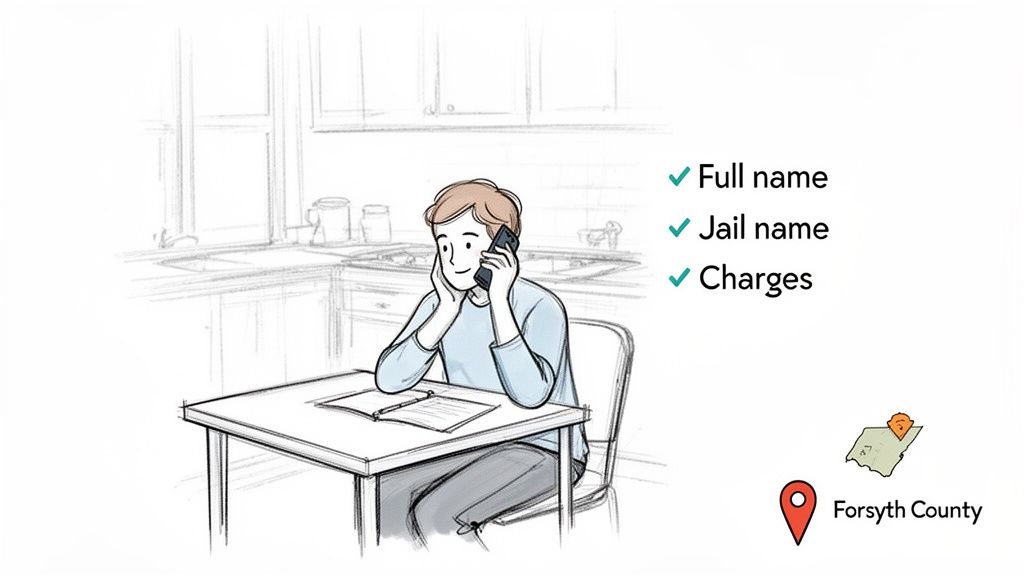
When the phone rings, the conversation is often brief and stressful. It’s important to slow down just enough to gather a few key pieces of information. Having these details ready when you call a professional bail bondsman in Forsyth County will make a significant difference and help the process move forward without delay.
Using a licensed bonding service is a common solution for families facing this situation. The goal is simple: provide a way for someone to be released from jail while they await their court date, even if the full cash amount is not available.
Gather the Essential Information
Your primary role during that first call is to get the facts. Do your best to confirm these three items before you hang up. If you miss a detail, don't worry—an experienced bondsman can often locate the necessary information.
- Full Legal Name and Date of Birth: Ensure you have their complete legal name, exactly as it appears on their identification. Nicknames will not work. Their date of birth is equally important for verification.
- Name of the Jail: Ask exactly where they are being held. In this area, it is often the Forsyth County Jail in Cumming or the Hall County Jail in Gainesville. It could also be a municipal jail in a city like Alpharetta or Johns Creek.
- The Charges: If they know, ask what charges they are facing. This information helps a bondsman understand the situation and anticipate the potential bail amount.
Having these three pieces of information—the person's full name, their location, and the charges—is the single most important step you can take to expedite the release. It allows a bonding agent to begin working for you immediately.
Your Next Step Is a Phone Call
Once you have the basic details, your next action should be to contact a reputable, local bonding company. Navigating this process alone can be confusing. A professional bondsman understands the procedures at local jails and can guide you through each step.
They will take the information you gathered, confirm the bail amount with the court, and clearly explain the fees and responsibilities involved in securing the bond. That initial conversation is designed to provide you with a clear plan. For a more detailed guide, see our post on what to do when someone gets arrested.
Remember, the objective in the first hour is not to solve everything at once. It's about taking calm, measured steps. By obtaining the correct details and calling for professional help, you are already moving toward bringing your loved one home.
Understanding Your Options: Cash Bail vs. a Bail Bondsman
After a judge sets the bail amount, you face a decision with immediate financial implications. There are two primary ways to secure someone's release from jail: paying the full amount in cash or working with a licensed bail bondsman. Understanding the difference is essential for making the right choice for your circumstances.
Many families first consider paying the court directly. While this is an option, it's important to understand what it entails before committing significant personal funds.
The Cash Bail Option
Paying a cash bail requires you to provide the entire bail amount directly to the jail or court. If bail is set at $10,000, you must deliver the full $10,000. This money serves as a guarantee that the person charged will appear for all required court dates.
If they attend every hearing, the court will refund this money after the case concludes. However, courts often deduct administrative fees from the refund, meaning you may not get the full amount back. The greatest challenge is that most people do not have thousands of dollars readily available, which can create a major financial strain and prolong the time your loved one remains in jail.
Working with a Bail Bondsman
This is where a bail bonding company can help, and it is the path most families choose because it is more financially practical.
Instead of paying the full bail amount, you pay the bondsman a non-refundable fee, known as the premium. This fee is a percentage of the total bail. For the same $10,000 bond, the premium would be a much smaller, more manageable payment.
Once the premium is paid and the paperwork is completed, the bonding company posts a "surety bond" with the court for the full bail amount. This bond is the bondsman’s promise to the court that the defendant will appear. If they do not, the bonding company is responsible for the full $10,000, not you. This is also why a co-signer is typically required—to share in that promise and financial responsibility. You can learn more about the difference between bail and a bond in our detailed guide.
A bail bond service makes it possible to secure a release for a fraction of the total cost. It bridges the financial gap, allowing families to bring their loved one home without depleting their savings or liquidating assets.
Comparing Your Options for Securing Release
To help you see the options more clearly, let's compare them side-by-side. Each path has very different financial requirements and outcomes.
| Factor | Paying Cash Bail Directly to the Court | Using a Bail Bondsman |
|---|---|---|
| Upfront Cost | You must pay 100% of the total bail amount. | You pay a non-refundable percentage (premium) of the total bail. |
| Financial Risk | Your entire cash payment is at risk if the defendant misses a court date. | The primary financial risk is transferred to the bonding company. |
| Refunds | The bail money is refundable (minus court fees) after the case is resolved. | The premium paid to the bondsman is non-refundable. |
| Speed & Process | You are responsible for handling the transaction and paperwork directly with the court. | The bondsman manages the process and paperwork with the jail on your behalf. |
As the table shows, a bondsman can remove much of the immediate financial pressure and procedural complexity from your shoulders.
It is also worth noting that for larger bonds, a bondsman might require collateral. This is a form of security—such as a vehicle title or property deed—to protect the bonding company if the defendant fails to appear in court. This is not always necessary and depends on the specifics of the case. A professional bondsman will be transparent and explain exactly what is needed for your situation from the start.
Navigating the Georgia Bail Bond Process
Once you decide to work with a bonding company, the situation becomes much more manageable. Instead of navigating the court system alone, you have an experienced local guide to handle the details. The process is designed to be clear and straightforward, beginning with a simple, confidential phone call.
This flowchart illustrates the two main paths to secure someone's release after an arrest.
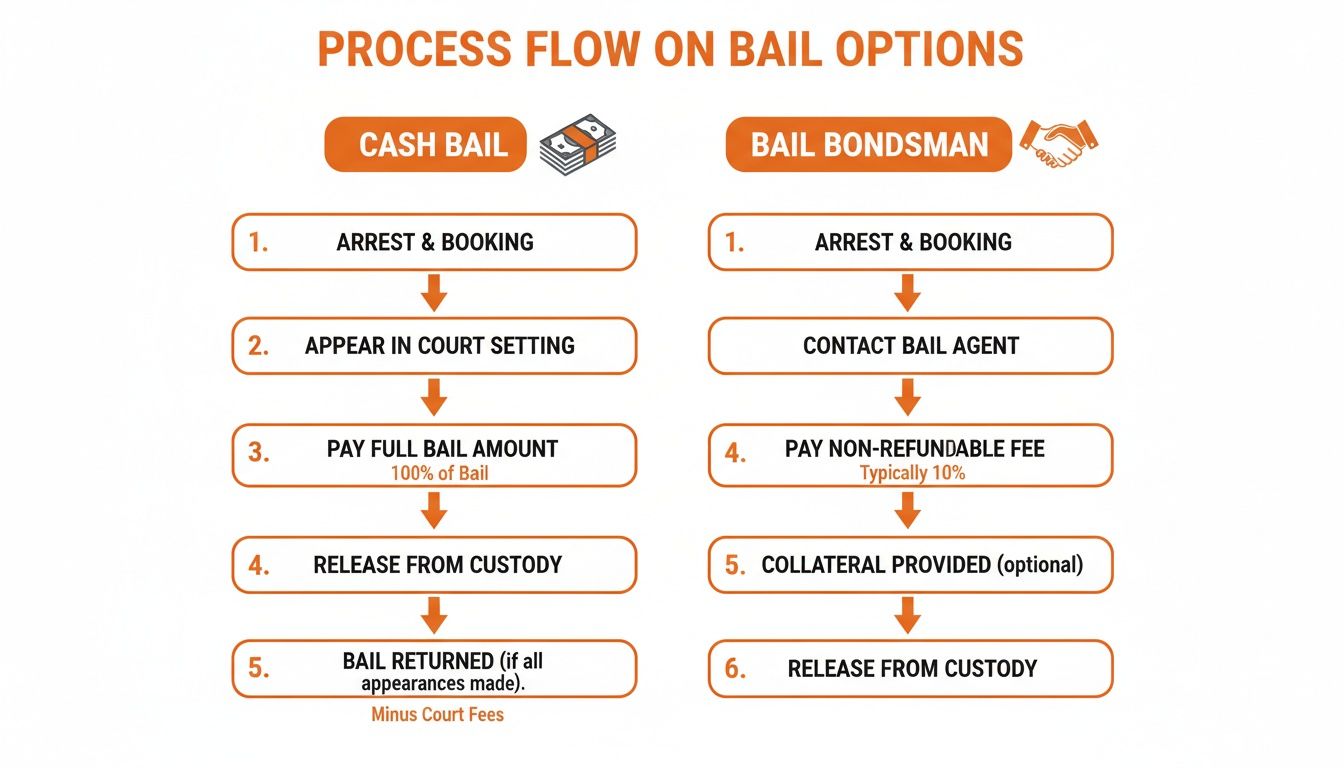
As you can see, a bail bondsman acts as an intermediary, which significantly reduces the immediate out-of-pocket expense compared to paying the full cash bail amount yourself.
Your Initial Call with the Bondsman
That first phone call with us is completely confidential. Our only focus is to get the process started—quickly and correctly. We’ll ask for the information you gathered earlier: the person’s full legal name, their date of birth, and which jail they’re in, such as the Forsyth County or Hall County facilities.
With just those few details, we can look up and verify the exact bail amount and any conditions the court has set. We understand you are under stress, so we take the time to calmly explain what to expect and answer every question you have. This call is all about establishing a clear plan.
Understanding the Co-Signer Paperwork
In nearly every case, a co-signer (also known as an indemnitor) is required to secure the bond. This is the person who agrees to be financially responsible for ensuring the defendant appears for all court dates. To make this official, we require some basic paperwork from the co-signer.
This typically includes:
- A valid, government-issued photo ID (like a driver's license)
- Proof of steady employment or income (a recent pay stub is sufficient)
We can often handle all of this over the phone and through email, so you do not have to make a special trip. Our goal is to make the paperwork process as simple as possible so we can move to the next step.
Handling the Premium Payment
The fee for using a bail bond service is a non-refundable payment called the premium. The amount is a set percentage of the total bail, regulated by Georgia law. For example, if bail is set at $5,000, the premium you pay is a much smaller, more affordable fraction of that number.
We are completely transparent about the cost. We will provide the exact amount upfront, with no hidden fees or surprises. We also accept various payment methods and can often work with you to find a solution that fits your budget. This payment authorizes us to post the full bond amount on your behalf.
The global bail bond services market is a $5.7 billion industry, which shows how many families rely on bondsmen to avoid lengthy pretrial jail stays. You can discover more insights about the bail bond services market size from Kentley Insights.
Posting the Bond at the Jail
As soon as the paperwork is complete and the premium is paid, our licensed bondsman goes directly to the jail to post the bond. Because we are a local Forsyth County bonding company, we are familiar with the procedures at the Forsyth County Jail in Cumming, as well as the facilities in Hall County, Alpharetta, and Johns Creek.
Our experience with these local jails means we know how to submit the bond correctly, avoiding common errors that can cause unnecessary delays. We manage this entire step for you.
The most important thing to remember is that you are not alone in this. From your first call until the bond is posted, our agent is managing every detail, freeing you up to focus on supporting your loved one.
The Timeline for Release
After the bond is officially posted with the jail, the final step is the release process itself. The time this takes can vary, depending entirely on the jail staff's workload at that moment. It's important to understand that this part of the process is managed by the jail, not the bonding company.
Release can take anywhere from a couple of hours to several hours. Based on our experience with that specific jail, we will provide a realistic estimate of the wait time and keep you informed. This way, you can be ready when your loved one is released.
The Co-Signer’s Role: Understanding Your Responsibilities
When you use a bonding company to bail someone out, you are almost always asked to be the co-signer—also known as an indemnitor. This is a serious commitment, so it is crucial to understand what you are agreeing to before signing. We ensure you have a clear picture of what is involved, with no confusion.
Think of a co-signer as the financial backstop for the bail bond. By signing the agreement, you are making a legally binding promise to the bonding company that the person being bailed out will appear for every court date. That promise is what makes the bail bond possible.
The Financial Guarantee Behind Your Signature
Your signature on the bond agreement is not just a formality; it has significant financial implications. It means you are accepting full financial liability for the entire bond amount if the defendant does not fulfill their obligations.
For example, if the court sets bail at $10,000 and the defendant misses a court date, you, the co-signer, become responsible for repaying that full $10,000 to our company. This is the core of a co-signer’s responsibility.
Because of this, we must verify that a co-signer is in a stable position to handle this potential debt. That is why we ask for a few basic items, such as:
- A valid photo ID to confirm your identity.
- Proof of employment to show a steady income.
- Your residency information to confirm you are established in the community.
This is not about prying into your finances. It is a standard procedure to secure the agreement, similar to co-signing for a loan. It ensures the guarantee we provide to the court is solid.
What Happens When Someone Fails to Appear in Court?
The single most critical event in the bail bond process is a "failure to appear" (FTA). This is when the defendant misses a required court date. An FTA immediately puts the bond at risk and initiates a series of serious consequences for everyone involved, especially the co-signer.
When the defendant does not appear, the judge issues a warrant for their arrest and begins the process of revoking the bond. This is when your role as the co-signer becomes central. We will contact you immediately to understand what happened and to help locate the defendant.
Your most important job as a co-signer is to do everything you can to make sure the defendant gets to court. That means staying in touch, reminding them of court dates, and making sure they understand the seriousness of their legal obligations.
The Financial Fallout of an FTA
If the defendant cannot be located and returned to court in a timely manner, the bond is officially forfeited. At that point, our company must pay the full bail amount to the court. We then turn to you, the co-signer, to recover that money, as outlined in the indemnity agreement you signed.
This is the worst-case scenario for a co-signer. Not only are you responsible for the full bail amount, but any collateral you provided to secure the bond—like a car title or property deed—could be used to cover the debt.
Our goal is to prevent the situation from ever reaching that point. We work with you from the beginning to ensure every court date is met. Understanding these responsibilities upfront helps you make an informed decision and highlights the importance of the defendant following through.
What Happens After They're Released?
The moment you bring your loved one home from jail is one of immense relief. However, it is crucial to remember that the bail bond process is not over—it continues until the case is officially closed. Release from jail is just the start of the next phase, which is focused on following the court's rules.
During this period, both the defendant and you, the co-signer, need to pay close attention to the details. This is the time to ensure everyone fully understands their obligations to the court and to us. A shared understanding now is the best way to avoid any issues that could jeopardize their freedom.
Fulfilling the Conditions of Release
Once released, the defendant must follow every condition the court has set. These are not suggestions; they are mandatory rules for their release. If even one condition is violated, the judge can revoke the bond, and they could be returned to jail.
Common conditions often include:
- Regular Check-ins: We typically require the defendant to check in with our office regularly, by phone or in person. This is a standard way for us to confirm they are still in the area and aware of their responsibilities.
- No New Offenses: This is straightforward—they must stay out of trouble and avoid any new arrests while on bail.
- Adherence to Court Orders: This could include anything from staying within Forsyth County, observing a curfew, or abiding by a no-contact order.
As a local bonding company, we make it a point to review these rules with our clients from the beginning. We are here to answer questions and provide reminders to help keep everything on track.
The Absolute Importance of Attending Court Dates
This is the single most important part of being out on bail: attending every single scheduled court appearance. There are no exceptions. This is the core promise made to the court when the bond was posted. Missing a court date, even accidentally, has immediate and serious consequences.
When someone fails to appear, the judge issues a bench warrant for their arrest. At the same time, the bail bond is forfeited, which means the co-signer is now responsible for the full bail amount. It is the worst-case scenario, and it is entirely avoidable with proper planning.
The success of the entire bail process hinges on one simple action: showing up for court. We encourage clients and co-signers to work together to track dates and arrange transportation well in advance to ensure compliance.
The good news is that people released on bail are generally very reliable. The Bail Project, a national nonprofit, reported a 92% court appearance rate for the tens of thousands of clients they have assisted. Their work shows that people consistently meet their obligations when given support. Here in Forsyth County, our goal is to provide that same clear guidance to help you navigate this process successfully.
Concluding the Bail Bond Agreement
The bail bond remains active for as long as the legal case is open. This could be a few months or, in more complex situations, a year or more. The responsibilities of both the defendant and the co-signer stay in place until the court officially resolves the case.
A case is typically considered closed when one of the following occurs:
- The charges are dropped.
- A "not guilty" verdict is reached.
- A plea agreement is accepted.
- The defendant is sentenced after being found guilty.
Once the court makes a final determination, the bond is dissolved, and all obligations are fulfilled. If you provided any collateral to secure the bond, it is returned to you at this time. For a closer look at this period, you might find our guide on what to expect when you're out on bail helpful. This final step marks the successful end of your journey with the bonding company.
Common Questions About Bailing Someone Out in Georgia
When you learn a loved one has been arrested, your mind is likely filled with questions. It is a confusing and stressful time, and uncertainty can make it worse. We have helped hundreds of families in Forsyth County through this exact situation, and we know that getting direct answers can provide a great sense of relief.
Our goal is to answer the questions we hear most often from families in Cumming, Alpharetta, and the surrounding communities to give you the clarity needed to move forward.
How Quickly Can Someone Be Released?
This is usually the first question people ask. The honest answer is that it depends entirely on how quickly the jail can process the release.
Once a licensed bondsman posts the bond at the Forsyth County Jail, the timing is completely in the hands of the jail staff. A release can happen in just a couple of hours, or it might take several. The timeline depends on how busy the jail is, if a shift change is occurring, and their specific procedures for that day.
An experienced local agent can provide a realistic time frame based on what we typically observe at that facility.
What Information Do I Need to Get Started?
You do not need to have every detail, but a few key pieces of information will help start the process much faster.
When you call, please try to have this information ready:
- The person’s full legal name and date of birth.
- The name of the jail where they are being held (e.g., Forsyth County Jail).
- The charges, if you know them.
Do not worry if you are missing a piece of information. A professional bondsman can usually help locate what is needed.
The most important thing to remember is that you don't need all the answers before you pick up the phone. A quick call with the basics is all it takes to get us started and provide you with clear next steps.
Can We Arrange Everything Over the Phone?
Yes. In most situations, the entire bail bond process can be handled over the phone or by email. We understand that arrests happen at inconvenient times, and you may not be able to drive to an office in the middle of the night.
We can manage all the necessary paperwork, such as the co-signer agreement, and process the payment securely and remotely. This allows us to begin working on the release immediately, no matter where you are.
Are You Really Available 24/7?
Yes. Arrests do not follow business hours, and neither do we. Our agents are on call 24 hours a day, 7 days a week, ready to help families in Forsyth County, Cumming, Alpharetta, Johns Creek, and Hall County.
This constant availability means you can get help the moment you need it, which is critical for starting the release process without delay. When you call, you will speak directly with an agent who is ready to assist.
What Happens if We Miss a Court Date?
Missing a court date is a serious issue that should be avoided at all costs. If it happens by mistake, the most important thing to do is call the bonding company immediately.
When a court date is missed, the judge will issue a warrant for the defendant’s arrest, and the bail bond is put at risk. If you call us right away, we can often work with you to resolve the situation with the court, which can help avoid another arrest and the financial consequences for the co-signer. In these moments, prompt communication is essential.
Navigating the bail process is much easier when you have an experienced local guide. At Best Bonding Forsyth, we provide the clear answers and steady support needed to bring your loved one home. Call us now to get clear next steps and start the process.
Learn more about our services at https://bestbondingforsyth.com.