
When a judge in Forsyth County requires GPS ankle monitoring as a condition of release, it's natural to feel overwhelmed. It is important to understand this is not a punishment. Instead, it's a tool the court uses to allow someone to return home, keep their job, and take care of their family while their case proceeds—offering a path to normalcy instead of remaining in jail.
Understanding GPS Ankle Monitoring as a Bail Condition
If a loved one has been ordered to wear a GPS ankle monitor in Forsyth County, you likely have many questions. This is a standard procedure in certain cases, intended to balance a person's freedom with the court's need to ensure they appear for future hearings. At Best Bonding Forsyth, we help families in Cumming, Alpharetta, and Johns Creek navigate these requirements every day, offering calm, clear guidance.
The primary function of a GPS monitor is simple: to confirm that a person is following the rules the court has established. It is a sign of trust that allows someone to be at home with their family instead of behind bars.
The Purpose Behind the Device
A judge might order electronic monitoring for a few key reasons, all focused on managing risk and ensuring someone adheres to their bail terms. This decision is not related to guilt—it is simply a condition for being released before trial.
Here are the main reasons courts use this tool:
- Ensuring Court Appearances: The monitor provides a significant incentive for an individual to attend all scheduled court dates.
- Enforcing Geographic Restrictions: A court can create "inclusion zones" (like a home or workplace) and "exclusion zones" (places the person must avoid). The GPS device tracks whether these boundaries are respected.
- Community Safety: For certain cases, the monitor adds an extra layer of reassurance for the community while a case is ongoing.
- Alternative to Incarceration: It is a much less restrictive option than jail, allowing people to maintain employment and stay connected with family, which is beneficial for everyone involved.
Think of GPS ankle monitoring as a temporary, digital form of checking in. It allows the legal process to continue while enabling the accused person to live their life within court-defined limits, a common practice in jurisdictions like Forsyth and Hall County.
As a local Forsyth County bonding company, our role is to make this process less confusing for you. We will explain what the court order means, help you understand the responsibilities that come with it, and ensure the bail process moves forward without unnecessary stress. This is a manageable step, and we're here to provide your family with the steady support and clear information you need.
How the Ankle Monitoring Technology Works
The term "GPS ankle monitoring" can sound intimidating, but the technology itself is quite straightforward. The simplest way to think about it is like a dedicated, secure smartphone whose only job is to report its location. It is a reliable system designed to meet court requirements while allowing someone to return to their life in communities like Cumming or Alpharetta.
The system relies on three key components working together: the device worn on the ankle, the GPS satellites orbiting the Earth, and a secure monitoring center that receives and logs the location data.
The Core Components of GPS Tracking
Each piece of this system has a specific role to ensure the tracking is accurate and dependable. The ankle device itself is built to be durable—it is tamper-resistant and water-resistant, so daily activities like showering are not an issue.
- The Ankle Device: This unit contains a GPS receiver to capture signals from satellites and a cellular transmitter (similar to a cell phone) to send that location data back to the monitoring center.
- GPS Satellites: This is a global network of satellites that provides positioning data, allowing the device to calculate its precise location as long as it has a clear view of the sky.
- The Monitoring Center: This is the central hub where trained staff receive location updates, establish approved zones (like home or work), and get immediate alerts for any issues, such as a low battery or if someone leaves an approved area.
This diagram helps visualize how the ankle monitor allows for a return to daily life by confirming a person is at approved locations, such as home and work.
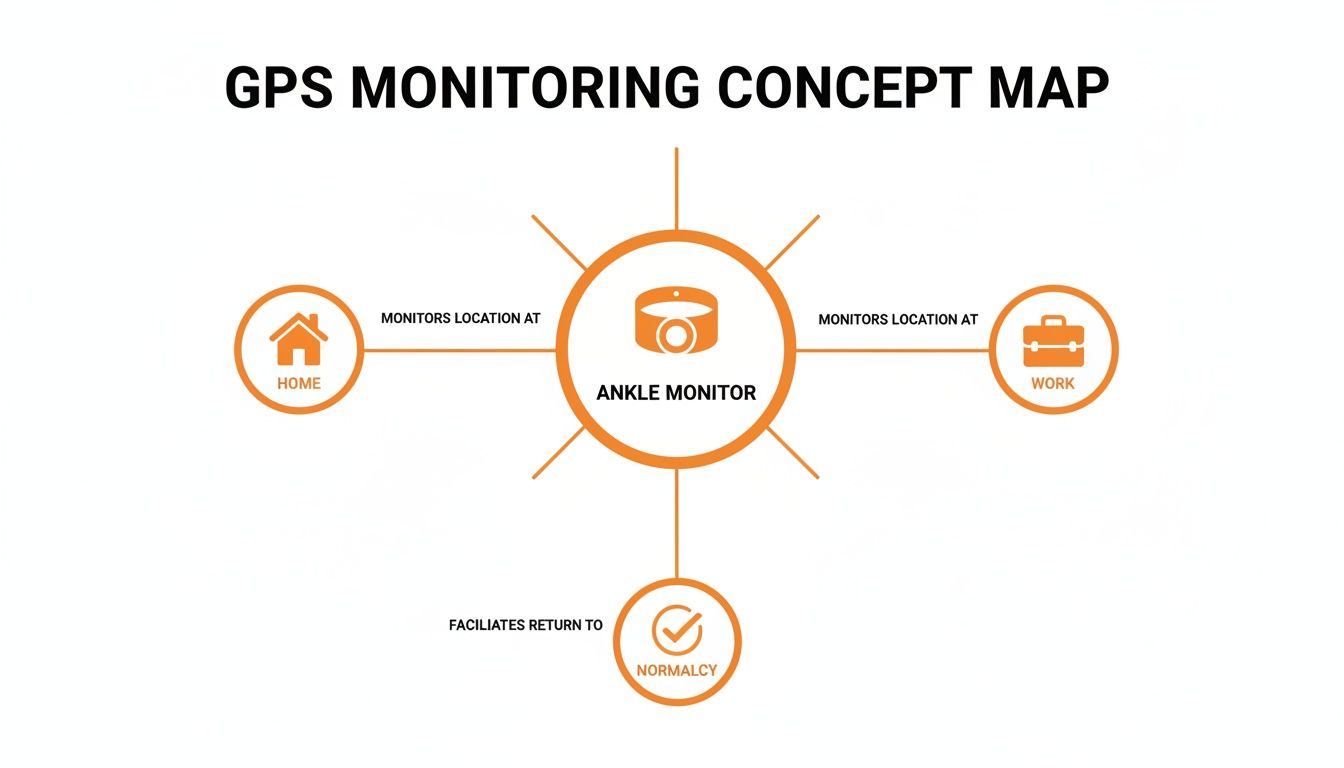
As you can see, the technology is simply a tool to help someone demonstrate responsibility and maintain a sense of normalcy while out on bond.
Active vs. Passive Monitoring
It is helpful to understand the two main types of monitoring a court in Forsyth or Hall County might order. The most common is active monitoring. This means the device sends location data to the monitoring center in near real-time, typically every few minutes. It provides the monitoring service with a continuous, live view of a person’s whereabouts.
The other option is passive monitoring. With this method, the device still tracks location constantly but only uploads the data periodically—perhaps once or twice a day when connected to a charger or a landline. It is a less intensive form of tracking. For more details, you can review our guide that explains the different types of ankle monitors.
GPS is the standard for good reason. GPS-based solutions held a dominant 67.60% market share of the global electronic monitoring industry in 2025. Courts and monitoring agencies prefer it because its real-time accuracy is far superior to older radio-frequency (RF) systems. Recent technological improvements have also boosted battery life to 7-10 days and made the signals more reliable, even in challenging areas.
At its core, the ankle monitor is a communication tool. It communicates location, compliance with boundaries, and its own operational status (like battery life) to a monitoring service, providing the court with the necessary assurance to grant pretrial release.
Ultimately, the goal is simple. The technology creates a clear, verifiable record of a person's movements, proving they are following the court’s orders. That is the entire purpose of having it as a condition of bail.
Responsibilities While on Electronic Monitoring
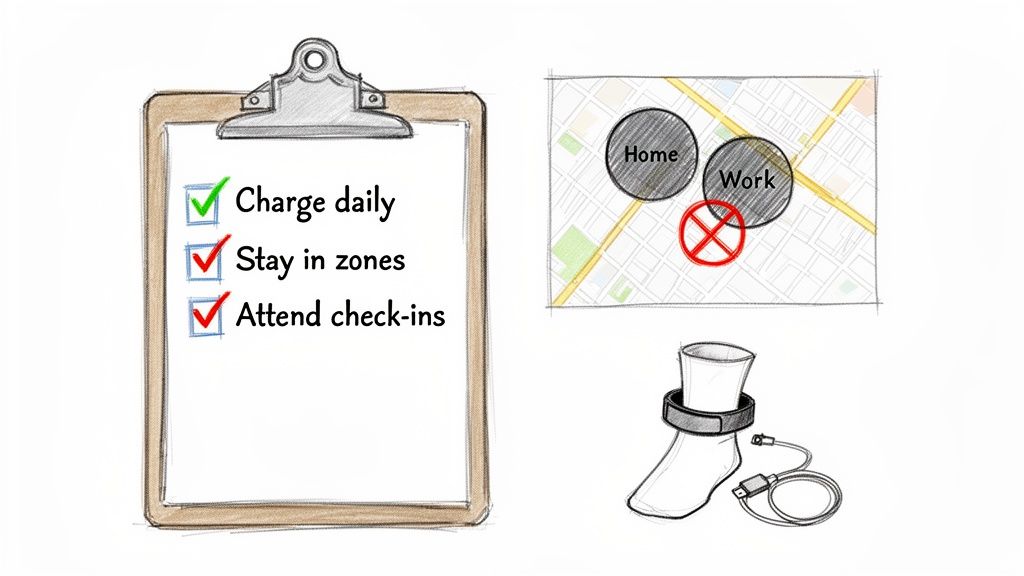
When a person is placed on GPS ankle monitoring, success depends on understanding and following the rules set by the court. The specific conditions can vary from case to case, but the primary responsibilities are generally consistent. Viewing it as a simple daily checklist is the best way to reduce stress and maintain compliance.
At Best Bonding Forsyth, we make sure families in Forsyth County, Cumming, and the surrounding areas know exactly what to expect. The goal is to complete the monitoring period without any issues, which starts with knowing the rules.
Core Obligations for Compliance
These are the non-negotiable requirements that must be followed every day. Building a solid routine around them is the easiest way to stay on track and avoid accidental violations. The monitoring service will provide detailed instructions, but these three duties are always at the top of the list.
- Keep the Device Charged: It is your responsibility to charge the monitor daily. A charger will be provided, and the device will indicate its battery level. Allowing it to lose power is considered a serious violation.
- Respect Geographic Boundaries: The court order will specify certain zones. Inclusion zones are places you are permitted to be, such as your home or work. Exclusion zones are areas you must stay away from, like a specific address or neighborhood. Crossing these lines, even briefly, sends an immediate alert.
- Attend All Scheduled Check-ins: You may have required check-ins with a probation officer or monitoring agent. Missing these appointments is a violation of the terms of release.
For a deeper look into the specifics, you can learn more about the common ankle monitor rules and how to adhere to them.
What Is Considered Device Tampering?
Simply put, any action taken to interfere with the device's function is considered tampering. Courts and monitoring agencies take this very seriously, as it undermines the purpose of the monitor. It is essential to avoid any action that could be interpreted as tampering.
An ankle monitor is a tool of trust granted by the court. Any action that breaks that trust, such as tampering or ignoring zone boundaries, can result in the immediate revocation of bail and a return to custody.
Common examples of tampering include:
- Attempting to cut, stretch, or remove the strap.
- Submerging the device in water for an extended period.
- Placing any object between the device and your skin.
- Attempting to block the GPS signal (e.g., wrapping it in foil).
- Trying to open or disassemble the device casing.
To help clarify what is expected, here is a summary of standard rules and the consequences for violating them.
Common GPS Monitoring Rules and Consequences
| Rule or Responsibility | What It Means | Potential Consequence of Violation |
|---|---|---|
| Daily Charging | You must charge the monitor's battery every day, typically for 1-2 hours, to ensure it remains active. | A "low battery" alert is sent. If it dies, it is considered a violation that may lead to a warning or a warrant. |
| Stay Within Inclusion Zones | You must remain within your approved geographical areas (e.g., home, work, school) during specified hours. | An alert is triggered, and your supervising officer is notified immediately. This could lead to revocation of the bond. |
| Avoid Exclusion Zones | You are forbidden from entering specific locations, such as a particular residence or part of town. | This is a serious violation. It triggers an immediate alert and can result in arrest and return to jail. |
| No Tampering | Do not attempt to cut, remove, block, submerge, or otherwise interfere with the device or its signal. | Any tampering alert is treated as a willful violation. This almost always results in immediate arrest and forfeiture of the bond. |
| Communicate Schedule Changes | You must get advance permission from your supervising officer for any necessary trips outside your approved zones (e.g., doctor's visit). | An unapproved trip triggers a zone violation. Failure to communicate is seen as non-compliance and can lead to penalties. |
Knowing these rules beforehand makes the entire process more manageable.
How to Avoid Accidental Violations
Most violations are not intentional; they typically result from simple oversights. The best defense is a structured routine. Set a specific time each day to charge the device, just as you would with your phone.
Take a few minutes each morning to review your approved zones and schedule. If you have a doctor’s appointment or need to run an errand outside your normal areas, you must get it pre-approved by your monitoring officer. Proactive communication goes a long way and is key to ensuring everything proceeds smoothly.
Why Forsyth County Courts Order GPS Monitoring
When a judge in Forsyth County—or a neighboring area like Hall County—orders GPS monitoring, it is important to understand that this decision is not about guilt. It is a standard tool courts use to manage risk.
Courts often view GPS ankle monitoring as a practical middle ground. It balances community safety with a defendant's right to be out on bond, allowing them to go home and maintain employment while their case moves forward.
Factors Influencing the Decision
A judge considers several factors to decide if electronic monitoring is appropriate for a particular case, ensuring the release conditions are suitable for everyone involved.
- The Nature of the Charge: For certain charges, a judge may want an extra layer of supervision to ensure court orders—like staying away from a person or place—are followed precisely.
- An Individual's Past History: A person’s background can play a role. A judge may use monitoring to add structure and accountability during the pretrial period, especially if there are past concerns.
- Ties to the Community: Having a steady job in Cumming or a long-time home in Alpharetta indicates a person is not a flight risk. If those ties are weak, a judge might see monitoring as a way to ensure they attend court dates.
The decision to order GPS monitoring is a calculated one, aimed at ensuring compliance with bail conditions. It is a tool that allows the judicial process to move forward while permitting the accused to live at home rather than remain in custody.
A Standard Tool for Accountability
Using GPS ankle monitors has become common as the justice system seeks alternatives to pretrial incarceration. It provides courts with a reliable way to supervise someone on bond and creates a clear record of their compliance.
This technology is seen as a way to promote accountability and ensure court appearances. Its effectiveness is a major reason for its widespread use. The GPS monitoring market has grown because it offers a cost-effective solution for busy legal systems. Studies show that individuals on this type of monitoring are 89% less likely to miss court appearances than those on traditional bail, with compliance rates often reaching 95% in well-managed programs. To get more details, you can learn about current ankle monitor trends.
Understanding that GPS monitoring is a standard legal tool can help ease the anxiety your family may be feeling. It is a structured path that allows life to continue with some normalcy during a difficult time. At Best Bonding Forsyth, we help families make sense of these court orders and navigate the process with confidence.
Navigating the Costs and Logistics of Monitoring
For most families, the practical aspects of GPS ankle monitoring—the cost and the setup process—are a significant source of stress. Understanding these logistics early on can bring much-needed clarity. At Best Bonding Forsyth, we make it a point to walk our clients through exactly what to expect, so there are no surprises.
One of the first questions we receive is, "Who pays for this?" The answer is straightforward: in nearly every case, the defendant or their family is responsible for all associated costs. These payments are made directly to a private monitoring company approved by the Forsyth County court, not to our company or the court itself.
This financial responsibility is a condition of pretrial release. While the court orders the monitoring, a third-party company manages the technology and ensures the rules are being followed.
Understanding the Financial Commitment
The costs for GPS ankle monitoring are typically broken into two parts. The exact figures can vary depending on the company and the judge's order, but the structure is generally standard.
You should be prepared for two main expenses:
- A One-Time Setup Fee: This is an upfront payment to create the account and activate the device. It is usually due before the monitor is installed.
- A Recurring Monitoring Fee: This is an ongoing fee, often billed daily or weekly, which covers the technology, data, and 24/7 supervision from the monitoring center.
The daily fee can range from $10 to $35 per day, which can add up over time. It is crucial to budget for this ongoing expense for the duration of the monitoring period. If you would like to explore this further, you can learn more about the costs of ankle monitors in our detailed guide.
When planning for bail, it is important to factor in these additional monitoring costs. Staying current with these payments is essential for meeting all conditions of release, which is key to keeping the legal process on track.
The Installation and Removal Process
Another common concern is how the device is installed and removed. The process is designed to be simple and is always handled by trained professionals from the monitoring company.
Installation usually occurs in one of two ways. Often, a representative from the monitoring company will meet you at the jail upon release. Alternatively, you may be required to go directly to the monitoring company’s local office in or near Forsyth County to have the device fitted.
During the initial appointment, a technician will securely attach the monitor to your ankle. They will also provide a full explanation of how everything works, including:
- How to charge the device correctly.
- What the different lights and sounds indicate.
- Who to contact if you have questions or a technical issue.
The removal process is even simpler. Once the court officially ends the monitoring period, you will return to the monitoring company’s office. A technician will remove the device, and your daily payments will cease.
How We Help You Navigate Monitoring Requirements
When a court orders GPS monitoring, it adds another layer to an already stressful situation. This is where our local experience is a significant advantage. At Best Bonding Forsyth, we help families navigate the entire bail process, including any ankle monitor requirements the court may add.

It is important to be clear about our role. While we do not provide the monitoring devices, our deep familiarity with the Forsyth County and Hall County court systems means we can guide you through the process smoothly. We are your first call for straightforward answers and a clear plan of action.
Your Local Guide Through the Process
Trying to understand court orders while coordinating with a separate monitoring company can be overwhelming. We cut through that confusion, offering patient, professional guidance that comes from years of experience working within the local system. Our only goal is to ensure you meet every condition for a smooth and prompt release.
Here’s how we help:
- Explaining the Court Order: We will break down the judge’s order so you understand every detail, from exclusion zones to curfews.
- Connecting You with Providers: We can direct you to the court-approved monitoring companies that serve Forsyth, Hall, and the surrounding North Metro Atlanta communities.
- Ensuring Compliance: We make sure you know exactly what is required so all conditions of the bond are met, preventing frustrating delays or issues.
Think of us as your calm, experienced guide. We have helped hundreds of families in Cumming, Alpharetta, and Johns Creek manage these exact requirements, and we are here to provide that same steady support.
Our role is to provide clarity and direction. We translate complex court requirements into simple, actionable steps, ensuring you feel confident and prepared to meet every obligation of your pretrial release.
Why Compliance is Key
Using a GPS ankle monitor is a common and established practice for ensuring someone follows the rules of their release—not just in Georgia, but across the country. The concept is simple: verify that a person is adhering to their release conditions. This principle is fundamental to the bail process and is even used in large-scale federal programs.
For example, U.S. Immigration and Customs Enforcement (ICE) supervises over 183,000 people through its Alternatives to Detention program, recently mandating GPS monitors whenever possible. This large-scale implementation demonstrates how effective the technology is at ensuring compliance—the same goal a local court has when setting bail conditions. You can discover more about the expanding use of ankle monitors to see how widespread this has become.
If you are feeling lost or overwhelmed by a GPS monitoring requirement, please call us. We are available 24/7 to answer your questions and help you take the right next steps.
Frequently Asked Questions About GPS Ankle Monitoring
Being required to wear a GPS ankle monitor brings up many practical, day-to-day questions. Getting clear answers can help reduce stress and provide a sense of control during a difficult time. Here are calm, direct responses to the most common concerns we hear from families in Forsyth County.
Our goal is to give you immediate clarity on the real-world issues you might face with this court-ordered condition.
Can I go to work while wearing a GPS ankle monitor?
In most cases, yes. The court's primary goal is often to allow individuals to maintain their employment and support their families while their case is pending. The release order will outline approved "inclusion zones," which are specific areas you are permitted to be.
These zones almost always include your home and your workplace. As long as you stay within those boundaries and follow any curfew hours, you can typically continue your normal work routine. It is essential to fully understand these boundaries to avoid an accidental violation.
Is the ankle monitor waterproof?
Yes, modern GPS ankle monitors are designed to be highly water-resistant. You can shower and perform normal daily hygiene routines without issue. They are built to handle everyday exposure to moisture.
However, water-resistant is not the same as waterproof. The devices should never be fully submerged for long periods. This means activities like swimming or taking a bath are generally not permitted. Always ask about specific device limitations during your setup appointment with the monitoring company.
What happens if the monitor battery dies?
Keeping the device charged is one of your most important responsibilities. The monitoring company will provide a specific charger and clear instructions on how to maintain a full battery. If the battery level becomes critically low, it sends an automatic alert to the monitoring center.
If the battery dies completely, the court considers it a serious violation of your release conditions. A dead battery creates a gap in the location data, which can lead to a warrant for your arrest. The best way to avoid this is to create a simple, daily charging routine, such as plugging it in every evening upon returning home.
A dead battery is not treated as an accident—it is viewed as a failure to follow a direct court order. Making battery charging a non-negotiable part of your daily routine is the best way to avoid this serious and preventable violation.
Who pays for the GPS monitoring service?
The defendant or their family is almost always responsible for paying all costs associated with the GPS monitoring service. It is an important expense to factor into your budget during the bail period.
These payments go directly to the private monitoring company that provides the device, not to the court or the bail bond company. The costs typically include an initial setup fee plus an ongoing daily monitoring fee. Staying current on these payments is a mandatory condition of your pretrial release.
At Best Bonding Forsyth, we know that court-ordered monitoring adds another layer of stress to an already difficult situation. If you need help making sense of the bail process in Forsyth, Hall, or surrounding counties, we are here to provide clear explanations and guide you through it. Call now to get the patient, professional help you need.