
When a court orders an ankle monitor, it can be an intimidating part of the process. It's helpful to understand that these rules are not designed as a punishment. Instead, they are a tool the courts in places like Forsyth County use to allow someone to remain at home while their case moves forward, ensuring all legal requirements are met.
Understanding Ankle Monitoring as a Bail Condition
Being placed on electronic monitoring might seem overwhelming at first, but it is a common condition that allows you to be at home instead of in jail. Think of it as a temporary set of boundaries meant to ensure you make it to all your court appearances. At Best Bonding Forsyth, we help families in Forsyth and Hall County navigate these rules every day, offering calm guidance and 24/7 support.
This guide provides a clear overview of what ankle monitor rules generally mean in Georgia. Our goal is to explain the process, cover the most common requirements, and give you the information needed to handle this part of your case with confidence.
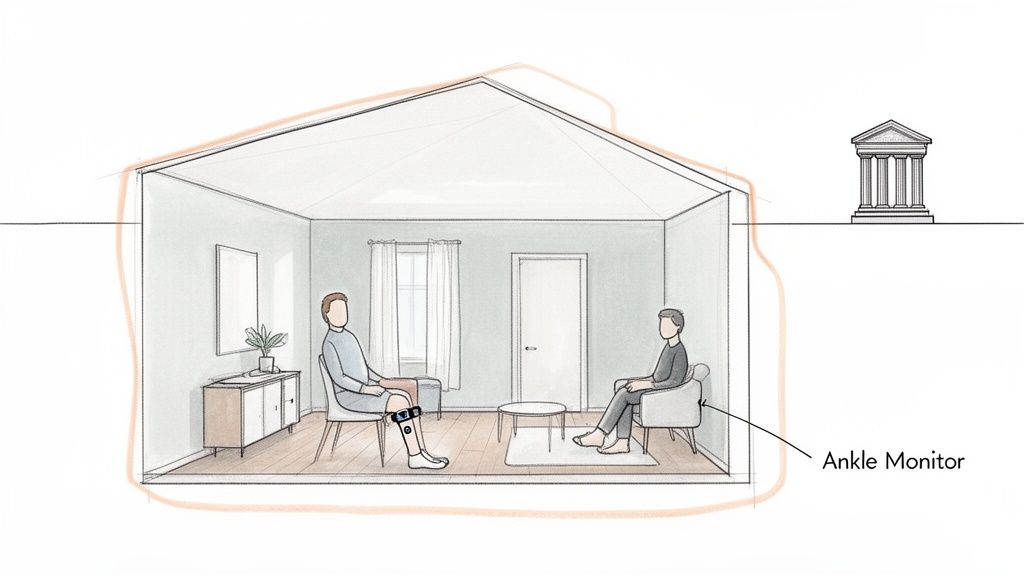
The Purpose of Electronic Monitoring
When a judge in Cumming, Alpharetta, or Johns Creek requires an ankle monitor as a condition of bail, the primary goal is to find a balance. The court needs to ensure public safety and a return to court while respecting a person's freedom. The device itself is simply the tool used to maintain that balance.
It gives the court a reliable way to verify that you are following the specific terms they have set. These terms are not chosen randomly; they are directly related to the specifics of the case and are designed to lower potential risks. For example, a curfew ensures you are home at night, and location tracking confirms you are not going into areas you have been instructed to avoid.
The core idea behind electronic monitoring is accountability. It offers a structured alternative to being in jail, allowing people to keep jobs, attend school, and support their families while awaiting trial.
What This Means for Your Daily Life
Adjusting to an ankle monitor requires a clear understanding of the rules and a commitment to following them. While it does place limits on where you can go, it is best viewed as a manageable step in the legal process.
The rules typically cover a few key areas:
- Geographic Boundaries: You will have approved places you can go, often called "inclusion zones," which usually include your home, workplace, or lawyer's office. At the same time, there will be "exclusion zones" that you are strictly forbidden from entering.
- Curfews: You will likely be required to be at your home during specific hours, almost always overnight.
- Device Maintenance: It is your responsibility to keep the device charged and in good working order. Allowing the battery to die is almost always considered a violation.
- Tampering Prohibitions: Any attempt to remove, damage, or interfere with the device is a serious violation that will have immediate consequences.
Understanding these foundational rules is the first and most important step to navigating this period without any issues.
Your Immediate Next Steps for Ankle Monitoring
When a judge orders electronic monitoring as part of bail conditions in Forsyth County, knowing what to do first can make a significant difference. It is easy to feel overwhelmed, but a few proactive steps will help you stay in control of the situation.
The rules are not one-size-fits-all; they are specific to your case. The key is to get clear, personalized information right from the start. By handling this methodically, you can ensure everything is done correctly from day one.
The First Phone Calls You Should Make
Before an ankle monitor is attached, there are two important calls you should make. Getting your questions answered now will help prevent simple mistakes later.
Confirm the Specifics with Your Attorney: Your lawyer is your best resource for understanding the exact legal terms of your release. They can explain the court-ordered rules, such as your curfew hours, approved travel zones for work or school, and any “exclusion zones” you are required to avoid.
Discuss the Process with Your Bail Bonds Agent: A professional bail agent, like the team at Best Bonding Forsyth, can walk you through the practical side of things. We can provide general information about which monitoring companies the court may use and what to expect during the setup process.
These two conversations can provide a complete picture—covering both the legal rules and the real-world steps you need to take.
It’s important to remember that the court, the monitoring company, and your bail agent are all separate entities. Knowing who does what helps you ask the right person the right questions, so you get accurate information quickly.
Preparing for the Monitoring Equipment
Once you know the rules, it's time to prepare for the device itself. The monitoring company will provide specific instructions, but you can get a head start.
First, find a reliable place in your home to charge the monitor. The device needs to be charged every day, usually for 1-2 hours. A dead battery is almost always treated as a serious violation, so this is a critical responsibility.
Next, get your documents in order. The monitoring company will likely need to see proof of your address and work schedule to program your approved locations. Having this information ready can make the installation appointment more efficient. If you need help understanding what to expect during this process in Cumming, Alpharetta, or the surrounding North Metro Atlanta area, we are here to help. Call Best Bonding Forsyth for clear next steps.
How RF and GPS Ankle Monitors Actually Work
When a court orders electronic monitoring, understanding the technology can help reduce stress. The good news is that the device isn't as complicated as it sounds. Here in Forsyth and Hall County, the courts generally use one of two main types of ankle monitors to ensure compliance with bail conditions.
Each system has a different function. One acts like a simple alarm to confirm you are at home when you are supposed to be. The other works more like the map on your phone, tracking your location across a wider area. Knowing which one you have been assigned is key to understanding the specific rules you will need to follow.
The Two Main Types of Monitoring Technology
The two systems you will encounter are Radio Frequency (RF) and Global Positioning System (GPS). While both involve a device worn on your ankle, they function in different ways and are used for different reasons.
Radio Frequency (RF) Monitors: Think of an RF monitor as a digital tether to your home. The system includes two parts: the ankle bracelet itself and a small base station that you set up in your house. The base station plugs into a wall outlet and connects to a phone line or cellular network, and it constantly communicates with the bracelet. Its only job is to ensure the ankle device stays within a specific range—usually about 50 to 150 feet—of the base. RF monitors are typically used to enforce house arrest or a curfew.
Global Positioning System (GPS) Monitors: A GPS monitor works much like the navigation system in your car or on your smartphone. It uses satellites to pinpoint your location in near real-time, 24 hours a day. This technology is used when the court needs to do more than just enforce a curfew. A GPS device can be programmed with approved "inclusion zones," like your job or school in Cumming, and restricted "exclusion zones," like a specific address or neighborhood. If you enter an exclusion zone or leave an inclusion zone outside of approved times, an alert is sent to the monitoring company.
Let's quickly break down the key differences between these two common types of ankle monitors.
Comparing RF and GPS Ankle Monitors
| Feature | Radio Frequency (RF) Monitor | GPS Monitor |
|---|---|---|
| Primary Function | Curfew/Home Confinement | Real-Time Location Tracking |
| How It Works | Connects to an in-home base station | Uses satellites to track location anywhere |
| Range | Limited (50-150 feet from base) | Virtually unlimited (anywhere with signal) |
| Common Use Case | Ensuring someone is home at specific times | Tracking movement, enforcing exclusion zones |
Ultimately, both are designed to help the court supervise a defendant, but the technology they use is tailored for different supervisory needs.
The visual guide below shows the first few steps you should take when facing an ankle monitoring requirement, starting with talking to your attorney and your bail bonds agent.

Getting clear legal and practical guidance upfront is critical before the device is even installed.
Why GPS Monitoring Has Become So Common
While both technologies are still in use, you are more likely to see a GPS monitor today. This shift is due to the flexibility and detailed data that GPS provides the courts. The use of ankle monitors has grown significantly in the U.S. over the last two decades. The number of people supervised with these devices increased by nearly 140 percent in just ten years, from 53,000 in 2005 to over 125,000 by 2015.
That growth was driven almost entirely by GPS technology. This means that today, more people on bail are subject to real-time location tracking rather than simple curfew checks. For more information on specific models and how they operate, you can learn about the different types of ankle monitors in our complete guide.
Here's the most important thing to remember: the type of monitor you get directly reflects what the court needs to verify for your release. An RF device is about presence at one specific location. A GPS device is about tracking your movement throughout the community.
Understanding that difference is the first step toward successfully managing your monitoring period. It clarifies what is expected of you and helps you build a daily routine that ensures you remain in full compliance with the ankle monitor rules for your case, whether you're in Forsyth County, Alpharetta, or Johns Creek.
The Most Common Ankle Monitor Rules in Georgia
While every case is different, the conditions for wearing an ankle monitor in Georgia usually follow a standard set of rules. Understanding these ahead of time helps you build a routine and avoid a simple mistake that could cause a major problem.
These rules are not meant to be confusing. They are straightforward instructions designed to show the court that you are responsible, which helps your case move forward positively.
Maintaining Your Curfew
The curfew is one of the most basic rules. It simply means you must be at your approved home address during certain hours, almost always overnight.
If you are wearing an RF monitor, the base station in your home confirms you are there. For GPS monitors, the device just needs to see you are within the boundaries of your property. Being even a few minutes late can trigger an alert, so punctuality is essential.
Keeping the Device Charged
You are 100% responsible for keeping the monitor's battery charged. If it dies, the monitoring company cannot track your location, and that is almost always treated as a serious violation. This is one of the easiest rules to follow, but it is also one of the easiest to forget.
Most monitors need to be charged for 1-2 hours every day. The best way to handle this is to make it part of your daily routine, just like charging your phone. Set a recurring alarm on your phone until it becomes a habit.
Think of the battery on your monitor like the gas gauge in your car. You wouldn't let it run to empty. Charging it proactively is the only way to prevent an avoidable problem.
Managing Inclusion and Exclusion Zones
If you are on a GPS monitor, your movements will be governed by different zones that control where you can and cannot go. Knowing these zones is absolutely critical.
- Inclusion Zones: These are the places you are allowed to be. This includes your home in Forsyth County, your job in Cumming, your lawyer's office, or your school. You will have to provide the exact addresses and stick to an approved schedule.
- Exclusion Zones: These are "no-go" areas. You are strictly forbidden from entering them. They are usually tied to your case, such as the home or workplace of a complainant. Entering an exclusion zone, even for a moment, sends an instant, high-priority alert.
It is your responsibility to know these boundaries and plan your travel routes to avoid any issues.
No Tampering or Obstruction
This rule is non-negotiable: any attempt to remove, damage, or interfere with the ankle monitor is a major violation. That includes trying to cut the strap, submerging it in water, or wrapping it in something to block the signal. These devices are built with sensors that will immediately alert the authorities if the strap is cut or the signal is lost in a suspicious way.
This rule also means no one else should handle the device. You are the only person who should be charging, cleaning, or otherwise touching it. Taking ownership of these tasks is a key part of what is known as pretrial supervision, where you are expected to actively participate in your own monitoring. You can get more information by reading our guide on what is pretrial supervision and what it involves.
Communicating with the Monitoring Company
Finally, you must stay in communication with the monitoring company. That means answering their calls and responding quickly if you receive an alert or notification.
If you have a doctor's appointment or your boss asks you to stay late, you need to clear it with them beforehand so they can adjust your schedule. Being proactive and honest shows you are taking this responsibility seriously and can often prevent a minor mix-up from becoming a full-blown violation. Good communication is a simple but vital part of managing this period successfully.
What Happens When a Monitoring Rule Is Broken?
One of the biggest concerns that comes with an ankle monitor is the fear of an accidental mistake. What if the battery dies unexpectedly? What if a family emergency requires you to leave your approved zone? These are valid concerns, but the consequences are often more reasonable than people might think.
A violation does not automatically mean you or your loved one will be returned to jail. The system is built to send an alert, but the first step is often a phone call, not a warrant. Understanding how the process works can help you handle these moments correctly and keep a small issue from becoming a large one.
The First Step: An Alert, Not an Arrest
When something goes wrong—the battery dies, the strap feels loose, or you accidentally enter an exclusion zone—an instant alert is sent to the monitoring company. This private company is the first line of response, and their job is to determine what happened.
For simple issues like a low battery warning or a temporary loss of GPS signal, their first action is almost always a phone call. If you answer right away and explain the situation, you can often clear things up on the spot. This is why it is critical to keep your phone charged and with you at all times.
How Different Violations Are Handled
Not every mistake is treated the same way. Authorities in Forsyth County generally look at whether a violation was a simple technical problem or a deliberate choice to break the rules.
- Technical Violations: These are usually minor and often unintentional. Examples include a dead battery, a brief signal loss, or arriving home a few minutes past curfew. For a first-time issue, these typically result in a warning.
- Substantive Violations: These are more serious. Entering a forbidden area, attempting to remove the device, or not returning home at all are major violations. These actions will almost certainly be reported to the court or supervising officer and could lead to a bond revocation hearing.
The most important thing to remember is that how you react after an alert makes all the difference. Honest, proactive communication shows you are taking responsibility and can help stop a mistake from becoming a legal problem.
Why Proactive Communication is Key
If you know a problem is coming, get ahead of it. If a doctor's appointment is running late and you know you will miss your curfew, call the monitoring company before it happens. If a true family emergency forces you to leave your approved zones in Cumming or Alpharetta, your first calls should be to your attorney and your bail agent.
Never assume it is okay to make a schedule change without permission. Asking first demonstrates to the court that you respect the conditions of your release.
Ankle monitor rules are tied to different technologies. For example, radio frequency (RF) devices enforce curfews by pinging the bracelet from a home unit with a range of 50 to 150 feet. If that signal is broken, an alert is sent. This technology is often used because it can be cost-effective. You can discover more insights about these ankle monitor trends and their financial impact.
If you find yourself in a difficult situation, call Best Bonding Forsyth. We can provide clear, immediate guidance on who to contact and what to do next.
Practical Advice for Living with an Ankle Monitor
Getting used to wearing an ankle monitor is a significant adjustment. While it requires close attention to detail, a few practical tips can make the experience much more manageable. Thinking about these small habits now can save a lot of stress later and help you successfully complete the monitoring period.
At Best Bonding Forsyth, we know this is more than just following a court order; it’s a major change to your daily routine. Our experience working with families in Forsyth County, Cumming, and Hall County has shown us that a simple, clear plan for these daily challenges makes a real difference.
Caring for the Device and Yourself
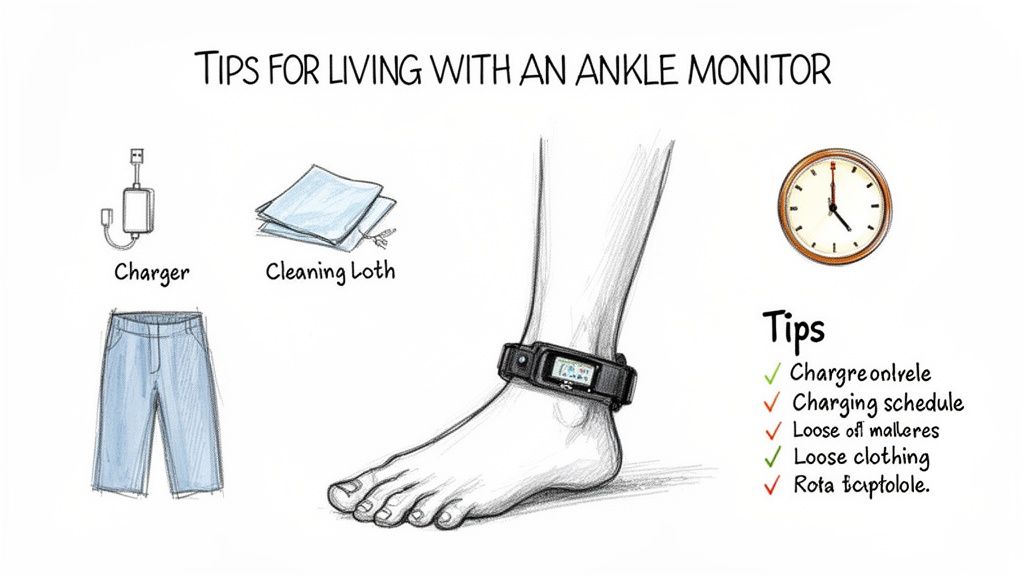
Taking proper care of the monitor is as important as taking care of yourself. These devices are meant to be worn 24/7, so keeping the area clean is the best way to prevent skin irritation.
Gently clean the device and the skin under the strap every day with a soft, damp cloth and mild soap. Be sure to rinse and dry the area completely afterward. This simple step can prevent chafing and keep you comfortable, which is important for long-term wear.
Choosing the Right Clothing
It's natural to feel self-conscious about the monitor being visible. The right clothes can help you feel more comfortable and maintain your privacy at work or school in places like Alpharetta or Johns Creek.
Here are a few clothing tips that work well:
- Loose-fitting pants: Boot-cut jeans, relaxed-fit slacks, or athletic sweatpants can easily cover the device without looking tight or obvious.
- Tall, thick socks: A tall sock can act as a soft cushion between the monitor and your skin, which can add comfort and help hide the device’s outline.
- Avoid tight clothing: Skinny jeans and tapered pants will only make the monitor stand out and can cause uncomfortable rubbing.
Managing the Psychological Adjustment
Feeling stressed or self-conscious while wearing a monitor is completely normal. The first step is to acknowledge those feelings. The next is to shift your focus to what you can control—following the rules, every day.
It can help to see the monitoring period as a temporary phase, not a permanent part of your identity. Every day you adhere to the rules is one step closer to putting this chapter behind you.
Successfully navigating your ankle monitor rules means understanding all the responsibilities that come with it, including the financial side. For a straightforward breakdown of the typical expenses, you can learn more about how much ankle monitors cost in our detailed guide. Getting into a routine and keeping your focus on the end goal will help you get through this time with confidence.
Answering Your Questions About Ankle Monitor Rules
It’s completely normal to have many questions when you or a loved one is dealing with electronic monitoring for the first time. We hear these same concerns from families throughout Forsyth and Hall County, so we have put together some straightforward answers to provide clarity.
Can I Still Go to Work or School with an Ankle Monitor?
Yes, in most cases. The court generally expects and encourages you to continue with normal responsibilities like work and school.
These locations are set up as approved "inclusion zones" in the monitoring system. It is very important that your exact schedule and the addresses for your job, school, and attorney’s office are given to the monitoring company ahead of time. This helps prevent the system from flagging a violation when you are exactly where you are supposed to be.
Is the Ankle Monitor Waterproof?
Most ankle monitors used today are water-resistant, which means showering with them on is generally fine.
However, they are not fully waterproof. You cannot submerge them, so activities like swimming or taking a bath are not allowed. It is always a good idea to confirm the specific rules for your device when you receive it.
Who Pays for the Ankle Monitor Service?
The person required to wear the monitor is almost always responsible for the costs. This typically involves an initial setup fee plus a daily monitoring fee that you pay directly to the private company providing the service.
It's important to understand that these costs are separate from your bail bond premium. They are an additional condition of release that must be managed to remain in compliance.
What Should I Do If My Ankle Monitor Starts Beeping?
First, remain calm. If the device alarms, the most important thing is to avoid trying to fix or silence it yourself. Your first action should always be to call the monitoring company right away and tell them what is happening.
Often, it is for a simple reason, like a low battery warning or a temporary loss of signal because you are in a basement or a large concrete building. Proactive communication is key—it shows you are taking the rules seriously and helps clear up any potential misunderstanding before it becomes a problem.
If you need help navigating bail conditions in Forsyth, Hall, or surrounding North Metro Atlanta communities, Best Bonding is available 24/7. We can start the process over the phone and guide you step by step. Learn more at https://bestbondingforsyth.com.