
When a loved one is arrested in Forsyth County, you are suddenly faced with many unfamiliar legal terms. One of the most important to understand is pretrial supervision, which is a court-ordered alternative that allows someone to go home instead of staying in jail while awaiting trial.
This is not a "get out of jail free" card. It means the individual must follow a specific set of rules to ensure they show up for all their court dates. At Best Bonding Forsyth, we help families navigate the first step—securing bail bonds in Forsyth County—so you can focus on what comes next.
What to Do Right Now
- Stay Calm: Take a deep breath. This is a manageable process.
- Gather Information: You will need the person's full name and the jail they are in.
- Call for a Clear Plan: Contact a professional bonding company to understand the exact steps to get them released.
If you need immediate help, we are available 24/7 to provide clear guidance. We can start the process right over the phone.
What Pretrial Supervision Means in Simple Terms
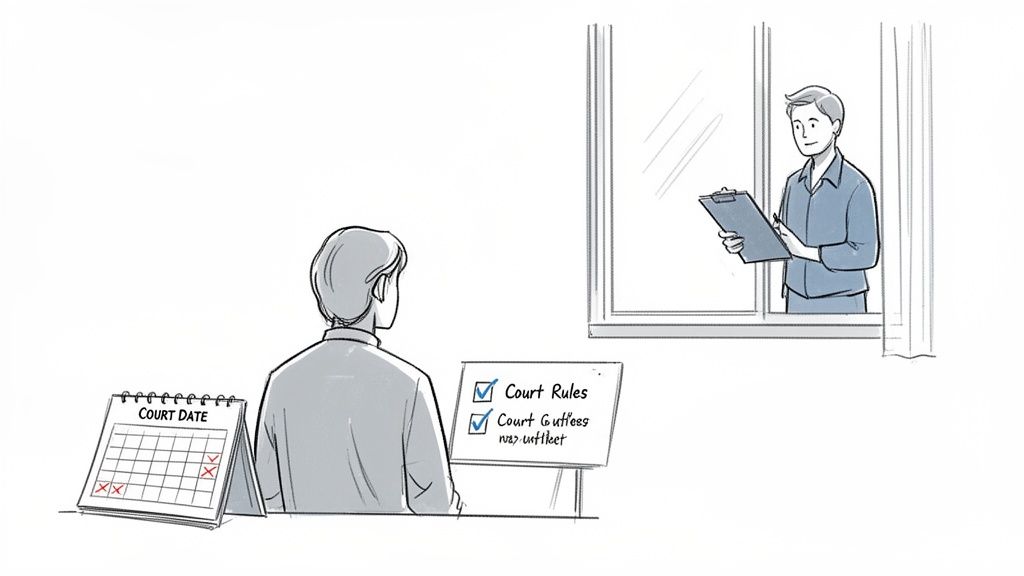
Think of pretrial supervision as a structured release program. It is not a form of punishment. Instead, its purpose is to give the court a reliable framework, reassuring the judge that the person will meet their legal obligations without having to be held in jail.
This approach has become a critical alternative to keeping people in jail before they have had their day in court. In fact, about 85% of large jurisdictions in the U.S. now have pretrial services agencies to handle this kind of monitoring. You can get more insights on how these community-based pretrial services work as an alternative to detention.
When a judge in Forsyth County or Hall County orders pretrial supervision, it is a sign they believe the person can safely wait for their trial at home—as long as they stick to the rules.
To give you a quick summary, here are the core components and their purpose.
Pretrial Supervision at a Glance
This table provides immediate clarity on what to expect from the program.
| Component | Its Purpose |
|---|---|
| Regular Check-Ins | To maintain consistent contact and ensure the defendant is on track. |
| Court Date Reminders | To help prevent accidental "failure to appear" charges. |
| Substance Abuse Testing | To ensure compliance with sobriety conditions if ordered by the court. |
| Electronic Monitoring | To track location and enforce curfews or stay-away orders. |
| Employment/Education Verification | To confirm the defendant is engaged in productive, stable activities. |
Each condition is designed to balance a person's freedom with community safety.
The Role of a Pretrial Services Officer
A key figure in this process is the pretrial services officer. This person is assigned by the court to monitor the defendant and make sure they are following all the conditions of their release.
It is important to understand their role is not to punish. They are there to supervise and report back to the court.
Their duties usually include:
- Conducting regular check-ins, which could be over the phone or in person.
- Ensuring any required monitoring equipment, like an ankle bracelet, is working correctly.
- Administering drug or alcohol tests or confirming they were completed elsewhere.
- Verifying that the individual is following every rule set by the court.
The entire system is designed to strike a balance between an individual's freedom, community safety, and the integrity of the judicial process. Knowing how it works can help reduce anxiety by showing it is a manageable, structured path forward.
Common Pretrial Supervision Conditions in Forsyth County
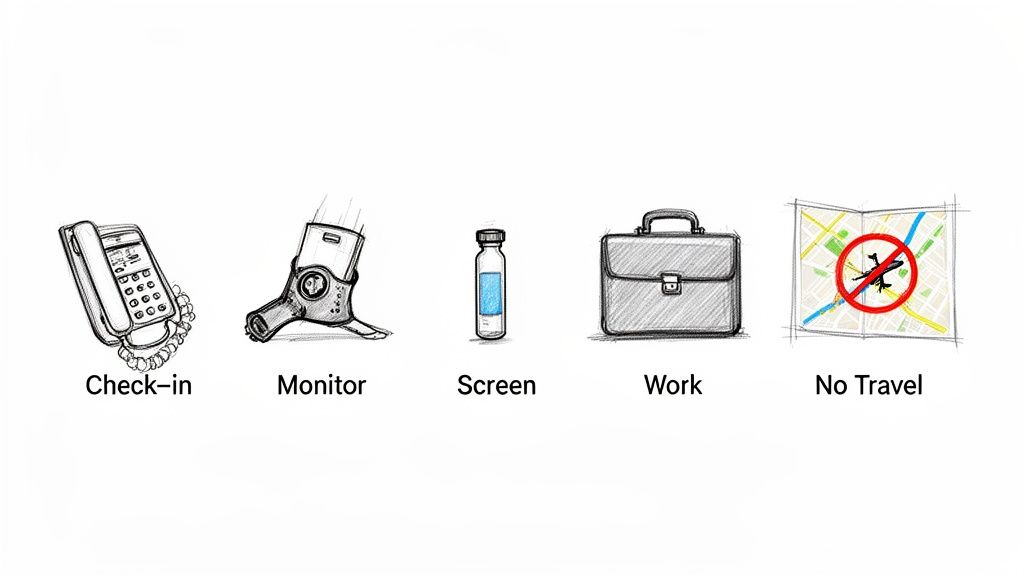
When a judge in Forsyth County orders pretrial supervision, a common question is: "What does that actually mean we have to do?" The conditions are not meant to be punishments. Instead, each rule is there to give the court confidence that the person will show up for their hearings.
While a judge customizes the requirements for every case, there are several common conditions. Knowing what to expect can help your family prepare for the responsibilities that come with this type of release.
Think of these conditions as the "rules of the road" while awaiting trial. Following them is the key to staying home.
Routine Monitoring and Check-Ins
One of the most common requirements is staying in regular contact with a pretrial services officer. This is the court's way of keeping lines of communication open.
- In-Person or Phone Check-Ins: This might mean reporting to an office in Cumming or calling the officer at specific times each week.
- Court Date Reminders: The officer is also a resource, often providing reminders for upcoming court appearances to prevent someone from accidentally missing a date.
- Employment Verification: The court wants to see stability. They may require the person to keep their job or be actively looking for one.
These simple actions build a routine and a direct line of communication, which are both essential for staying in compliance.
Specific Restrictions and Requirements
Beyond regular check-ins, a judge might add more specific conditions based on the charges or a person's background. These are tailored to address any particular concerns the court might have.
A common one is electronic monitoring, which usually means wearing an ankle bracelet to track a person's location. It is often used to enforce a curfew or ensure someone stays away from a certain place or person. You can learn more about what to expect from an ankle monitor.
The main goal of every condition, from a simple phone call to electronic monitoring, is to reduce two risks: the person not appearing for court and any potential threat to public safety.
Other restrictions you might see include:
- Travel Limitations: The defendant may be barred from leaving Forsyth County or the state of Georgia without getting the court's permission first.
- Substance Abuse Screening: If drugs or alcohol were involved in the case, the court will likely order random testing to ensure sobriety.
- No-Contact Orders: It is common for a defendant to be ordered to have zero contact—no calls, texts, or in-person visits—with the alleged victim or any witnesses.
It can feel like a lot to manage, but understanding these rules is the first step. Each condition is part of the agreement that allows your loved one to be home while their case moves forward.
How Is Pretrial Supervision Different From Probation?
During a stressful legal situation, it's easy to get overwhelmed by jargon. You might hear terms like "pretrial supervision" and "probation" and assume they are the same thing. They are not.
Knowing the difference is important. It clarifies where you or your loved one stands in the legal process. The most important distinction comes down to one thing: timing.
Pretrial Supervision Happens Before a Conviction
Pretrial supervision is exactly what it sounds like—it happens before a trial. It is a set of conditions for someone who has been accused of a crime but is legally presumed innocent.
Think of it as a structured agreement that allows a person to go home and live their life while awaiting their court date. The point is to make sure they appear for court and stay out of trouble. It is not a punishment or part of a sentence.
Probation Happens After a Conviction
Probation, on the other hand, is a post-conviction penalty. It is part of the sentence a judge gives after someone has been found guilty or has pleaded guilty.
- Probation is a sentence served in the community instead of going to jail.
- Parole is a similar concept, involving supervised release from prison after someone has already served part of their sentence.
Both are different because they are consequences of a conviction. Pretrial supervision is not.
The key takeaway is simple: Pretrial supervision manages the time before a trial. Probation is part of a sentence after a conviction.
To make this clear, let's break it down side-by-side.
Pretrial Supervision vs Probation
This table lays out the core differences between these two distinct legal statuses.
| Factor | Pretrial Supervision | Probation |
|---|---|---|
| Timing | Before a trial or conviction | After a conviction, as part of a sentence |
| Purpose | Ensure court appearance and public safety | Serve a sentence in the community instead of jail |
| Legal Status | Accused and presumed innocent | Convicted of a crime |
Understanding this distinction can provide some comfort. If a judge has ordered pretrial supervision, it means your loved one is on a temporary, manageable step in their legal journey.
Connecting Bail Bonds to Pretrial Release
So, where do bail bonds fit into the pretrial supervision picture? It’s a common question, and it’s important to understand that they work together but handle two different parts of getting someone home after an arrest.
A bail bond is the financial tool used to get a person released from jail. It is the first and most critical step. Pretrial supervision is the set of rules the court orders them to follow after they are out.
Think of it this way: the bail bond is the key that unlocks the jail cell. The pretrial supervision conditions are the rules of the road they have to follow to stay home until their case is resolved.
Two Steps to Getting Home
In many cases here in Forsyth County, a judge will require both. The process typically happens in this order:
- Securing the Bond: This is our role. At Best Bonding Forsyth, our focus is on posting the bond as quickly and smoothly as possible to satisfy the court's financial requirement for release.
- Beginning Supervision: Once your loved one is released, they must immediately start following the pretrial supervision rules the judge set. This part is managed by a pretrial services officer, not the bonding company.
Our job is to handle the first step with clarity and speed. By providing professional bail bonds in Forsyth County, we get your family member out of jail so you can all focus on the next phase—complying with the court’s requirements. To get a better handle on the process, you can read more about the fundamentals of pretrial release.
This chart helps visualize the different paths a person might take after an arrest, showing exactly where pretrial supervision fits in.
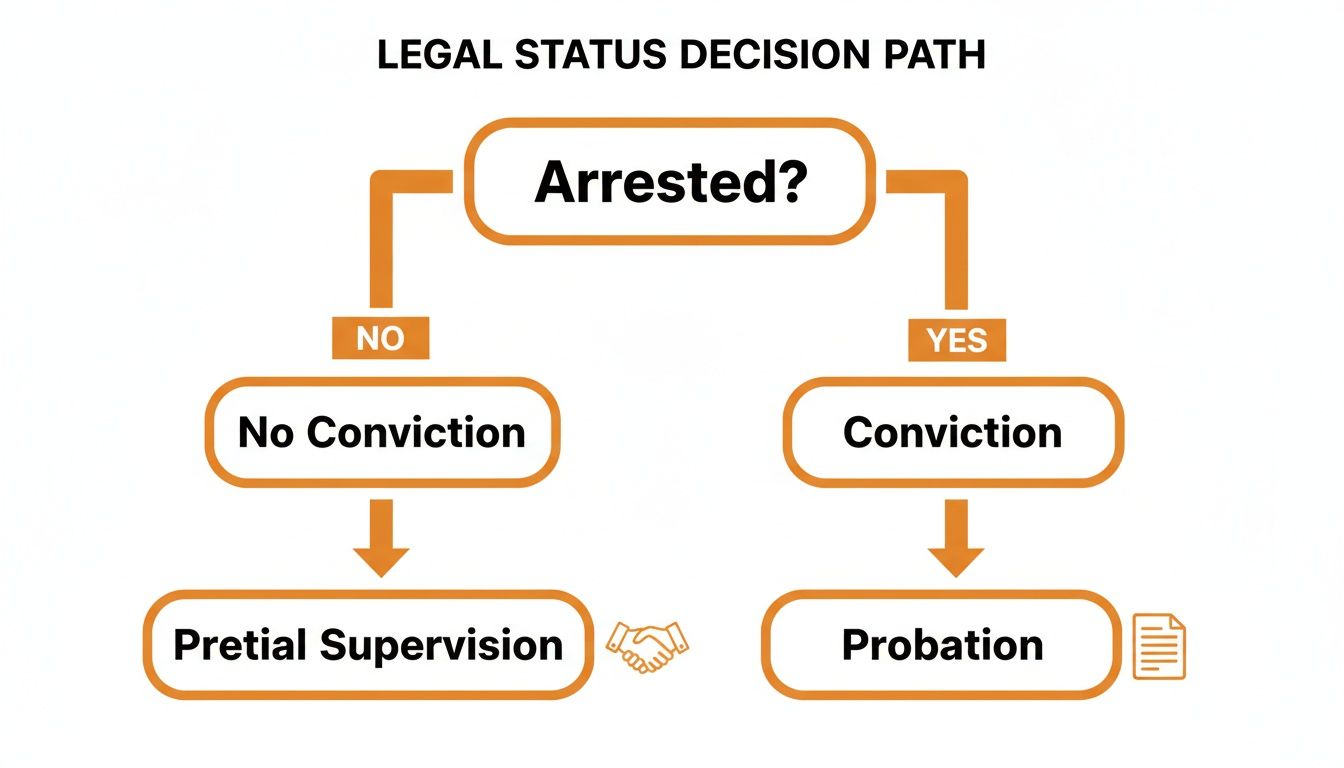
As the graphic shows, pretrial supervision happens before a conviction, which is a crucial distinction. It operates under the principle that a person is innocent until proven guilty.
Finding the Right Balance
Recent research shows that for many defendants, simpler, low-contact methods of supervision are just as effective at making sure they appear for court and stay out of trouble.
Our focus is on providing a calm, professional service that helps you manage the first and most immediate step. We handle the bond so you can prepare for what comes next.
Working with an experienced, local bonding company gives you clear guidance through the often-confusing process. This frees up your family to put its energy where it’s needed most: supporting your loved one and ensuring they successfully navigate their court-ordered obligations.
What Happens if Supervision Conditions Are Violated?
Knowing the rules of pretrial supervision is one thing, but a big worry for families is, "What happens if there's a mistake?" It's a fair question. Understanding the consequences helps everyone see why sticking to every condition is so important.
A small mistake does not automatically send someone back to jail. The outcome depends on what happened, the defendant's track record, and the judge's decision. The goal here is to be clear, not to cause alarm.
The Violation and Reporting Process
When a condition is broken—a missed check-in, a failed drug test, or traveling without permission—the pretrial services officer must report it to the court. They are not the ones making the final decision, but they act as the court's eyes and ears.
That report gets the judge's attention. From there, a few things can happen, ranging from a simple warning to more serious action. The court's response is almost always based on the seriousness of the violation.
Potential Consequences of a Violation
The court has several options when a violation is reported. A minor, first-time issue will likely be treated very differently than a major or repeated problem.
Here’s what could happen:
- A Formal Warning: For a small issue, the judge might issue a warning and stress the importance of following the rules.
- Stricter Conditions: The judge could decide to add more requirements, such as more frequent check-ins, an ankle monitor, or mandatory counseling.
- Bond Revocation: This is the most serious outcome. If the violation involves a new arrest or a clear refusal to follow the rules, the judge can issue a warrant. This leads to being re-arrested and the original bond being revoked.
When a bond is revoked, it can create a serious financial problem for the person who co-signed it. You can get the full details on what that means in our guide to bail forfeiture.
Adhering to every condition of pretrial supervision is the most reliable path to maintaining freedom while a case moves through the legal system in Forsyth County.
At the end of the day, compliance is what everyone wants—the court, the defendant, and the family. It is what keeps someone at home, able to work on their case, which is the purpose of both the bail bond and the supervision program.
How We Provide Clarity Through This Process
Dealing with an arrest is overwhelming, and trying to understand complex terms like pretrial supervision is just one piece of the puzzle. This is when a clear explanation and a steady hand can make all the difference.
As a local company with experience in Forsyth County, Cumming, and Hall County, our job is to be your calm, steady guide through that first critical step: getting your loved one out of jail.
How Our Bonding Process Works in Georgia
- Call Us 24/7: The first step is a simple phone call to get clear answers.
- Provide Basic Information: We'll ask for the person's name and where they are being held.
- Handle Paperwork: We can handle most of the necessary paperwork quickly over the phone.
- Post the Bond: We coordinate with the jail staff to post the bond and secure the release.
Our entire focus is handling the bail bond process quickly and professionally. We provide simple explanations and step-by-step directions, so you know what is happening and what you need to do next. While we are not lawyers and cannot give legal advice, we can demystify the bonding process itself.
When you contact us, you will speak with a patient professional who has helped hundreds of local families through the exact same situation you are facing right now.
Our commitment is to treat your family with the respect and discretion you deserve. We handle the details of the bond so you can focus on supporting your loved one and preparing for what comes next.
What We Can Do Right Now
We offer a direct, uncomplicated solution to a stressful problem. When you call us, we will:
- Explain exactly what information we need to start the bail bond process.
- Clearly outline the costs and what it means to be a co-signer.
- Start the necessary paperwork immediately, often right over the phone.
- Coordinate directly with the jail staff in Forsyth County or Hall County to get things moving.
If you need help in Forsyth or Hall County, call and we’ll explain what to do. We are here to provide calm, clear guidance and start the process of bringing your loved one home.
Frequently Asked Questions
When families are trying to make sense of pretrial supervision, many of the same questions come up. Here are some straightforward answers.
Is Pretrial Supervision Automatic for Everyone on Bond?
No. A judge makes that decision on a case-by-case basis. Many people are released on bond with no extra supervision required. Whether pretrial supervision is ordered depends on factors like the charges involved and a person's background.
Who Pays for Services Like an Ankle Monitor?
In most Georgia counties, including Forsyth, the defendant is typically responsible for paying the fees for their own pretrial services. This could be a daily fee for an electronic ankle monitor or the cost of mandatory classes. These fees are separate from what you pay a bail bond company.
Can We Change the Pretrial Rules if Something Comes Up?
Yes, but it requires a formal request to the court. An attorney must file a motion asking the judge to approve a modification, such as changing a curfew for a work schedule or getting permission to travel. A pretrial officer cannot approve changes.
How Long Does Pretrial Supervision Last?
Pretrial supervision continues for as long as the case is open. It starts the day a person gets out of jail and ends when the case is officially closed, either through a plea agreement, dismissal, or a trial verdict. The supervision is tied directly to the timeline of the legal process.
If you need immediate help in Forsyth or Hall County, we can start everything over the phone and guide you step by step. Call Best Bonding Forsyth 24/7 for calm, experienced assistance with the bail bond process.