
If a loved one has recently been arrested in Forsyth County, GA, or the surrounding communities, one of the first and most confusing steps is the arraignment hearing. For families new to the court system, this hearing can be a source of significant stress, mostly due to uncertainty about what to expect.
We have helped hundreds of families through this exact situation. Let’s clarify one key point right away: an arraignment is not a trial. Guilt or innocence is not decided here. This is a formal, procedural first step in the court process. Understanding what happens can bring a sense of calm and control to a difficult day.
If you need help posting bail after an arraignment in Forsyth or Hall County, our team at Best Bonding Forsyth is available 24/7. Call now for clear guidance and to start the process right away.
What to Do Right Now
- Call a Local Bail Bonds Company: We can explain the process and prepare to post bond as soon as it's set.
- Gather Necessary Information: Have the full name and date of birth of the person arrested, and the jail where they are being held (likely Forsyth or Hall County).
- Contact an Attorney: The person charged has the right to legal counsel. An attorney is essential for navigating the arraignment and all future court dates.
Your First Step Inside a Georgia Courtroom
After an arrest in Forsyth County, or in nearby towns like Cumming and Alpharetta, the legal system can feel overwhelming. The arraignment hearing is the starting point for the court process, and simply knowing what to expect can make a stressful situation more manageable.
Think of it as the court's official kickoff meeting for the case. The goal is to ensure everyone understands the charges, the defendant’s rights, and the next steps.
For families across North Georgia, understanding this hearing is key. Here is what happens in the courtroom:
- The Charges are Read Aloud: A judge or court clerk will formally state the criminal charges filed against the person accused.
- Your Rights are Confirmed: The court will make sure the defendant understands their constitutional rights, especially the right to a lawyer.
- A Plea is Entered: The defendant will be asked to give an initial plea—typically "guilty," "not guilty," or "no contest."
- Bail and Bond are Addressed: If bail has not been set yet, or if it needs to be reviewed, the judge will handle it during the arraignment.
To give you an even clearer picture, here's a simple breakdown of the hearing's flow.
Key Events During an Arraignment Hearing
| Event | What It Means for You |
|---|---|
| Case is Called | The judge will call the defendant's name and case number. |
| Charges are Read | The specific offenses the state has filed are announced officially. |
| Rights are Explained | The judge ensures the defendant knows they have the right to a lawyer and a trial. |
| Plea is Entered | The defendant will state an initial plea of "guilty," "not guilty," or "no contest." |
| Bail/Bond is Discussed | The judge confirms or sets the conditions for release pending trial. |
| Next Court Date is Set | The defendant will be told when they need to appear in court again. |
Essentially, this hearing gets the legal process started. By demystifying the arraignment, you can face the day with more preparation and less anxiety.
A Step-By-Step Walkthrough of the Arraignment
Knowing the purpose of an arraignment is one thing, but picturing how it unfolds can bring a sense of calm. While every judge in Forsyth County runs their courtroom a bit differently, the fundamental steps are consistent. The process is formal and designed to move cases forward efficiently.
When the case is called, the person accused will stand before the judge. This is when the official hearing starts, and it is critical to listen closely and follow directions from the court.
The Formal Reading of Charges
The first step is the formal reading of the charges. The judge or a court clerk will state exactly what offenses the prosecutor has filed. This is not a debate or a discussion; it is a straightforward announcement to ensure the defendant knows precisely what the allegations are.
The language can be technical, which is why having an attorney present is so important. A lawyer can explain everything in plain terms. The court must confirm the charges have been heard and understood before moving on.
Confirmation of Your Constitutional Rights
Next, the judge will make sure the defendant understands their basic constitutional rights. This is a critical checkpoint in the legal system.
These rights always include:
- The right to have an attorney represent you, even if you cannot afford one.
- The right to remain silent to avoid self-incrimination.
- The right to a trial by jury.
The judge is creating an official record that the defendant was informed of their legal protections. When asked if they understand, it is essential to provide a clear acknowledgment.
This simple flow chart breaks down the three main stages of an arraignment hearing in Georgia.
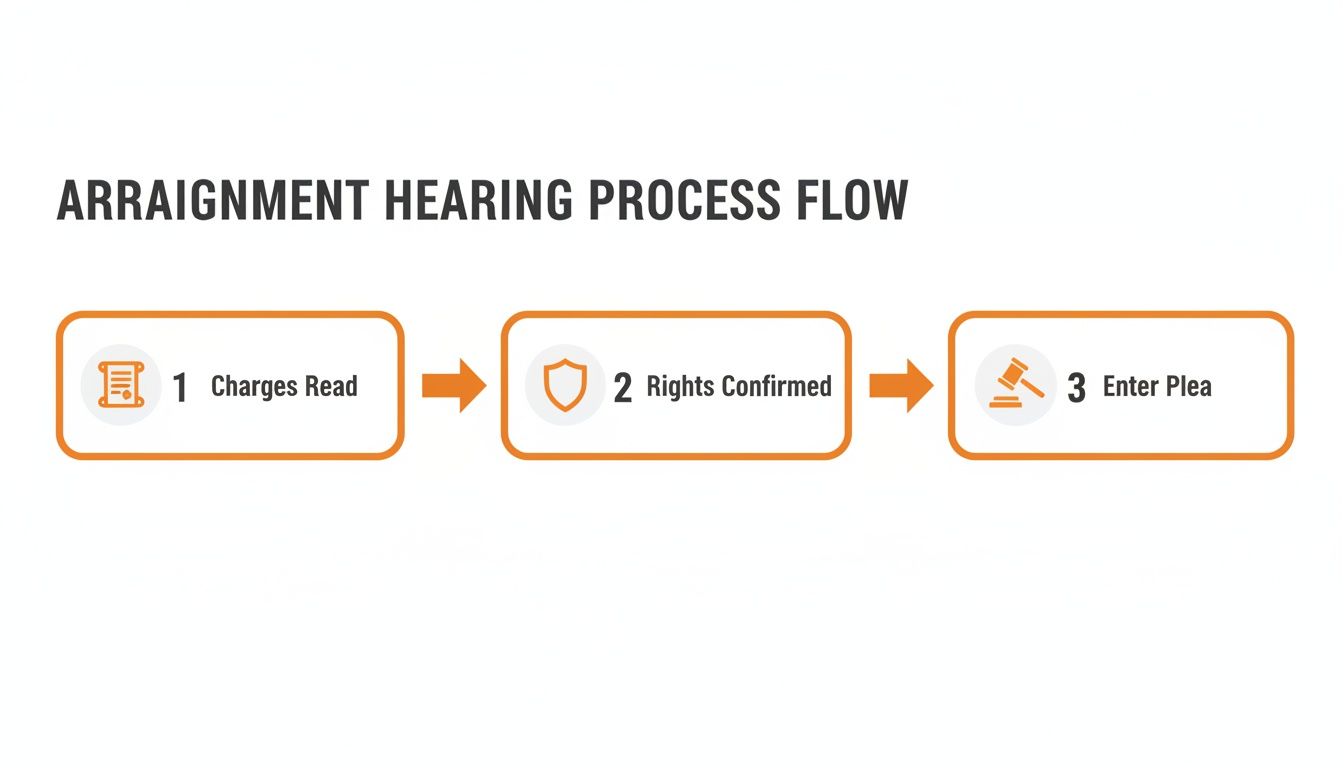
As you can see, each step builds on the last, creating a structured and orderly court proceeding.
Entering the Initial Plea
Once the charges have been read and rights confirmed, the judge will ask for an initial plea. This requires a simple, one-word answer: "guilty," "not guilty," or sometimes, "no contest."
In nearly all cases, especially before an attorney has had time to review the evidence, the standard plea is "not guilty." Pleading not guilty does not mean a trial is guaranteed; it simply protects all legal rights and gives the attorney time to review the case.
This is not the moment to explain what happened. The plea is a formal response that determines the next steps. An attorney's advice on this single word is one of the most important reasons to have one present at this hearing.
Understanding Your Three Plea Options
The arraignment hearing leads to one pivotal question from the judge: "How do you plead?" The answer charts the course for the entire case. In Georgia, there are generally three ways to respond.
This is a decision that should only be made after consulting with a lawyer. The following is for general informational purposes, not to serve as legal advice.
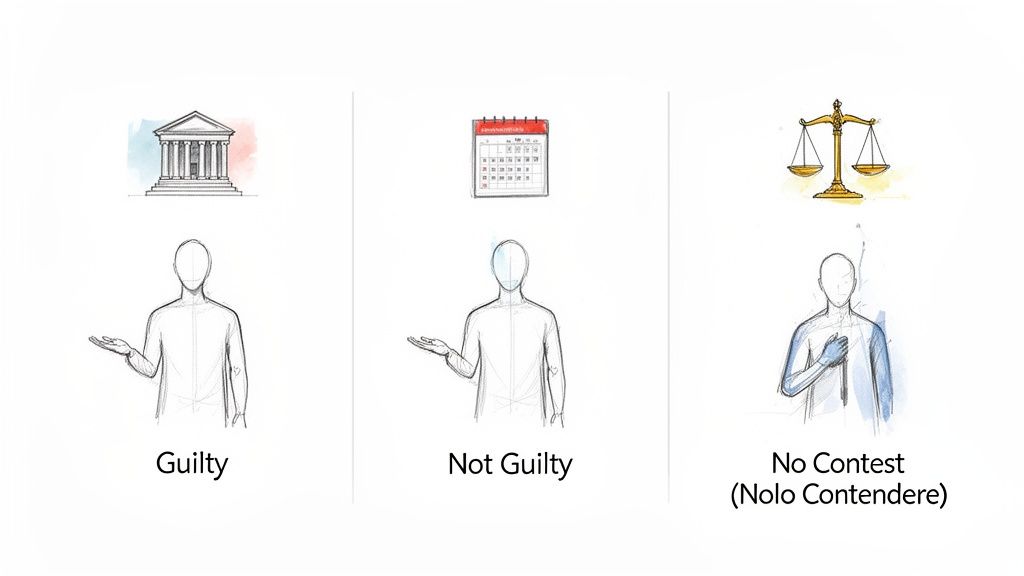
Pleading Not Guilty
This is the most common plea at an arraignment in Forsyth County, Cumming, or anywhere else in Georgia. Pleading not guilty is a formal way of exercising the constitutional right to require the prosecution to prove their case beyond a reasonable doubt.
Making this plea does two crucial things:
- It protects all legal rights and keeps every defense option available.
- It gives an attorney the time needed to review the evidence, investigate the facts, and advise on the best path forward.
After a not guilty plea, the judge will set future court dates, and the case moves forward.
Pleading Guilty
A guilty plea is a formal admission in court to committing the crime as charged. This plea means giving up several major rights, most importantly the right to a trial. The case usually moves directly to sentencing, which can happen immediately or be scheduled for a later date.
A guilty plea is a final, serious decision with lasting consequences. It is almost never advisable to plead guilty at an arraignment without a full case review from a defense attorney.
Pleading Nolo Contendere (No Contest)
The third option, nolo contendere, is Latin for "no contest." This is a unique plea. It is not an admission of guilt, but an agreement to accept the court's punishment. The key difference is that a no contest plea typically cannot be used as proof of guilt in a separate civil lawsuit.
Judges do not have to accept this plea, and its legal nuances are complex. It is another decision that requires guidance from an attorney. For most people at their first court appearance, pleading "not guilty" is the standard way to ensure everything is handled correctly.
How Bail Is Determined at the Arraignment
For most families, the biggest question during an arraignment is about release from jail. If bail wasn't set after the arrest, the judge almost always addresses it at this hearing. This is the moment when a decision on pretrial release is made.
When a judge in Forsyth or Hall County considers bail, they are balancing two main goals: ensuring the accused person returns for all future court dates and maintaining public safety. This is not about punishment—it is about managing the case until it is resolved.
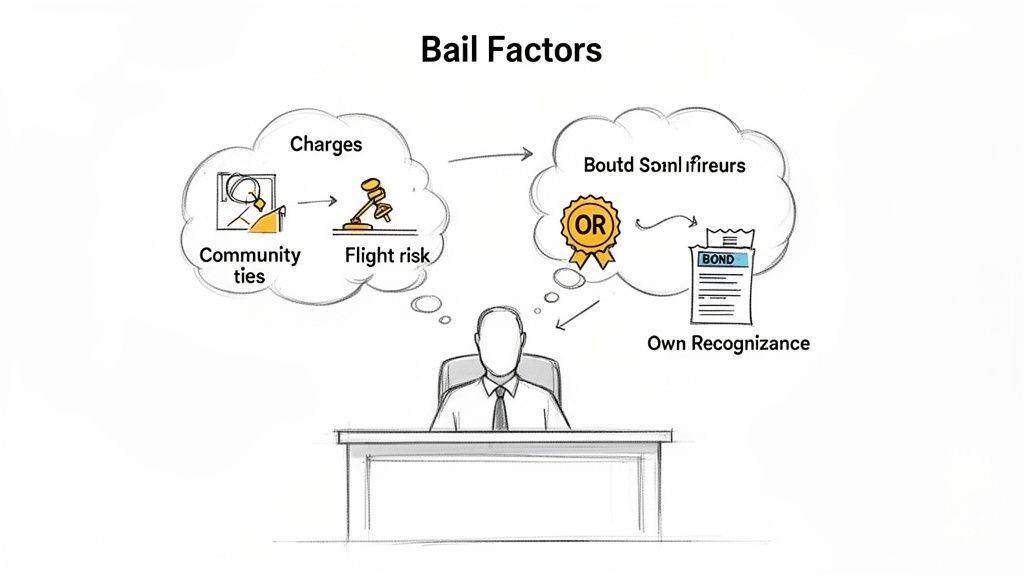
Factors a Judge Considers for Bail
Judges weigh several specific factors related to the defendant and the case.
- The Nature of the Charges: More serious charges often lead to higher bond amounts or stricter conditions for release.
- Ties to the Community: Does the person have a steady job, family nearby, and a long-term home in a place like Cumming, Johns Creek, or Alpharetta? Strong local roots suggest they are less of a flight risk.
- Past Criminal History: A criminal record, especially with any past failures to appear in court, will influence the judge's decision.
- Flight Risk Assessment: The court must evaluate how likely it is that the defendant might leave the area to avoid facing the charges.
After reviewing these factors, the judge makes a decision about release.
Release on Recognizance vs. Setting a Bond
In some situations, a judge might grant a Release on Recognizance (OR). This means the defendant is released on their written promise to return to court, with no money required. This is usually reserved for people facing minor charges who have strong community ties.
More commonly, the judge will set a specific dollar amount for the bond. According to some federal data, the use of money bail in felony cases rose from 53% in 1990 to 70% by 2006. With median felony bail often set over $10,000, many people remain in jail simply because they cannot afford the full amount.
This is where a bail bonding company provides a crucial service. Instead of paying the entire bond amount, you work with a company like Best Bonding Forsyth. We post the required financial guarantee to the court for a small percentage of the total, making release from jail much faster and more affordable. You can learn more about how bail hearings work and what to expect in our detailed guide.
What You Must Do After the Arraignment
Release from jail after an arraignment brings a great sense of relief. However, it is the beginning of a new set of serious responsibilities. Once out on bond, the obligations to the court are officially in motion, and following them precisely is the most important thing to do.
The number one responsibility is to show up for every single court date. No exceptions.
Missing a court appearance, even by mistake, can trigger serious problems. A judge will issue a Failure to Appear (FTA), which almost always leads to a new arrest warrant and the forfeiture of the entire bond. This means the co-signer becomes responsible for paying the full bail amount to the court.
Understanding Your Conditions of Release
In addition to attending court, the judge will set specific conditions of pretrial release. These are the rules that must be followed while the case is active. Violating them can result in the bond being revoked and a return to jail.
Common conditions in Forsyth and Hall County courts include:
- No-Contact Orders: A strict order to avoid any contact with certain people, like an alleged victim or co-defendants. This includes phone calls, texts, social media, or messages through third parties.
- Regular Check-ins: Reporting to a pretrial services officer on a set schedule, either in person or by phone.
- Travel Restrictions: Freedom to travel may be limited. A judge could order the defendant to stay within the county or state and require permission before leaving the area.
These are direct court orders, not suggestions, and must be taken seriously.
The Importance of Clear Communication
It is easy to make a simple mistake, like writing down the wrong court date. Most people who miss court do so due to confusion or a simple mix-up. This is where clear communication is essential.
Studies have shown that simple text message reminders for court dates can reduce failure-to-appear rates by more than 8%. This highlights how staying organized and in close contact with an attorney can prevent major issues.
Both the defendant and the co-signer must be clear on these post-arraignment responsibilities. Following every rule is the only way to keep the process moving forward smoothly. You can learn more about the different types of release and what they entail in our guide on what is pretrial release.
A Clear Path Forward with a Local Bail Bondsman
Understanding what happens at an arraignment hearing—and the bonding process that follows—can feel overwhelming, especially when you are worried about a loved one. The legal system has its own language and pace, but you do not have to navigate it alone. This is where a professional bail bondsman provides a clear, direct path to getting someone released.
Instead of needing to come up with the court's full bond amount, our job is to handle that critical step for you. We provide the court with the necessary financial guarantee, which allows your loved one to come home while their case proceeds. This frees your family to focus on what matters: offering support and preparing for future court dates.
How We Provide Clear, Local Help
At Best Bonding Forsyth, we have helped hundreds of families across Forsyth County, Cumming, and Hall County through this exact situation. We understand the local court and jail procedures and are available 24/7 to answer your questions with patience and respect.
Our process is simple. We start by explaining your options in plain language, making sure you understand every step. One phone call is all it takes for us to begin the paperwork and walk you through what is needed.
Our commitment is to be a calm, steady guide during a difficult time. We manage the bonding process efficiently so you can focus on your family.
When you need clear answers and fast, respectful service in Forsyth County, Alpharetta, or Johns Creek, we are here to help. To get more insight into our role, feel free to read our article that explains what a bail bond agent does and how we help our clients. Let us help you take the next step with confidence.
Your Arraignment Hearing Questions, Answered
Facing an arraignment naturally brings up many questions. We understand. Families need clear, straightforward information when dealing with an uncertain process. Below are answers to some of the most common concerns we hear about arraignment hearings.
This information is for general purposes and is not a substitute for legal advice from a qualified attorney.
Do I Need a Lawyer at My Arraignment?
While you can attend an arraignment without an attorney, it is highly recommended to have one. A lawyer acts as your professional advocate in the courtroom. They provide critical advice on how to plead, can argue for a reasonable bail amount, and ensure your rights are protected from the start. If you cannot afford a private attorney, you have the right to request a court-appointed public defender.
What Should I Wear and Bring to Court?
How you present yourself in court is important. Always dress respectfully, similar to a serious job interview. Business casual attire is a safe choice. Avoid shorts, tank tops, hats, sunglasses, and T-shirts with graphics or slogans. Bring only what is necessary, such as your photo ID and any case-related paperwork. Courthouse security is strict, so do not bring food, drinks, or anything that could be considered a weapon.
Can a Bond Amount Be Changed at Arraignment?
Yes, it can. The judge has the authority to review and change the bond during the arraignment. They can raise it, lower it, or add new conditions to a release based on the information presented in court. This is another key reason why having an attorney present is so valuable, as they can argue for a lower bond or more favorable release conditions.
How Quickly Can Someone Be Released After Bond Is Posted?
Once the judge sets the bond and a bail bondsman posts it, the jail begins its release process. The timeline can vary, often taking from a few to several hours, depending on how busy the facility is. Court observation studies found that judges set cash bonds in 68% of cases, while only releasing 21% on their own recognizance. These pretrial research findings show why a reliable bail bonds service is often essential. A local bondsman who knows the procedures in Forsyth or Hall County can give you a realistic time estimate based on current conditions.
If you need help navigating the bail process after an arraignment in Forsyth County, Cumming, or the surrounding North Georgia communities, Best Bonding Forsyth is here to provide clear guidance and 24/7 support. Call now to get immediate assistance and start the process over the phone.