
Finding out there might be a warrant with your name on it is a stressful, sinking feeling. We understand. Before you worry, it's important to understand exactly what you're dealing with. At Best Bonding Forsyth, we've helped hundreds of families in Forsyth County, GA, navigate this exact situation with clear, calm guidance.
In simple terms, a bench warrant is a direct order from a judge for law enforcement to arrest someone. Unlike a typical arrest warrant tied to a new crime, bench warrants are usually issued for procedural reasons, like missing a court date or failing to follow through on something the court ordered you to do.
Clarifying What a Bench Warrant Is
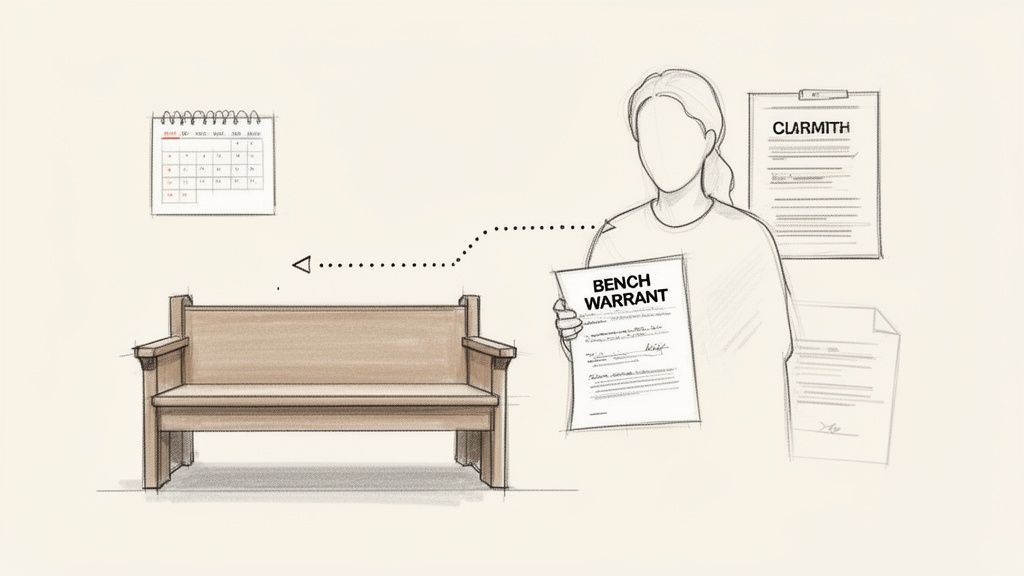
This is an overwhelming situation, but the first step is to take a breath and figure out what this means. The name "bench warrant" is literal—it’s issued directly from the judge's "bench" during a court proceeding. It’s the court’s tool for keeping the legal process on track.
This guide is here to give you clear, straightforward information for general purposes, not legal advice. Our goal is to explain the process and show you there’s a clear path forward.
The Purpose of a Bench Warrant
At its core, a bench warrant is about getting a person to show up in court. It isn't meant as a punishment; it's a legal tool to fix a problem when someone doesn't comply with a court directive. When you miss a scheduled appearance or violate a condition of your release, the entire case stops.
The judge issues the warrant to bring you back into the system so the original matter can be handled. Think of it as the court pausing your case until you're back in the room.
How a Bench Warrant Is Issued
The process is surprisingly simple. If you're scheduled to be in a Forsyth County or Hall County courtroom and you don't show up, the judge can issue the warrant right then. The same can happen if you fail to pay a fine or complete a court-ordered class by a specific deadline.
Once it's issued, the warrant goes into a law enforcement database. That means any police officer who runs your name during a traffic stop or any other routine interaction will see the active warrant and be required to arrest the individual. This is why it’s so important to handle a warrant proactively—it lets you control the "when" and "how" of your court appearance.
A bench warrant authorizes law enforcement to arrest an individual and bring them before the court. It is a serious order, and failing to address it can result in additional complications, but there are clear steps you can take to resolve the issue.
As a local bonding company serving Forsyth County, Cumming, and the surrounding North Metro Atlanta communities, we’ve helped countless families through this situation with respect and discretion. Understanding what a bench warrant is—and what it isn't—is the first step toward regaining control.
How a Bench Warrant Differs From an Arrest Warrant
While both a bench warrant and an arrest warrant can lead to an arrest, they’re issued for completely different reasons. Understanding this distinction is the first step to knowing what you’re facing. It tells you whether you're dealing with a new criminal charge or a procedural issue in an existing court case.
An arrest warrant is what most people think of—it’s the official start of a new criminal case. A judge only signs one after police present evidence showing probable cause that a specific person committed a crime. Think of it as the green light for law enforcement to bring someone into the system to answer for a suspected offense.
A bench warrant, on the other hand, isn’t about a new crime. A judge issues it directly from “the bench” to enforce the court’s authority. It’s a tool used to get your attention when you’ve failed to follow a court order, like missing a court date or not paying a fine.
The Core Difference: "Why" It Was Issued
The biggest difference boils down to one question: Why was the warrant issued? An arrest warrant kicks off a new criminal case, while a bench warrant is about managing a case that's already underway.
- Arrest Warrant: This is for bringing someone in to face new charges. It's based on a police investigation into a potential crime.
- Bench Warrant: This is for bringing someone back to court to deal with a failure to follow orders in an ongoing case.
This is a critical distinction because it shapes your next steps. Resolving a bench warrant usually means fixing the specific mistake that caused it, which then allows your original case to move forward.
An easy way to remember it: An arrest warrant usually starts a case. A bench warrant is a reaction to something that happened (or didn't happen) during a case.
Bench Warrant vs. Arrest Warrant at a Glance
Sometimes seeing things side-by-side makes it click. This table breaks down the core differences between the two types of warrants to help you understand your situation.
| Feature | Bench Warrant | Arrest Warrant |
|---|---|---|
| Reason for Issuance | Failure to appear in court, non-payment of fines, or violating a court order. | Probable cause that a new criminal offense has been committed. |
| Who Issues It | A judge, directly from the bench, during court proceedings. | A judge, based on a request and evidence provided by law enforcement. |
| When It Is Issued | Typically issued after a case has already begun. | Usually issued at the beginning of a new criminal case. |
| Typical Offenses | Connected to procedural failures, not new criminal activity. | Connected to specific criminal acts like theft, assault, or drug charges. |
| How It Is Resolved | Often requires appearing before the judge to address the non-compliance and potentially posting a bond. | Requires going through the standard booking and arraignment process for a new charge. |
At the end of the day, both warrants are serious legal documents that won't just disappear on their own.
Why This Distinction Matters
Knowing if you're facing a bench warrant or an arrest warrant tells you how to prepare. If you have a bench warrant for a missed court date in Cumming or Gainesville, the goal is to get back in front of the judge, explain what happened, and get the case moving again. A bond is usually set to make sure you show up next time.
An arrest warrant for a new charge is a different situation, involving a more complex process with arraignment, pleas, and pretrial hearings. No matter which one it is, the warrant stays active until it is addressed, meaning you could be arrested at any time. Taking a calm, proactive approach is always the best way to regain control.
Common Reasons Judges Issue Bench Warrants in Georgia
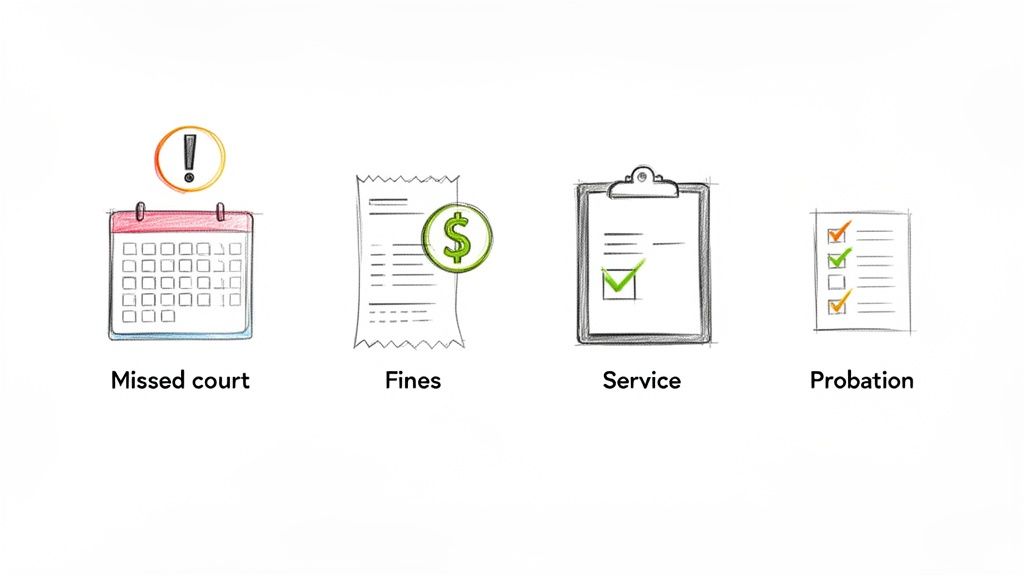
A bench warrant can sound intimidating, but the reasons behind them are usually manageable oversights, not new criminal acts. Knowing why a judge in Georgia issues these orders helps you figure out what might have happened and how to move forward calmly. Think of it as the court's way of getting your attention to fix an administrative problem.
The triggers are almost always procedural. When you see how a simple misstep can lead to a warrant, it becomes clear why handling the situation quickly—and with professional help—is so important.
Failure to Appear in Court
This is by far the number one reason a bench warrant gets issued. When you have a court date for anything—a traffic ticket in Cumming or a more serious charge in Forsyth County—showing up is mandatory. If you miss it, the judge has little choice but to issue a warrant to ensure you are there for the next one.
Life happens. People forget dates, get them mixed up, have car trouble, or deal with a family emergency. Whatever the reason, the court sees a failure to appear (FTA) as a breakdown in the legal process that has to be corrected.
A missed court date doesn’t mean the judge thinks you were trying to evade the system. But from their perspective on the bench, it’s a problem that needs a formal solution—the bench warrant—to get your case back on track.
Unpaid Fines or Restitution
Another common trigger is failing to pay court-ordered fines or restitution on time. When a judge includes a payment plan in your sentence, sticking to that schedule is a direct order. If you fall behind without communicating with the court, they can see it as ignoring their ruling.
This is a widespread issue that can affect people facing financial struggles. Across the country, court debt has become a significant driver of warrants. For instance, between 2018 and 2022, just 13 states issued over 2.5 million bench warrants tied to court debt. It’s a cycle where people can be arrested simply for being unable to pay. You can learn more about how fines and fees contribute to this problem nationwide.
Violating Conditions of Probation or Release
When someone is out on bond or on probation, they have to follow a specific set of rules. These conditions are not suggestions; they are court orders. Breaking any of these terms can cause a judge to issue a bench warrant immediately.
Common violations that can trigger a warrant include:
- Missing a meeting with a probation officer.
- Failing a drug or alcohol test if sobriety is a condition.
- Not completing required classes, like DUI school or anger management.
- Failing to finish court-ordered community service hours.
In these situations, the warrant’s purpose is to bring you back in front of the judge to discuss the violation. From there, the judge will decide what's next—perhaps stricter probation terms, or even revoking it.
In every case, the bench warrant does the same job: it compels a person to come back to court to fix a problem. It’s the court’s tool for making sure its orders are followed and that cases keep moving forward.
The Real-World Consequences of an Active Warrant
Living with an unresolved bench warrant creates a constant, low-level stress that can disrupt your life in unexpected ways. The biggest and most immediate risk? You can be arrested at any time.
This rarely happens dramatically. More often, it's during a routine traffic stop for a minor issue. The moment an officer runs your name and sees an active warrant, they have to make an arrest. That unpredictability takes the control out of your hands, leaving you to face arrest at work, in front of your family, or while running errands.
The point is not to cause alarm, but to be direct about why taking action yourself is so important. When you understand what’s at stake, you can make a clear decision to handle it on your own terms.
Immediate and Tangible Impacts
While the threat of arrest is the most obvious problem, the ripple effects of a bench warrant can touch almost every part of your life. These are not small hassles; they can create major roadblocks that get in the way of your job and family responsibilities.
Some of the most common consequences include:
- Suspension of Your Driver’s License: In Georgia, if you fail to appear in court for a traffic violation, the Department of Driver Services (DDS) can suspend your license. This makes it nearly impossible to legally drive to work or manage family needs.
- Complications with Employment: Many employers run background checks, and an active warrant will appear. This could affect your current job or prevent you from getting a new one.
- Issues with Professional Licenses: If you have a professional license—for nursing, real estate, or a commercial driver's license (CDL)—an active warrant can trigger a review by the licensing board.
- Ineligibility for Certain Benefits: An outstanding warrant might also interfere with your ability to get or renew government benefits or housing assistance.
These problems don't just go away; they can grow, turning one missed court date into a complex web of issues. This is why facing the warrant head-on is the best way to get your life back on track.
The National Scope of Bench Warrants
It’s easy to feel like you’re the only one in this situation, but bench warrants are an incredibly common tool courts use everywhere. They are a judge's order to arrest someone who didn't appear for court or follow a court order, often for something minor. The sheer number of them shows just how easily a small mistake can escalate.
Just look at the numbers. In 2025, the U.S. Marshals Service arrested 73,323 fugitives. Of those, 44,790 were for state and local warrants—a large portion of which were bench warrants for simple failures to appear. Those arrests cleared a total of 87,984 warrants, since individuals often have more than one. These stats show how quickly these can accumulate. You can find more of the data in the Marshals' end-of-year review.
An active warrant does not simply go away with time. It remains in law enforcement databases indefinitely until it is addressed through the court system, meaning the risk of arrest is always present.
Regaining Control of the Situation
The consequences are serious, but they are designed to get you to take action. The good news is that there’s a clear path forward. Resolving the warrant lets you deal with the court on your own schedule, instead of waiting for an arrest to happen at the worst possible moment. For more information, see our guide on what happens if you miss court in Georgia.
When you work with a professional bonding company in Forsyth County, you can plan a voluntary surrender and often arrange for a bond ahead of time. Taking this step shows the court you’re being responsible. It also dramatically reduces the time you might spend in jail, turning a stressful situation into a manageable one.
Your Step-by-Step Guide to Resolving a Bench Warrant
Discovering you have a bench warrant can be stressful, but taking action is the surest way to regain control. While it might feel like a huge problem, there's a clear, manageable process you can follow to handle the situation here in North Georgia.
The best approach is what’s called a voluntary surrender. This doesn't mean just walking into the jail unprepared. The single most important first step is to call a trusted bail bondsman before you go to a law enforcement facility.
Step 1: Contact a Bail Bonding Company First
This is the most critical move you can make. By arranging for your bail in advance, you get all the financial details and necessary paperwork sorted out ahead of time. Taking this proactive step can drastically reduce how much time you spend in custody.
When you call us, we will walk you through everything you need. It helps to have this information ready:
- The full name and date of birth of the person with the warrant.
- The county where the warrant was issued (like Forsyth, Hall, etc.).
- Any details you know about the original charge or why the warrant was issued.
With this information, we can get to work preparing the bond right away.
Step 2: Plan a Controlled Voluntary Surrender
Once the bond is arranged, you are back in control. You can plan the timing of your surrender to minimize disruption to your job and family. This gives you time to make personal arrangements, let loved ones know the plan, and walk into the facility with the peace of mind that your release is already underway.
This is a world away from waiting for an unexpected arrest during a routine traffic stop. That scenario forces you to make frantic calls from jail, causing unnecessary anxiety for everyone involved. The flow chart below shows how quickly a simple interaction with police can escalate when there's an active warrant.
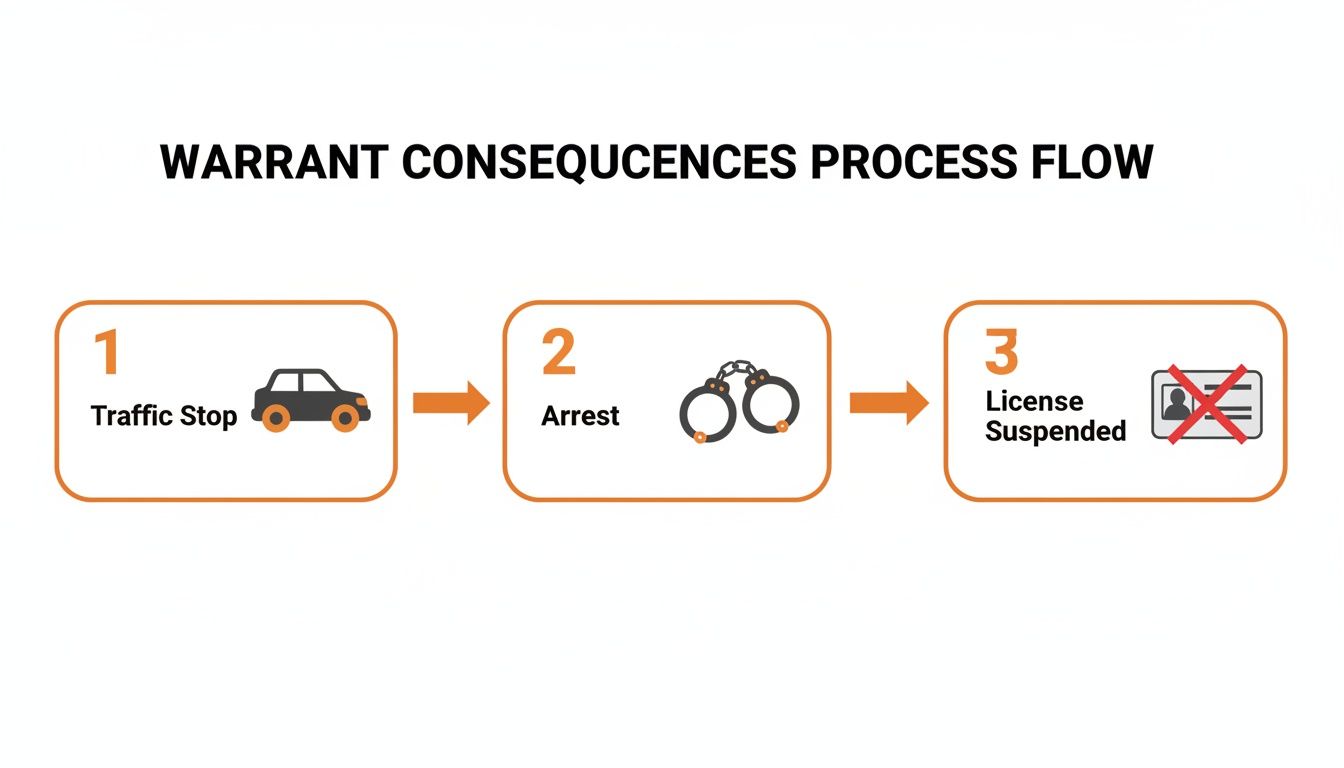
As you can see, something as simple as getting pulled over can lead straight to an arrest and even a license suspension if a warrant appears. This highlights why it’s so important to get out ahead of it.
Step 3: The Booking and Release Process
When you turn yourself in at the Forsyth County jail or another local facility, you will still go through the standard booking process, which includes fingerprints and photos. The key difference is, because your bond is pre-arranged, the release process can begin almost immediately once booking is complete.
Instead of sitting in a cell waiting hours for a bond hearing, the paperwork we prepared is ready to go. This preparation makes for a smooth and quick release.
Taking proactive steps demonstrates responsibility to the court. By arranging a voluntary surrender, you show that you are addressing the issue seriously, which can be viewed favorably when you eventually appear before the judge.
This situation is more common than people think. Judges in the U.S. issue millions of bench warrants every year, often for low-level issues. They authorize immediate arrest, but most are not for people actively trying to evade the law. More often, it’s people who forgot, had a scheduling conflict, or got confused by the court process.
By following these steps, you can turn a stressful situation into a manageable plan. For a deeper look at what comes next, check out our guide on understanding pretrial release in Georgia. It will help you face the court with confidence, knowing you've handled things the right way.
Frequently Asked Questions About Bench Warrants
Facing a bench warrant can feel overwhelming, and it's natural to have questions. We get calls all the time from people in Forsyth and Hall County who are unsure what to do next. Below are some straightforward answers to the questions we hear most often. This is for general information, not legal advice, but it will give you some clarity.
How Can I Find Out If I Have a Bench Warrant in Forsyth County?
The most certain way to know is to contact the Forsyth County Clerk of Courts or the Sheriff's Office. They can look up the person's name in their system and give you a definite answer. While you might find some information online, a direct phone call is the only way to be 100% sure if there's an active warrant. It removes all guesswork from the equation.
Can I Just Pay a Fine to Make a Bench Warrant Go Away?
Unfortunately, it’s not that simple. A bench warrant is a direct order from a judge for you to appear in court. The judge issued it to get you to address the original problem, like a missed court date.
While you might end up paying a fine as part of the solution, just sending a payment won't make the warrant disappear. You must go through the court process to get it officially cleared.
What Happens If I Get Pulled Over with an Active Warrant?
If a police officer stops you for any reason and finds an active bench warrant, they are required by law to arrest you on the spot. From there, you will be taken to the county jail for booking and held until you can see a judge or post bond. This is why it's much better to handle it on your own terms.
A proactive approach, such as arranging a bond ahead of time and planning a voluntary surrender, allows you to manage the situation on your own terms. It minimizes disruption and shows the court that you are taking the matter seriously.
This controlled process is far less stressful than the shock of an unexpected arrest.
How Can a Bail Bondsman Help Me with a Bench Warrant?
This is where we can help. A bail bondsman is your key to a proactive plan. We can get your bond arranged before you ever walk into the jail.
At Best Bonding Forsyth, we work with you to get all the paperwork and financial arrangements sorted out ahead of time. You can learn more about how a professional agent helps in our guide on what a bail bond agent does.
With everything pre-arranged, your release can be processed much faster once you're booked. It often turns a multi-day stay into just a few hours, letting you get back home to your family while you wait for your court date.
Does a Bench Warrant Ever Expire?
No, bench warrants do not expire or "go away" over time. A warrant will stay active in police databases indefinitely until the person is arrested or appears in court to have it recalled (or "quashed"). Ignoring it will not solve the issue; only taking direct action will.
Will I Have to Go to Jail If I Voluntarily Turn Myself In?
Yes, you will still need to be processed at the Forsyth or Hall County jail. This is a standard procedure that includes getting fingerprints and a photo taken.
The huge difference, though, is that when you have a bond pre-arranged with us, the process of getting you out starts the moment you're booked. Our goal is to make your time in custody as brief as possible, turning a difficult ordeal into a manageable one.
If you need to deal with a bench warrant in Forsyth County, Cumming, or anywhere in the North Metro Atlanta area, the first step is getting clear, calm guidance. Best Bonding Forsyth is available 24/7 to walk you through the process and help you prepare.