
The moment of an arrest is overwhelming. Your mind races with confusion, and it is natural to feel pressure to explain yourself. However, this is the exact moment when understanding your rights—and using them calmly—is most important.
Your fundamental protections are the right to remain silent and the right to an attorney. Using them is not about being difficult; it's about protecting yourself from the very beginning. If you need assistance with the next steps, like securing bail bonds in Forsyth County, GA, our team is available to provide clear guidance.
Your First Steps Immediately After an Arrest
Being arrested in Forsyth County or surrounding communities like Cumming and Alpharetta can feel disorienting. In this high-stress situation, your first instinct might be to cooperate by answering every question. It is often better to pause. Your rights are practical tools, not just legal terms, designed for these challenging moments.
The most critical protections you have are your Miranda Rights, which law enforcement officers should provide before questioning you in custody. These are fundamental safeguards rooted in the Fifth and Sixth Amendments.
Understanding Your Miranda Rights
The Miranda v. Arizona Supreme Court case in 1966 established these rights within the justice system. The court recognized that without being informed, individuals might unknowingly give up their constitutional protections. That is why officers should inform you of the following:
- You have the right to remain silent. This is your most important protection. It means you do not have to answer questions about what happened, where you were, or anything else. Staying quiet is not an admission of guilt—it is a measured response.
- Anything you say can and will be used against you in a court of law. This is a serious point. Even a casual remark or an attempt to "clear things up" can be used later in ways you may not have intended.
- You have the right to an attorney. You are entitled to have a lawyer with you before and during any questioning. This is a key protection for your interests.
- If you cannot afford an attorney, one will be appointed for you. This ensures everyone has access to legal representation, regardless of their financial situation.
It can feel complex, but it boils down to three simple, powerful actions.
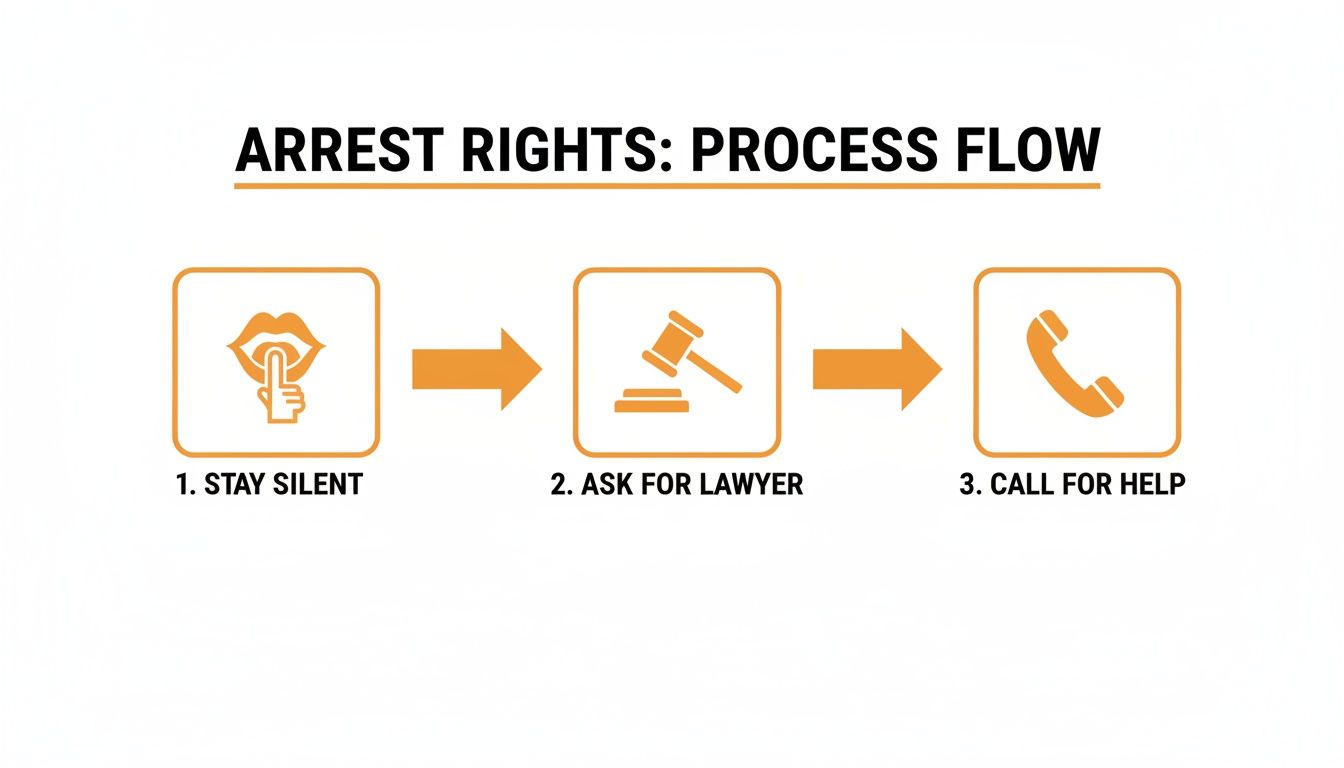
This simple roadmap cuts through the confusion, reminding you that your first moves are the most important ones.
Your Immediate Rights Checklist
When you are under pressure, it can be difficult to remember details. This quick checklist simplifies what you need to know and do the second you are detained or arrested.
| Your Right | What It Means for You | What to Say Calmly |
|---|---|---|
| Right to Remain Silent | You do not have to answer any questions from law enforcement. | "I am exercising my right to remain silent." |
| Right to an Attorney | You can have a lawyer present before and during any questioning. | "I want a lawyer." |
| Right to End Questioning | Once you ask for a lawyer, police should stop their interrogation. | After asking for a lawyer, say nothing else. |
Sticking to these simple, direct statements is the best way to protect yourself until you can get legal advice and support from the outside.
What to Say and What to Avoid
You do not need to be aggressive or confrontational to use your rights. In fact, a calm and clear approach is far more effective.
What to Say: "I am going to remain silent." and "I would like a lawyer."
Once you have said those two things, you can stop talking. You do not need to justify your request or explain anything further. As soon as you ask for an attorney, the police are required to stop all questioning.
To see how this fits into the bigger picture, you can learn more about what happens after an arrest in our guide. After you have invoked your rights, the next step is getting help. That means calling family and a trusted Forsyth County bonding company to start arranging for release.
Using Your Right to Remain Silent

Of all the rights you have when arrested, the one that provides your first and best line of defense is the right to remain silent. It is protected by the Fifth Amendment, and knowing how to use it can prevent a simple misunderstanding from becoming something much more serious.
Think of it this way: trying to explain yourself to law enforcement without a lawyer present is like navigating a complex legal maze blindfolded. Every word you say could lead you deeper into challenges you did not see coming.
The urge to talk is completely natural. Most people believe that if they can just explain their side of the story, the situation will be cleared up. But the high-stress environment of an arrest is not the time for explanations. Even statements you believe are innocent can be taken out of context or used against you.
Why Silence Is Your Strongest Ally
The moment you are under arrest, the conversation is no longer just a conversation—it is an investigation. Law enforcement's job is to gather information, and anything you say becomes potential evidence.
Staying silent is not an admission of guilt. It is a prudent, strategic move to protect yourself until you can speak with an attorney who knows the legal landscape. A lawyer will help you understand the charges and ensure your side of the story is told correctly and at the appropriate time.
A 2022 Innocence Project analysis found that a significant percentage of DNA exonerations involved false confessions. Using your right to silence is your best safeguard against that kind of pressure. For more on how legal rights impact justice, you can review this report on global rights trends from 2019-2023.
How to Exercise Your Right Calmly and Clearly
You do not need a dramatic confrontation to invoke your right to silence. The best approach is to be calm, clear, and direct. The goal is to be firm but respectful, leaving no room for misunderstanding.
There is no need to be rude or aggressive. A simple, polite statement is all that is required to exercise this fundamental right.
Here are a few phrases that work well:
- "I am choosing to remain silent."
- "I will not be answering any questions."
- "I would like to speak with my lawyer."
Once you have said it, the most important part is to actually stay quiet. Officers might continue asking questions, but you are not obligated to answer.
Key Takeaway: Your silence cannot be used against you in court as evidence of guilt. The decision to stop talking is a protected right, and using it shows you understand the situation and are protecting your interests.
What Happens After You Remain Silent
After you have clearly stated your decision to stay silent and asked for a lawyer, law enforcement questioning is supposed to stop. That gives you a critical moment to breathe and focus on what comes next.
Your immediate priority now is arranging for release from jail. This is where a local bail bonds company becomes essential. By securing a bond, you can get out of custody, which allows you to work more effectively with your attorney, keep your job, and build your defense from a stable environment.
A professional bonding agent in Forsyth County can explain the bail process, handle the paperwork, and work to post the bond. This is the crucial step that bridges the gap between invoking your rights and starting the process of moving forward.
Securing Your Right to an Attorney
After you have stated your intention to remain silent, your very next move should be to secure your right to a lawyer. This is not just a suggestion; it is a powerful protection guaranteed by the Sixth Amendment. Think of it as your right to have a knowledgeable guide who can make sense of the charges and the legal road ahead.
This right applies the moment you are in custody and law enforcement begins asking questions. Having a lawyer present is the single best way to level the playing field when you are feeling cornered and vulnerable.
Making a Clear and Direct Request
When you ask for a lawyer, there is no room for subtlety. You have to be crystal clear. Vague statements like, “Do you think I need a lawyer?” may not be legally sufficient. You should make a firm statement that leaves no doubt about your request.
Being direct is always the best way to go.
- Try this: "I want to speak with a lawyer."
- Or this: "I will not answer any questions until my attorney is present."
Once you say those words, all questioning is supposed to stop. This gives you a critical moment to breathe, think, and avoid saying anything that could be misinterpreted later. It changes the entire dynamic from an interrogation to a formal legal process where your rights are at the forefront.
What If You Cannot Afford a Lawyer?
One of the biggest worries for people is the cost of hiring an attorney. The good news is, the system is prepared for this. Your Miranda rights include the promise that if you cannot afford a lawyer, one will be provided for you.
This is where a public defender comes in. A public defender is an attorney paid for by the state to represent people who do not have the money to hire their own lawyer. Requesting one ensures you get legal help no matter your financial situation.
Important Reminder: Asking for a lawyer is not an admission of guilt. It is a sign that you understand the seriousness of the situation and are taking the correct steps to protect yourself.
The Connection Between Legal Counsel and Release
Invoking your right to an attorney is the first step in building a solid defense. The second, equally crucial step is getting out of jail so you can work with that attorney. It is very difficult to help build your own case from inside a cell.
This is why arranging for release should be a top priority. After exercising your rights with law enforcement, the very next call should be to a local bonding company that serves Forsyth County. An experienced agent can get the bail process started immediately, working to get you back home.
Once you are out, you can meet with your lawyer privately, track down important documents, talk to potential witnesses, and keep your life on track. Securing a timely release with the help of a bonding company in Forsyth County is the practical move that allows you to take full advantage of your right to an attorney.
Navigating Searches and Seizures

The Fourth Amendment is a core protection—it protects you from unreasonable searches and seizures. In plain English, this means law enforcement generally cannot search your property—your home, car, or personal belongings—without first getting a warrant signed by a judge. This right is a cornerstone of your privacy, but knowing how it actually works during a traffic stop in Cumming or an interaction at your front door in Johns Creek is critical.
A search is considered "reasonable" if an officer has a valid warrant. However, there are also a handful of specific, legally recognized situations where they can conduct a search without one. Understanding this difference helps you know when you can—and should—refuse a search.
Understanding Warrants and Consent
A search warrant is a court order that clearly describes the place to be searched and what law enforcement is looking for. To be valid, it must be based on probable cause and signed by a judge. If an officer comes to your home with a warrant, you have the right to ask to see it and check that it is legitimate.
However, the most common way officers get around needing a warrant is by asking for your permission. If you voluntarily say "yes" to a search, you have waived your Fourth Amendment protection for that specific situation.
You are never obligated to consent to a search. You can politely and clearly say no. Refusing a search is not an admission of guilt; it is you exercising a fundamental right.
How to Politely Refuse a Search
Knowing exactly what to say can make all the difference. Your goal is to be firm and unmistakable without escalating the situation. Whether you are pulled over in Alpharetta or standing on your own porch, a calm and direct response is your best option.
If an officer asks to search your car or home, you can simply say:
- "Officer, I do not consent to a search."
- "I am not giving you my permission to search my property."
That is it. Once you have clearly said no, you do not need to explain why or get into an argument. It is also important to remain calm and not physically resist if the officer decides to search anyway. Your verbal refusal is a crucial legal point that your attorney can use later.
Common Exceptions to the Warrant Rule
While a warrant is the standard, there are a few key exceptions where police can legally conduct a search without one. It is helpful to know what they are.
- Plain View Doctrine: If an officer is legally in a location and sees something incriminating out in the open—like on the passenger seat of your car during a traffic stop—they may seize it without a warrant.
- Search Incident to a Lawful Arrest: When you are being lawfully arrested, officers are allowed to search you and the area immediately around you.
- Probable Cause and Vehicles: Cars are treated differently because they are mobile. An officer can sometimes search a vehicle without a warrant if they have probable cause to believe it contains evidence of a crime.
Even with these exceptions, the main principle holds true: you do not have to give your consent. Protecting your rights during an encounter is step one. If an arrest does happen, the next priority is getting released, which is where a local Forsyth County bail bonds service becomes your most important call.
What Happens in the First 24 Hours
The first 24 hours after an arrest can be a blur, but they are absolutely critical. This is the window where the choices you make can shape everything that comes next. While your arrest involves dealing directly with officers, this period is about navigating the legal system in places like Forsyth or Hall County. It starts with a single phone call.
From booking and processing to standing before a judge for the first time, this is your first real opportunity to address being released. Knowing the steps provides clarity.
The Right to a Phone Call
Once you are processed at the jail, you typically get to make a phone call. This is your lifeline to the outside world and the first step in protecting yourself. Who you call—and in what order—can be the difference between a timely release and unnecessary delays.
Your first instinct is probably to call a family member or a trusted friend. This is a good first step. You need someone on the outside to start coordinating for you. But what you do next is just as crucial.
Key Action: Your phone calls are your way out. Use them to contact family, an attorney, and a local bail bonds company. This three-part approach covers all your bases—personal support, legal advice, and a clear path to getting released from jail.
Contacting an attorney ensures your rights are protected from the start. At the same time, calling a 24/7 bail bonds company in Forsyth County gets the ball rolling on your release, sometimes even before a judge has officially set the bond amount.
Who to Call After an Arrest
It can be hard to think clearly under stress. Having a simple, prioritized plan for your phone calls makes a world of difference. Here is who you should be calling, and why.
| Priority | Who to Call | Purpose of the Call |
|---|---|---|
| 1. Family/Trusted Contact | Your spouse, parent, or a close friend. | Let them know what is happening and ask them to be your point person. They can help make the other important calls. |
| 2. A Defense Attorney | A lawyer who knows the local court system. | Get immediate legal advice. You need to ensure your rights are protected during the bond hearing and beyond. |
| 3. A Bail Bonds Company | An experienced local agent. | Start the process of getting out of jail. A company like 24-7 Best Bonding can begin gathering information and be ready to post bond the second it is set. |
Having this three-call strategy in mind gives you a clear, actionable plan when you need it most.
The Initial Appearance and Bond Hearing
In Georgia, you will typically see a judge for an initial appearance or bond hearing within 48 to 72 hours of being arrested. It is a court proceeding where the judge officially informs you of the charges and decides on pretrial release. For most people, this is the most important opportunity to get out of jail.
During the hearing, the judge will decide whether to grant bail and how much it will be. They consider a few key factors:
- The seriousness of the charge: More severe allegations often lead to higher bond amounts.
- Your ties to the community: Do you have a job, family, and a home in areas like Cumming or Alpharetta? Strong local ties are beneficial.
- Your personal history: Any past criminal record or history of missing court dates will be a major factor.
- Any potential risk: The judge weighs whether the accused might be a flight risk or a danger to others if released.
This hearing happens quickly. This is why having a bail bonds agent already informed is so helpful. As soon as the judge sets the bond, a prepared company can post it without delay, speeding up your release from the Forsyth County or Hall County jail. It is exactly why having a 24/7 service ready to act makes a significant difference.
How Bail Bonds Help You Prepare Your Defense
Understanding your rights during an arrest is the first critical step. The second, just as important, is getting out of jail. This is where you move from knowing your rights to taking action, and a professional bail bonds company becomes your most important ally.
Trying to build a strong legal defense from a jail cell is very challenging. Once you are released, you regain control over your life and, most importantly, the ability to work hand-in-hand with your attorney. Our primary role is to help secure your release quickly so you can start preparing your case.
Securing Release to Build Your Case
Getting released from a facility in Forsyth or Hall County gives you a significant advantage. You can return to your family and your job, which brings stability to an unstable situation. But the biggest benefit is that you become an active partner in your own defense.
Once you are home, you can:
- Meet with your attorney privately: You can have the open, confidential discussions that are not possible from inside a jail.
- Gather evidence and documents: You can track down records, find potential witnesses, and help your legal team build a stronger case.
- Keep your job: Staying employed means you can support your family and manage legal costs, which removes a huge amount of stress.
A timely release is not just about comfort—it is a strategic move that can directly impact the outcome of your case. For a closer look at the different ways to get out of jail, you can learn more about pretrial release in our guide.
Guidance Through the Bonding Process
The bail bond process can feel overwhelming, especially when you are already under stress. An experienced local agent is there to be a steady guide for you and your family. We have helped hundreds of families in Cumming, Alpharetta, and the surrounding areas navigate this exact situation.
Our job is to provide clear, simple explanations at every turn. We will calmly walk you through the paperwork and explain the role and responsibilities of a co-signer. You will not find confusing jargon or last-minute surprises with us.
A professional bonding company cuts through the complexity. We handle the paperwork and deal with the court system so you can focus on what matters—supporting your loved one and preparing for what comes next.
With our 24/7 availability, we are ready to help the moment you call. It does not matter if an arrest happens late at night or over a holiday weekend; our team is always on standby. We know the local procedures in Forsyth and Hall County, which helps us post the bond and expedite the release process. This combination of local knowledge and constant availability is designed to bring calm to a difficult situation, helping you move from the chaos of an arrest to the important work of building your defense.
Common Questions About Arrest Rights and Bail
When a friend or family member is arrested, your mind races with questions. Getting clear, straightforward answers is the first step to feeling in control and focusing on what matters—getting them home. This section addresses some of the most common questions we hear about arrest rights and the bail process.
Do I Have to Answer Police Questions If I'm Not Under Arrest?
You are generally not required to answer questions from law enforcement if you are not being detained. The most effective way to handle this is to calmly and politely ask, "Am I free to leave?" If they say yes, you can walk away.
If you are not free to go, it is wise to clearly state that you wish to remain silent and want to speak with a lawyer. Saying this is not an admission of guilt; it is you protecting your rights.
What Happens If My Miranda Rights Are Not Read to Me?
This is a common point of confusion. The Miranda warning is only required before a custodial interrogation—meaning, when you are in custody and police start questioning you to obtain a confession. If they question you in custody without reading you your rights, anything you say might not be admissible in court.
However, this does not automatically get the case dismissed. It is a complex legal issue your attorney will need to handle. The most important thing is securing a prompt release, which gives you the freedom to consult with legal counsel and properly prepare a defense.
How Quickly Can Someone Be Released on Bond in Forsyth County?
The timeline for release can vary. It often depends on factors like the time of the arrest and how busy the jail is. Once a judge sets a bond amount at the first hearing, a licensed bail bonds company can step in and post the bond for you.
Our local experience in Forsyth and Hall County means we know how to navigate the system efficiently and avoid unnecessary delays. We are available 24/7 to start the process the moment you call. To get a better idea of the costs involved, you can learn more about how much bail might cost in our detailed guide.
Key Takeaway: The release process involves several steps, from the bond hearing to the jail's internal procedures. A local bondsman who knows the system can make your part of the process much smoother.
What Information Do I Need to Start the Bail Bond Process?
Getting started is very simple. We just need a few key pieces of information to begin:
- The full name of the person arrested
- Their date of birth
- The name of the jail where they are being held (such as the Forsyth County Jail)
- The charges, if you happen to know them
Having this information ready when you call helps us act quickly, verify the details, and explain your next steps clearly.
If you need help navigating the bail process in Forsyth County, Cumming, or anywhere in the North Metro Atlanta area, 24-7 Best Bonding is here with clear guidance and fast, professional service. We can start everything over the phone and guide you step by step.