
When a loved one is in jail, the first question is often, how do bail bonds actually work? It's a stressful and confusing time, but the process is more straightforward than it seems. We are here to provide clear, calm answers.
A bail bond is a practical way to secure someone's release from jail without paying the full bail amount set by the court, which can be thousands of dollars. Instead, you work with a bonding company, paying a smaller, non-refundable fee. We then post a bond for the full bail amount with the court, which allows the release process to begin. For families in Forsyth County, GA, and surrounding communities like Cumming, this service makes a difficult situation more manageable.
Your First Step: Understanding the Bail Bond Process
Receiving a call that a loved one is in the Forsyth County jail can be overwhelming. The legal system has its own language, and navigating it under pressure is a challenge. A bail bond is a tool designed to make the process of getting someone out of jail faster and more affordable for families here in Cumming, Alpharetta, and our surrounding North Georgia communities.
A bail bond allows your loved one to return home, prepare their defense, maintain their employment, and handle personal responsibilities while their case moves forward.
Think of it as a three-way agreement between the court, the person charged (the defendant), and the bail bond company.
- The Court: Sets a bail amount as a financial guarantee that the defendant will attend all future court dates.
- The Defendant: Needs to be released from jail but typically does not have the full cash amount available.
- The Bonding Company: Provides the court with a financial guarantee for the full bail amount, taking on the financial risk.
Before we go further, it helps to understand the basic terms. It's not as complicated as it sounds.
Key Bail Bond Terms at a Glance
This table breaks down the essential terms you'll hear during the bail bond process.
| Term | Simple Explanation |
|---|---|
| Bail | The full amount of money a court requires to release a defendant from jail. |
| Premium | The non-refundable fee you pay a bonding company, typically a percentage of the total bail. |
| Bond Agent | The licensed professional who arranges and posts the bail bond on your behalf. |
| Co-signer | The person who signs the bail bond agreement, guaranteeing the defendant will appear in court. |
| Collateral | An asset (like property) sometimes used to secure a bond if the risk is high or the amount is large. |
| Forfeiture | Occurs if the defendant misses a court date; the bonding company may then be required to pay the full bail. |
Understanding these terms makes the entire process much clearer from the start.
The Role of a Bail Bond Agent
Your main point of contact is a licensed bail bond agent. This is the person who guides you through the paperwork, explains your responsibilities in plain language, and posts the bond at the local jail—whether it’s in Forsyth County, Hall County, or another nearby facility.
A professional agent doesn't just handle the financial transaction; they provide calm, clear support when you need it most.
At its core, a bail bond is a financial promise to the court. Our company is essentially telling the judge, "If this individual does not attend their court dates, our company will pay the full bail amount." This promise is what allows the defendant to be released.
So, how does this work in a practical sense? Let’s say a judge sets bail at $10,000. Instead of trying to find that full amount in cash, a family in Forsyth County would call us and pay a premium, which is a fraction of the total.
Once the agreement is in place, we provide a guarantee for the entire $10,000 to the court, and the jail begins its release process. It’s a system that makes release accessible while ensuring people meet their legal obligations.
A Step-by-Step Guide to the Bail Bond Process in Forsyth and Hall County
When you get that call, it can feel like your world stops. Navigating the local system seems impossibly complex, but it follows a clear, predictable path. The key is knowing what those steps are. We are here to walk you through the exact process we follow every day for families in Forsyth and Hall counties, from the first phone call to the moment your loved one is released.
Our goal is to provide clarity. Understanding the practical steps helps remove the fear of the unknown and lets you focus on what matters—bringing someone home.
The infographic below outlines the entire journey in three core stages.
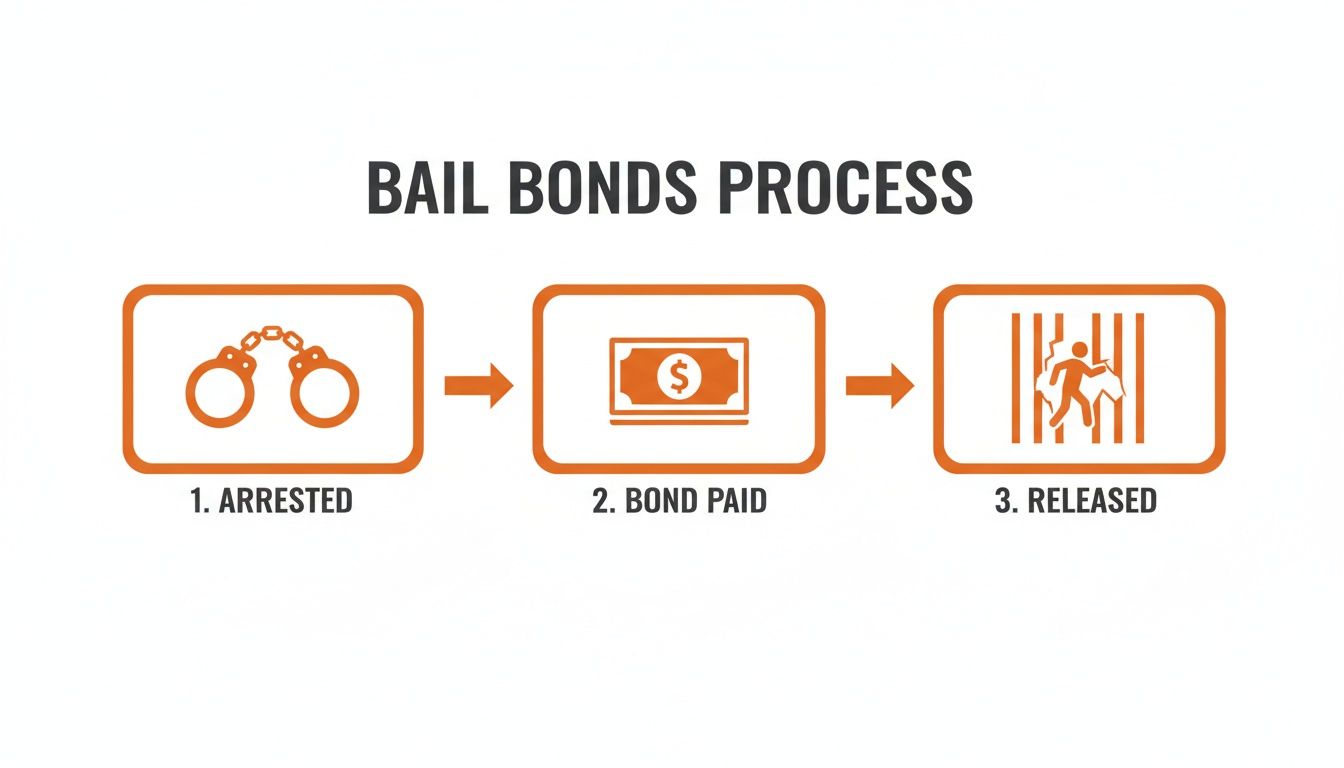
A bail bond is the bridge from being in custody to being back home while a legal case moves forward. Here’s how we build that bridge, step by step.
Step 1: Your First Phone Call
Everything begins with a single, confidential phone call. Difficult situations don't keep business hours, which is why we are available 24/7. When you call us, our first job is to listen and give you clear, immediate information.
To get started quickly, it helps to have a few pieces of information. If you don't have everything, don't worry—we can help you find what's missing.
Information Needed to Start:
- Full Name of the Person Arrested: We need their legal name to find them in the jail system.
- Their Date of Birth: This helps confirm we have the right person.
- The Jail Where They Are Being Held: Let us know if they're in Forsyth County, Hall County, or another local facility.
- The Bail Amount: If a judge has set an amount and you know it, we can calculate your cost right away.
In that first conversation, we’ll explain the premium, discuss the co-signer's role, and answer any questions you have. There is no pressure or confusing jargon.
Step 2: Completing the Paperwork
Once you are ready to move forward, the next step is completing the bail bond agreement. This is a straightforward contract that outlines the responsibilities for everyone involved—the person being released and the co-signer. It ensures everyone is on the same page.
We have made this part as simple as possible. Much of the paperwork can be handled electronically, so you may not have to make a late-night trip, especially if you aren't close to the Cumming or Gainesville area.
This agreement is a two-way promise. We promise the court to be financially responsible for the full bail amount if the defendant fails to appear, and the co-signer promises to help ensure they attend all court dates.
Step 3: Paying the Premium
As mentioned, you do not pay the full bail amount. Instead, you pay a much smaller, non-refundable fee called a premium. This fee is our compensation for taking on the financial risk of the full bond.
For example, on a $10,000 bail, you would only pay a fraction of that, which makes securing a release financially possible for most families.
We accept various payment methods and can discuss options that fit your situation. For larger bonds, collateral might be needed to secure it. Collateral is simply an asset used to guarantee the bond, and it's returned once the case is over and all court dates have been met. We will explain everything clearly if this applies.
The premium allows our company to take on the full financial risk of the bail amount. It enables us to provide the court with a financial guarantee, which is the foundation of how the entire bail bond system operates.
Step 4: Posting the Bond at the Jail
With the agreement signed and the premium handled, our licensed agent goes directly to the correct jail—whether it’s the Forsyth County Jail or the Hall County Jail—to post the bond. This is the official action that initiates the release process.
Our experience with the procedures at jails in Forsyth County, Cumming, Alpharetta, and Johns Creek is an advantage here. We know how to file the bond correctly to help prevent unnecessary delays.
Step 5: The Release From Custody
Once the bond is officially posted, the jail staff begins their internal release process. The timing is entirely handled by the jail and depends on their current workload and staffing levels. It can take a few hours, and we will remain available to provide updates as we receive them.
We understand that waiting is difficult. Our job is to keep you informed and offer reassurance while the jail’s administrative work is completed. After your loved one is released, our support continues by helping them stay aware of their court schedule.
Understanding the Co-Signer's Role and Responsibility
Being asked to co-sign a bail bond is an act of trust, and it is also a significant responsibility. For many families, a willing co-signer makes it possible to get someone out of jail. Before you agree, it’s critical to understand what you are committing to.
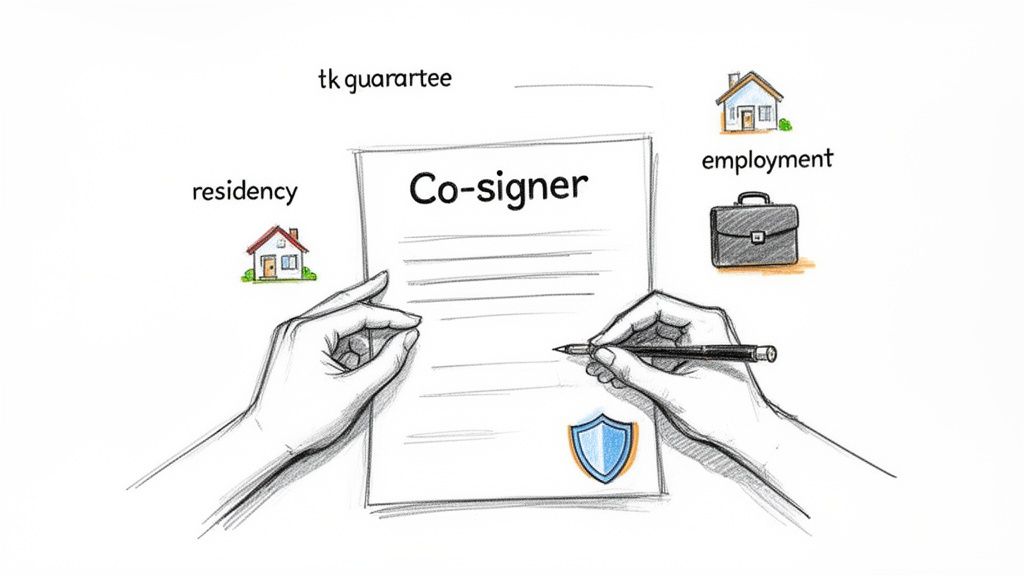
So, what exactly is a co-signer? A co-signer personally guarantees the bail bond. When you sign the agreement, you are making a promise to the bonding company that the defendant will show up for all required court dates. Your guarantee gives the bondsman the confidence to take on the financial risk for the full bail amount.
The Core Responsibilities of a Co-Signer
The role of a co-signer comes down to two key things. First, you are responsible for helping ensure the defendant gets to court. Second, you have a financial obligation that only comes into play if they do not.
It is vital that you understand both parts of this commitment. Any reputable bonding company will walk you through these duties carefully so you can feel confident in your decision. Our goal is always a successful outcome where the defendant meets their obligations and the bond is eventually closed without any issues.
Here are the main responsibilities you will be taking on:
- Ensuring Court Appearances: Your most important job is to do what you can to make sure the person who was arrested appears at every single court date until the case is resolved. This could mean providing reminders or helping them arrange transportation.
- Financial Liability: If the defendant misses a court date—often called "skipping bail"—you become financially responsible for paying the full bail amount to the bonding company.
- Staying in Communication: You agree to maintain contact with the bonding company and inform them if you have concerns about the defendant's ability to make it to court.
A co-signer provides the essential assurance that allows the bail bond process to work. Your signature is a powerful promise to the bonding company, helping ensure accountability throughout the case.
What Happens If a Court Date Is Missed
When a defendant fails to appear in court, it triggers a serious chain of events. The court will almost certainly issue a warrant for their arrest and begin the process of bond forfeiture. At that point, the bonding company is legally responsible for paying the court the full bail amount.
Because you guaranteed the bond, the company will then look to you to cover that cost. This is why the role carries so much weight. The good news is that bonding companies work hard to prevent this from happening. We provide court date reminders and keep communication open to help everyone stay on track.
Common Requirements for a Co-Signer
To qualify as a co-signer, a bonding company needs to see that you are in a stable position to back up your promise. This is about confirming you can handle the responsibility you're taking on.
Having the right documents ready can make the process much faster, whether you're in Forsyth County, Hall County, or another nearby community.
A Simple Checklist for Co-Signers
Here’s a quick list of what a co-signer typically needs to provide. Getting these items together can help speed things up.
| Requirement | Why It's Needed |
|---|---|
| Valid Photo ID | To verify your identity and confirm you are of legal age to sign a contract. |
| Proof of Stable Employment | Shows you have a steady income and are established in the community. |
| Proof of Residency | A utility bill or lease agreement shows you have a stable, verifiable address. |
| General Financial Information | To help assess your ability to cover the bond if it were ever forfeited. |
Deciding to co-sign is a personal choice. Our role is to give you all the information you need in a clear, straightforward way so you can make the right decision for you and your family. We are always here to answer your questions with respect and discretion.
Comparing Cash Bail and a Surety Bond
After a judge in Forsyth County or Hall County sets a bail amount, you have a decision to make. There are two primary ways to get someone out of jail: pay the full bail amount yourself, which is called a cash bail, or work with a licensed bondsman to post a surety bond.
Understanding the difference is the first step to making the right choice for your family.
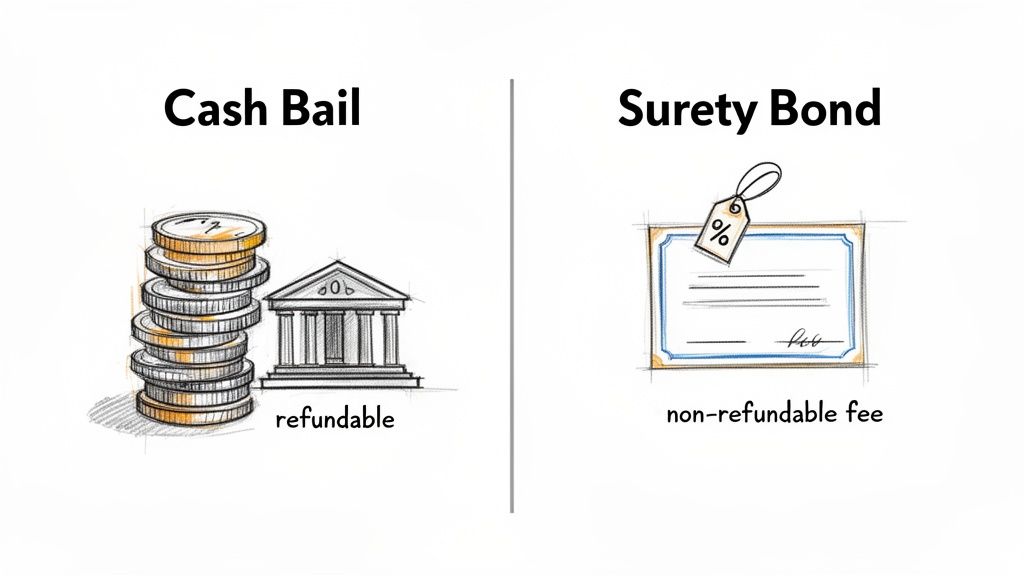
Each path has its advantages and disadvantages. One option returns your money but requires a large amount of cash upfront. The other gets your loved one home for a much smaller, non-refundable fee.
The Cash Bail Option
A cash bail is exactly what it sounds like. You must pay the entire bail amount directly to the court or jail. If bail is set at $10,000, you would need to provide $10,000 in certified funds to the facility holding your loved one.
The biggest advantage is that the money is refundable. As long as the defendant attends every court date, the court returns the full amount once the case is over, minus any court fees or fines.
However, there is a major downside: the significant upfront cost. Most families do not have thousands of dollars readily available. This makes paying cash bail out of reach for many people.
The Surety Bond Option
A surety bond is the much more common choice, and it's the service a bail bonding company provides. Instead of paying the full bail amount, you pay a small percentage of it—the premium—to the bonding company. This premium is a non-refundable fee for their service and for the significant financial risk they are taking on your behalf.
Once you pay the premium, the bondsman posts a bond with the court for the full bail amount. This is their guarantee to the court that the defendant will be at their hearings. If they miss court, the bonding company is responsible for paying the entire bail amount.
A surety bond makes getting out of jail financially possible. It lets you bring a loved one home for a fraction of the total bail, freeing up your savings for other important expenses.
The bail bond system was created to solve this exact problem. When someone is arrested in Cumming and the family cannot afford the full bail, they call a bondsman, pay the fee, and an agent delivers the bond to the jail to secure a release.
This system is designed to help families in Forsyth County, Alpharetta, and Johns Creek get through a difficult financial situation. To get a better idea of what goes into that initial fee, you can learn more about how bail bond costs are calculated. A surety bond turns a large financial obstacle into a manageable step.
What Happens After the Release from Jail
Bringing a loved one home is a significant relief, but their release is not the end of the process. It is the beginning of the next phase, where the focus shifts to ensuring all conditions of the bond agreement are met until the case is officially concluded.
The defendant has one primary responsibility: they must show up for every single court appearance. Missing a court date is a serious mistake with major consequences, not just for them but also for the co-signer who put their trust and finances on the line.
Staying on Track After Release
A professional bonding company does more than just post the bond. We serve as a resource to help you navigate the system smoothly from the moment of release until the case is closed. Court schedules in Forsyth or Hall County can be complex, and we understand that.
To make things easier, a reliable agent will provide:
- Court Date Reminders: We help you keep track of upcoming dates so nothing is missed by accident.
- A Go-To Contact: If you have questions about bond conditions or next steps, we are here to provide straight answers.
- Guidance on the Rules: We can explain the court's conditions for release and what is required to remain in compliance with the agreement.
Think of us as a steady partner, here to help you and your family avoid missteps that could complicate a difficult situation.
When the Bond Is Exonerated
The final step in the process comes when the case is completely resolved. Once the defendant has attended every required court date and the judge makes a final decision—whether it’s a dismissal, a plea, or a verdict—the bond has served its purpose.
At this point, the court exonerates the bond.
Exoneration is the official court term for releasing the bonding company from its financial promise. It signifies that the defendant fulfilled all their obligations, and the bond is officially closed.
Once the bond is exonerated, the co-signer's financial responsibility ends. Any collateral used to secure the bond is returned. This moment brings the process to a close and officially ends your agreement with us. It’s the successful outcome we aim for from the very first phone call.
The non-refundable premium you paid at the start covers our service and the financial risk we took. If you're wondering what happens to the money involved, you can learn more by reading about where bail money goes after a case concludes.
Your Bail Bond Questions Answered
When you're navigating a stressful situation, you need clear, direct answers, not more confusion. Here, we address the most common questions we hear from families across Forsyth and Hall County, providing the straightforward information you need.
How Do I Start the Bonding Process?
The best first step is to call a licensed bonding company. You don't need to have every detail ready before you pick up the phone. A professional agent will calmly walk you through exactly what they need and what happens next.
To get started faster, it helps to have the arrested person’s full name, their date of birth, and the name of the jail where they are being held. With that information, we can usually find them in the system and confirm the bond amount quickly.
What’s the Difference Between Bail and a Bond?
These two terms are often used interchangeably, but they mean different things. The easiest way to think about it is:
- Bail is the total cash amount the court demands for a person's release from jail. If bail is set at $10,000, you would have to give $10,000 in cash directly to the court.
- A Bond is a promise for that full amount, made by a bonding company on your behalf. Instead of paying the whole $10,000, you pay our company a smaller, non-refundable fee (the premium). We then take on the full financial risk for the court.
Simply put, a bail bond makes release from jail possible when paying the full cash amount isn't an option. It is how most people secure a release while their case is pending.
How Long Does It Take to Get Out of Jail?
This is a very common question, and the answer has two parts. The first part—our part—is fast. Once the paperwork is signed and the premium is handled, one of our agents can post the bond at the Forsyth County Jail or Hall County Jail very quickly.
The second part is the jail's internal release process. That timeline is entirely up to the jail staff and how busy they are. It can often take a few hours. We stay in communication with you to provide updates and reduce the uncertainty of waiting. We cannot guarantee an exact time, but we promise to do our part with urgency.
Is a Co-Signer Required for a Bail Bond?
Yes, in most cases, a co-signer is essential. A co-signer provides a financial guarantee to the bonding company. By signing the agreement, they take on the responsibility of ensuring the defendant appears at every court date. If the defendant fails to appear, the co-signer is responsible for the full bail amount.
A co-signer is the backbone of the bail bond agreement. Their commitment gives the bonding company the security needed to post the bond and secure the defendant's release from custody.
The requirements are straightforward. We generally look for a responsible adult who has stable employment and residency. This demonstrates they are in a position to handle the responsibilities of the agreement.
What Happens If Someone Skips a Court Date?
Missing court is a serious mistake with significant consequences. When a defendant fails to appear, the judge issues a warrant for their arrest and begins a process known as bond forfeiture. This means the court legally requires the bonding company to pay the entire bail amount.
Since the co-signer guaranteed the bond, the company then has to turn to them to cover that financial loss. This is the primary risk involved in co-signing. At Best Bonding Forsyth, we do everything we can to prevent this. We send court date reminders and keep communication open to help everyone stay on top of their legal obligations.
Let's Get This Sorted Out
Trying to figure out the bail bond system alone can be confusing, but you don't have to. Think of us as your calm, steady guide through a difficult situation. We have helped countless families across Forsyth County, Cumming, Hall County, and Johns Creek. Our job is to answer your questions and explain how everything works in plain English—no pressure, no confusing jargon.
The single best thing you can do right now is make one phone call. We know the local system, and we can tell you exactly what needs to happen to start the release process immediately.
Our team is available 24/7 to give you the straightforward information and support you need. There is no reason to wait and let the stress build. Let us help you move forward.
If you need help in Forsyth or Hall County, call Best Bonding Forsyth. We can start everything over the phone and guide you step by step. Call now to get clear next steps and start the process.