
When someone you care about is arrested in Forsyth County, one of the first and most stressful questions is, "How much will the bond be?" The uncertainty can feel overwhelming, but understanding how the process works brings much-needed clarity.
In Georgia, bond amounts are not set from a simple price list. A judge or magistrate reviews the details of each case before making a decision. Having an experienced local guide who understands the system in Cumming, Alpharetta, and the surrounding areas can help you navigate this difficult time with confidence. If you need help with bail bonds in Forsyth County, our team is available 24/7 to provide clear next steps.
What to Do Right Now
- Gather Basic Information: Try to find the person's full legal name, their date of birth, and the jail where they are being held (e.g., Forsyth County Jail). If you don't have it all, that's okay—we can help.
- Call for a Confidential Consultation: Contact a licensed bonding company. We can confirm the bond amount, explain the fee, and walk you through the process without any pressure or obligation.
- Prepare for the Next Steps: The process often involves simple paperwork that can be handled electronically and a discussion about the responsibilities of a co-signer.
How Bond Is Set in Georgia
After an arrest in Forsyth County, Hall County, or nearby communities like Johns Creek, the process of setting a bond begins. It is not an arbitrary number but a decision based on specific legal principles. The judge's role is to balance the accused person's right to pretrial release with the need to ensure community safety and their appearance in court.
To do this, judges consider several key factors. The goal is to set an amount that is fair and effective without being punitive. We have guided hundreds of local families through this exact situation, and we find that simply understanding why a bond is set a certain way provides a sense of control and calm.
The Main Factors a Judge Considers
While every case is unique, a judge in Georgia will typically review a core set of criteria to maintain fairness and consistency.
Here are the key factors they will evaluate:
- The Seriousness of the Alleged Offense: This is a primary consideration. More serious charges, particularly felonies, will result in higher bond amounts than misdemeanors. The judge weighs the nature of the charge and any potential harm involved.
- The Defendant’s Criminal History: A person's past record is very important. If someone has prior convictions, especially for similar or violent offenses, a judge will likely set a higher bond. A clean record is a significant positive factor.
- Ties to the Community: Is the person a long-time resident of Forsyth or Hall County? Do they have a steady job and family nearby? Strong roots in the local community suggest they are less likely to be a flight risk.
- Risk of Flight: The judge must assess whether the person has the means or motivation to leave the area to avoid court dates. Lacking strong community ties or residing out-of-state can increase this perceived risk.
- Potential Danger to the Community: If the charges involve violence or if the judge believes releasing the person could endanger others, they may set a very high bond or, in some cases, deny bond.
Understanding the cost of bail is a critical next step after learning how the amount is set. For a detailed breakdown, you can learn more about how much bail costs and what determines the final fee.
The judge weighs all these factors to arrive at a final number. This individualized system is why two people facing the same charge might receive different bond amounts. Our role at Best Bonding Forsyth is not to influence the judge, but to help you act quickly and effectively once that decision is made, making the release process as smooth as possible.
The Role of Bail Schedules in Local Courts
To maintain consistency, courts in Georgia, including those in Forsyth and Hall Counties, often use a bail schedule as a starting point. This is a set of pre-determined bond amounts for common, less serious offenses.
This schedule is not a rigid price list but a reference point for judges and magistrates. It helps standardize the initial bond amount for minor charges, ensuring similar treatment before a judge has the opportunity to review the specific details of a case.
It is important to remember that the bail schedule is only the beginning. The amount listed is rarely the final number.
How Judges Use Bail Schedules
A bail schedule acts as a default setting, particularly for misdemeanors where an individual might be released shortly after booking without a formal hearing. For more serious charges, or once the case is before a magistrate for a bond hearing, the judge's discretion becomes the primary factor.
The judge always has the final say and can adjust the bond amount up or down based on the specific circumstances.
The infographic below illustrates the main factors a judge will weigh when deciding whether to adhere to the schedule or modify the amount.
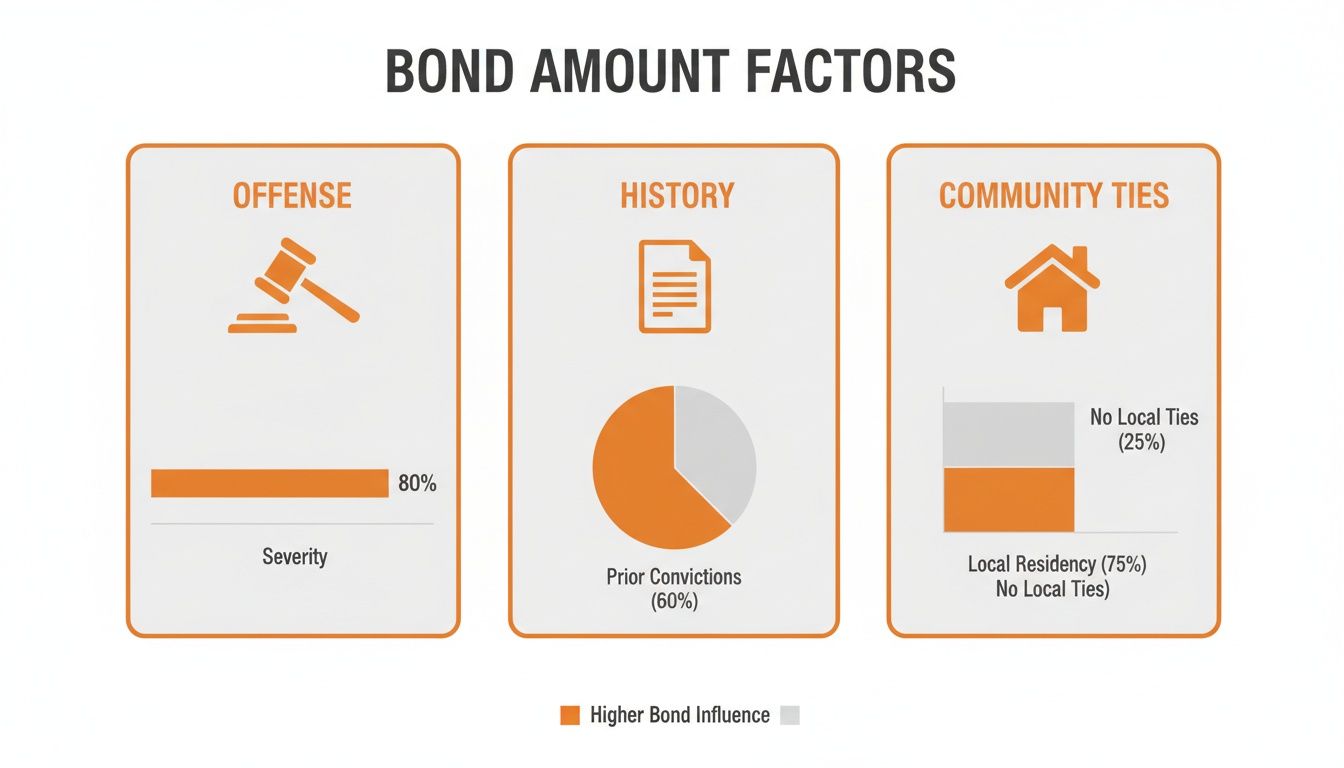
As shown, the offense type, criminal history, and community ties provide the full picture a judge needs to set a fair and appropriate bond.
General Bond Amount Ranges for Common Charges in Georgia
While each jurisdiction in North Metro Atlanta has its own schedule, the amounts for common charges often fall within similar ranges. The table below provides general examples for informational purposes only.
Please remember, these are not guaranteed amounts and should not be considered legal advice. The actual bond is set only by the court.
| Type of Offense | Example Charges | Typical Bond Amount Range (Informational) |
|---|---|---|
| Misdemeanor | Simple Battery, Shoplifting, Reckless Driving | $1,000 – $5,000 |
| Serious Misdemeanor | DUI (First Offense), Domestic Violence | $2,500 – $10,000 |
| Low-Grade Felony | Drug Possession (Small Amount), Theft by Taking | $5,000 – $25,000 |
| Serious Felony | Aggravated Assault, Burglary, Robbery | $20,000 – $100,000+ |
These figures show why the bail process can present a significant financial challenge for most families. Paying the full cash amount for a felony charge is often not feasible.
This is why professional bonding services are essential. Georgia's bail bond industry is part of a national market projected to reach $3.5 billion in revenue by 2025. Recent Georgia laws, like Senate Bill 63, have expanded cash bail requirements for dozens of charges, making it even more important for families in Forsyth and Hall County to have a licensed provider to help manage these costs. You can learn more about the growth of the bail bond industry to see the trends.
Ultimately, the bail schedule provides a starting point, but the judge’s assessment of the case details determines the final bond amount.
Factors That Influence a Judge's Decision
While a bail schedule provides a consistent starting point, it is far from the final word on bond amounts in Georgia. Once a case is before a judge for a bond hearing, particularly in Forsyth County or nearby Hall County, the process becomes much more individualized.
The judge’s primary task is to weigh several personal factors to arrive at a number that is appropriate for that specific person and their situation. This is where the human element of the legal system becomes apparent. The judge looks beyond the charge itself to consider the accused person, their history, and their life within the community.
Their decision ultimately comes down to two critical questions: Is this person likely to appear for their court dates? And do they pose a risk to public safety if released?

Prior Criminal Record and Court History
One of the first things a judge will examine is the defendant's past. This is more than a quick scan for prior convictions; it's a careful review of the person's reliability and past behavior within the justice system.
A clean record is a significant advantage, as it may suggest the current charge is an isolated incident. Conversely, a history of convictions—especially for similar or violent crimes—will likely lead to a higher bond amount. From the judge's perspective, a pattern of behavior indicates a higher risk.
Even more critical is a history of failing to appear in court. A past "Failure to Appear" (FTA) is a major red flag for any judge. It directly calls into question the person's reliability, which is the exact issue bail is designed to address. An FTA on someone's record will almost always result in a much higher bond.
Community Ties and Stability
On the other side of the scale, the judge actively looks for signs of stability and connection to the local area. Strong community ties are a powerful indicator that someone is likely to remain and see their case through rather than flee.
A judge wants to see concrete evidence of a stable life in places like Cumming, Alpharetta, or Johns Creek.
- Local Residency: How long have they lived in Forsyth County or a neighboring area? A long-term resident with a fixed address is viewed more favorably than someone who recently moved to town or has no permanent home.
- Employment Status: Do they have a steady job nearby? Verifiable employment demonstrates responsibility and provides another strong reason to stay in the area.
- Family Support: Is their close family—a spouse, children, or parents—living in the area? The presence of a strong local support system is a significant positive factor.
A judge carefully balances these personal factors. Someone with a minor prior offense but deep community roots might receive a lower bond than a person with a clean record but no job or local family. It’s this personal assessment that makes every bond hearing unique.
The Nature of the Current Charge
Finally, the judge returns to the specifics of the current charge. They look beyond whether it's a misdemeanor or a felony and consider the context. For example, was a weapon involved? Was anyone injured? Did the alleged crime result in a significant financial loss for a victim?
These details provide a clearer picture of the potential risk to the community. Any charge that involves violence or harm to others will be handled with extra caution, which typically means a higher bond.
The judge's role is to protect the community while respecting the rights of the accused, and the details of the charge are key to finding that balance. Understanding these factors makes it clear why bond amounts in Georgia can vary so much from one case to the next.
Understanding Your Payment Options
Once the court sets a bond amount in Forsyth County, the next question is, "How do we pay for this?" Seeing a large number can be intimidating, but Georgia's system provides two main paths to secure a release.
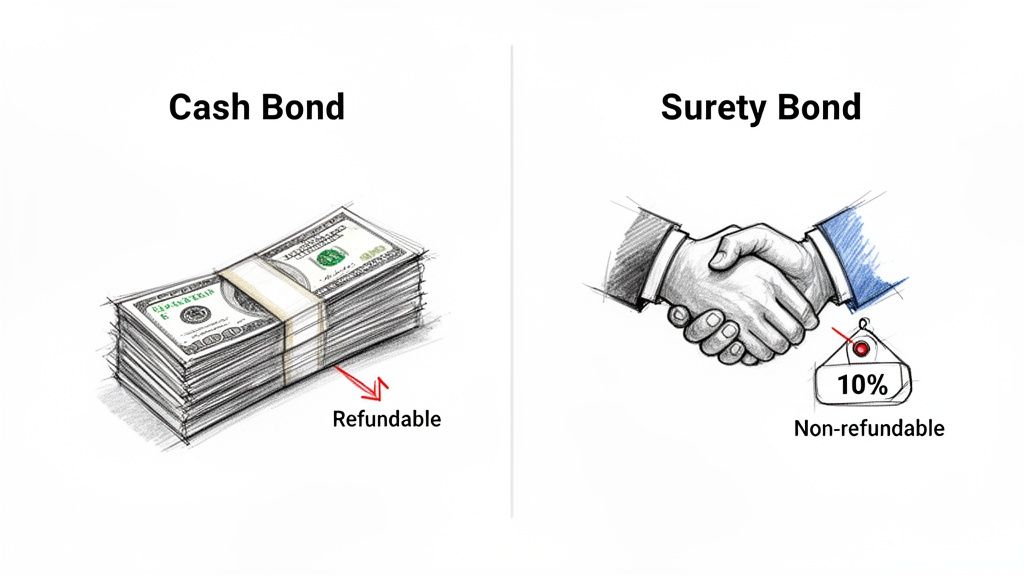
Each option has its own advantages and disadvantages, and the best choice often depends on your family's financial situation. Understanding the difference between a cash bond and a surety bond is key to making a confident decision.
Option 1: The Cash Bond
A cash bond requires you to pay the entire bond amount in full, directly to the court clerk's office. If a judge sets a $10,000 bond, you would need to provide $10,000 in cash or with a certified check to the jail or court.
The main benefit of a cash bond is that the money is refundable. As long as the defendant appears for all required court dates, the court returns the full amount to the person who paid it after the case is resolved.
However, the high upfront cost is a significant drawback. Most people do not have thousands of dollars readily available for an emergency. Raising that much money on short notice can be a major financial hardship.
Option 2: The Surety Bond
This is where a licensed bail bonding company like Best Bonding Forsyth can help. A surety bond is the most common and practical choice for families in Cumming, Alpharetta, and across North Metro Atlanta.
Instead of paying the full bond amount, you pay us a non-refundable fee known as a premium. In Georgia, this fee is typically between 12% and 15% of the total bond amount. In exchange, we post the entire bond amount on your behalf and guarantee to the court that the defendant will attend their court appearances.
Using the same $10,000 bond example:
- Cash Bond: You pay the court the full $10,000.
- Surety Bond: You pay a bonding company a premium of around $1,200 to $1,500.
This approach makes securing a release much more affordable. It allows you to bring your loved one home promptly without depleting your family's finances. The premium is the fee for our service and for assuming the full financial risk of the bond.
A surety bond allows you to leverage a small, manageable fee to secure a release that would otherwise require a significant upfront cash payment. This makes it the most practical choice for the vast majority of families navigating the bail process.
Comparing Your Choices Side-by-Side
To put it simply, here is a breakdown of the two payment options available after a bond is set.
| Feature | Cash Bond | Surety Bond |
|---|---|---|
| Upfront Cost | 100% of the full bond amount. | A non-refundable percentage (premium). |
| Refundable? | Yes, the full amount is returned post-case. | No, the premium is the fee for the service. |
| Who Pays the Court? | You or your family. | The bail bonding company. |
| Financial Risk | You risk forfeiting the entire amount if court is missed. | The bonding company assumes the full financial risk. |
For most people, a surety bond is the most realistic way to get someone out of jail quickly. It bridges the financial gap and provides a clear path forward during a stressful time. We offer several ways to handle the premium, which you can learn about in our guide to bail bond payment options. Our goal is to make the process simple and transparent so you can focus on supporting your loved one.
How Georgia Law Shapes the Bail Bond Process
Understanding the legal framework behind bail in Georgia can help you see why the process works the way it does. While some states have moved away from cash bail, Georgia maintains a traditional system where a financial guarantee is the primary method for ensuring a defendant's appearance in court.
This legal environment explains why release on one's own signature is less common for many charges and why a professional, licensed bonding company is so important for families in communities like Cumming, Alpharetta, and Gainesville.
Georgia’s Stance on Cash Bail
At its core, Georgia's legal system operates on the principle that a financial guarantee—the bond—is the most effective way to ensure a defendant returns for court. This differs from states that have pursued bail reform to reduce or eliminate the use of money for pretrial release, especially for lower-level offenses.
In recent years, Georgia lawmakers have passed laws that reinforce this system, making it clear that for most crimes, a monetary bond is required for pretrial release. This is the practical reality of the system we operate in every day, which is built on financial accountability.
Recent Legal Changes to Be Aware Of
A significant recent change came with Senate Bill 63. This legislation solidified the state's position by adding 30 new charges that specifically require cash bail. It also mandates that any organization posting more than three bonds per year must be a licensed bonding company. You can explore more about how Georgia's bail laws are being implemented and their effects.
This legislative shift means that for many families, contacting a licensed and regulated bail bondsman is not just an option—it is often a necessity. The law itself acknowledges the essential role professional bail agents play in the court system.
Why This Matters for Your Family
What does this mean for you if a loved one has been arrested in Forsyth or Hall County? It means that their release will almost certainly involve a financial component.
Here is what that looks like in practical terms:
- A Financial Guarantee is the Norm: For most charges beyond a minor citation, a judge will set a specific dollar amount for the bond.
- Signature Bonds Are Less Common: Release on one's "own recognizance" (a signature bond) still exists but is typically reserved for the most minor, non-violent offenses. Recent laws have made it even less frequent.
- Professional Help is Essential: Because bond amounts in Georgia can be high, the system relies on surety companies to make release affordable for the average family.
This is where our service is crucial. We are not just a financial service; we are experienced guides who work within this exact legal structure every day. Our deep familiarity with the procedures in Forsyth and Hall County courts allows us to explain your options clearly, handle the necessary paperwork, and help you meet the court's requirements without confusion or delay.
Your Next Steps for a Prompt Release
Understanding how bond amounts in Georgia are set is the first step. Now, it is time to take calm, focused action.
Having a clear plan makes a significant difference when you are feeling overwhelmed. We have helped hundreds of families in Forsyth County through this process, and we always begin with a simple, direct approach. Your immediate task is to gather a few key pieces of information so we can work quickly on your behalf.
How Our Bonding Process Works in Georgia
We keep things as simple as possible. You have enough to manage without a complicated process adding to the stress.
Here is what you can expect when you call Best Bonding Forsyth for help in Cumming, Alpharetta, or the surrounding communities.
- A Quick, Confidential Call: We will listen to your situation, confirm the bond amount, and clearly explain the cost. We will also walk you through your responsibilities as a co-signer. There is never any pressure or obligation.
- Simple Paperwork: Most of the necessary forms can be handled electronically from your phone or computer. This saves critical time and means you do not have to drive to an office in the middle of the night. Our guide on how to bail someone out of jail covers these initial steps in more detail.
- Posting the Bond: As soon as the paperwork is complete and the premium is paid, one of our licensed agents will go directly to the Forsyth County Jail or the appropriate detention center to post the bond. From there, we wait for the facility to process the release.
Our entire focus is on moving the process forward with clarity and professionalism, so you can bring your loved one home.
Frequently Asked Questions about Bail Bonds
Navigating the bail process for the first time naturally brings up many questions. Below are straightforward answers to some of the most common questions we hear from families in Forsyth and Hall Counties.
What Is the Fee for a Bail Bond in Forsyth County?
The fee you pay a bonding company is called the premium. In Georgia, this fee is regulated and is usually between 12% and 15% of the full bond amount set by the court.
This premium is non-refundable. It is the cost for our service and for us assuming the full financial risk of the bond with the court. For a $10,000 bond, the premium would be between $1,200 and $1,500. The best course of action is to call a licensed bonding agent for a clear quote. We can explain the exact cost based on the specifics of the situation with no obligation.
Can a Bond Amount Be Reduced?
Yes, it is sometimes possible for a bond amount to be lowered, but this must be done through a legal process in court. An attorney can file a "motion for bond reduction" and present arguments to the judge as to why a lower amount is appropriate.
A bail bonding company cannot negotiate or change the bond amount. Our role begins once the court has officially set the amount. From that point, our focus is on providing the fastest possible service to post that bond.
What Information Do I Need to Get Started?
To begin the process as quickly as possible, it is helpful to have three key pieces of information ready:
- The defendant's full legal name
- Their date of birth
- The jail where they are being held (such as the Forsyth County Jail)
If you do not have all of these details, please call us anyway. With years of experience, we can often find the necessary information with just a name and move forward without delay.
The most important step you can take is the first one: making the phone call. Having some basic information is helpful, but speaking with an experienced agent will provide the clear direction you need right now.
How Long Does Release Take After the Bond Is Posted?
Once we post the bond at the jail, the facility's internal release process begins. We act immediately on our end, but the final timing is determined by the jail staff.
The administrative work at the facility can take anywhere from under an hour to several hours, depending on how busy they are. While we cannot guarantee a specific release time, we are here to support you and provide updates while you wait. Our priority is to complete our part promptly to prevent any unnecessary delays.
If you need help in Forsyth or Hall County, call and we’ll explain what to do. The team at Best Bonding Forsyth is available 24/7 to provide clear guidance and start the release process. Call now to get the straightforward answers you deserve.